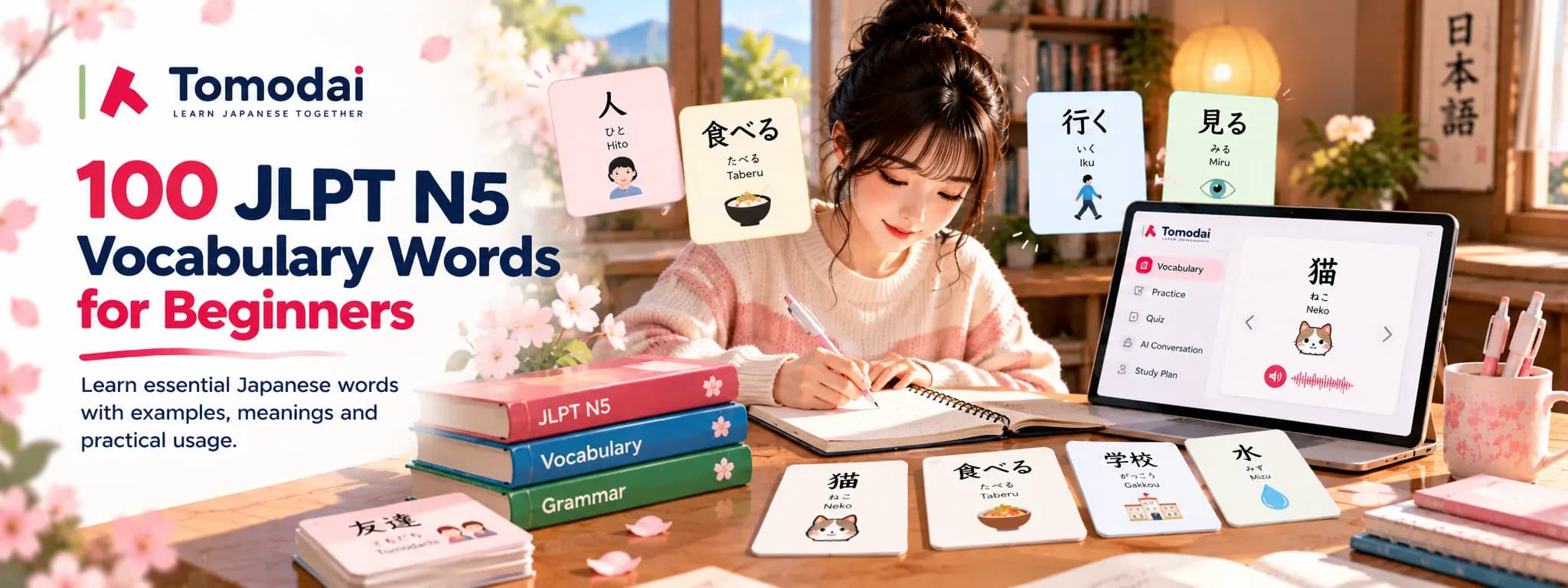
For JLPT N5, prioritize high-frequency, modular vocabulary that enables you to build and comprehend basic sentences: people and family, everyday transitive and intransitive verbs, time markers, places, food, い-adjectives, question words, and demonstratives (これ・それ・あれ). While the official JLPT does not publish a rigid specification list, mastering this 100-word core foundation in full sentence context unlocks over 80% of daily conversational frames and beginner test comprehension.
Learning Japanese vocabulary can feel overwhelming. With thousands of Japanese words in circulation, the very first question beginner learners ask is: "Which words should I actually learn first?"
If you are preparing for JLPT N5, the answer is never to memorize endless isolated flashcards. You need vocabulary that immediately empowers you to understand basic sentences, introduce yourself, express daily habits, navigate Tokyo or Kyoto, and understand listening passages.
As outlined by the official JLPT in their N5 Competency Summary, the exam assesses the ability to understand some basic Japanese across kanji orthography, contextual definitions, and daily communication. Neither the Japan Foundation nor JEES publishes a rigid, memorizable vocabulary list. Instead, communicative frameworks like the Japan Foundation's Irodori Japanese Program emphasize using vocabulary functionally in real-world situations. Think of this curated 100-word list as your practical Tomodai foundation: learn the word, see it in context, and immediately use it to produce your own Japanese sentences.
The Golden Rule of N5 Vocabulary
Never study isolated dictionary definitions without full sentence context
Category 1: People & Family (Words 1–10)
Social FoundationThese foundational nouns allow you to identify yourself, describe your household, talk about friends, and introduce key social relationships.
| # | Kanji | Hiragana | Romaji | English Meaning | Part of Speech | Practical Context Sentence |
|---|---|---|---|---|---|---|
| 01 | 私 | わたし | Watashi | I; me | Pronoun | 私は学生です。(I am a student.) |
| 02 | 人 | ひと | Hito | Person | Noun | あの人はだれですか。(Who is that person?) |
| 03 | 男 | おとこ | Otoko | Man; male | Noun | 男の人がいます。(There is a man.) |
| 04 | 女 | おんな | Onna | Woman; female | Noun | 女の子がいます。(There is a girl.) |
| 05 | 子供 | こども | Kodomo | Child | Noun | 子供と遊びます。(I play with the child.) |
| 06 | 友達 | ともだち | Tomodachi | Friend | Noun | 友達と話します。(I talk with my friend.) |
| 07 | 家族 | かぞく | Kazoku | Family | Noun | 家族は四人です。(There are 4 people in my family.) |
| 08 | 父 | ちち | Chichi | My father | Noun | 父は会社員です。(My father is a company employee.) |
| 09 | 母 | はは | Haha | My mother | Noun | 母は優しいです。(My mother is kind.) |
| 10 | 先生 | せんせい | Sensei | Teacher; Doctor | Noun | 先生は日本人です。(The teacher is Japanese.) |
Category 2: Everyday Verbs (Words 11–25)
The Core EngineVerbs bring Japanese sentences to life. Practice these in both their dictionary plain form and standard polite 〜ます form:
| # | Dictionary Form | Polite (ます) Form | Romaji | English Meaning | Context Sentence |
|---|---|---|---|---|---|
| 11 | 行く | 行きます | Iku / Ikimasu | To go | 学校へ行きます。(I go to school.) |
| 12 | 来る | 来ます | Kuru / Kimasu | To come | 友達が来ます。(My friend is coming.) |
| 13 | 帰る | 帰ります | Kaeru / Kaerimasu | To return; go home | 家に帰ります。(I go back home.) |
| 14 | 食べる | 食べます | Taberu / Tabemasu | To eat | パンを食べます。(I eat bread.) |
| 15 | 飲む | 飲みます | Nomu / Nomimasu | To drink | 水を飲みます。(I drink water.) |
| 16 | 見る | 見ます | Miru / Mimasu | To see; watch | テレビを見ます。(I watch television.) |
| 17 | 聞く | 聞きます | Kiku / Kikimasu | To listen; hear; ask | 音楽を聞きます。(I listen to music.) |
| 18 | 読む | 読みます | Yomu / Yomimasu | To read | 本を読みます。(I read a book.) |
| 19 | 書く | 書きます | Kaku / Kakimasu | To write | 名前を書きます。(I write my name.) |
| 20 | 話す | 話します | Hanasu / Hanashimasu | To speak; talk | 日本語を話します。(I speak Japanese.) |
| 21 | 買う | 買います | Kau / Kaimasu | To buy | パンを買います。(I buy bread.) |
| 22 | 会う | 会います | Au / Aimasu | To meet | 友達に会います。(I meet my friend.) |
| 23 | 寝る | 寝ます | Neru / Nemasu | To sleep; go to bed | 十時に寝ます。(I go to sleep at 10:00.) |
| 24 | 起きる | 起きます | Okiru / Okimasu | To wake up; arise | 七時に起きます。(I wake up at 7:00.) |
| 25 | 勉強する | 勉強します | Benkyō suru / shimasu | To study | 日本語を勉強します。(I study Japanese.) |
Category 3: Time & Calendar (Words 26–35)
Temporal AnchorsTime words are essential for describing daily schedules and past/future events. Notice how words like 今日 and 明日 act as adverbial nouns without requiring the particle に:
| # | Kanji | Hiragana | Romaji | English Meaning | Context Sentence |
|---|---|---|---|---|---|
| 26 | 今日 | きょう | Kyō | Today | 今日は月曜日です。(Today is Monday.) |
| 27 | 明日 | あした | Ashita | Tomorrow | 明日学校へ行きます。(I will go to school tomorrow.) |
| 28 | 昨日 | きのう | Kinō | Yesterday | 昨日は忙しかったです。(I was busy yesterday.) |
| 29 | 今 | いま | Ima | Now | 今、勉強します。(I am studying now.) |
| 30 | 朝 | あさ | Asa | Morning | 朝コーヒーを飲みます。(I drink coffee in the morning.) |
| 31 | 昼 | ひる | Hiru | Noon; daytime | 昼に食べます。(I eat at noon.) |
| 32 | 夜 | よる | Yoru | Night; evening | 夜テレビを見ます。(I watch TV at night.) |
| 33 | 時間 | じかん | Jikan | Time; hours (duration) | 時間がありません。(I do not have time.) |
| 34 | 毎日 | まいにち | Mainichi | Every day | 毎日勉強します。(I study every day.) |
| 35 | 週 | しゅう | Shū | Week | 来週行きます。(I will go next week.) |
Category 4: Places & Locations (Words 36–45)
Spatial DirectionUse these location words with motion particles (へ or に for destinations) and action particles (で for where an event occurs):
| # | Kanji | Hiragana | Romaji | English Meaning | Context Sentence |
|---|---|---|---|---|---|
| 36 | 家 | いえ / うち | Ie / Uchi | House; home | 家に帰ります。(I return home.) |
| 37 | 学校 | がっこう | Gakkō | School | 学校は駅の近くです。(The school is near the station.) |
| 38 | 会社 | かいしゃ | Kaisha | Company; office | 会社へ行きます。(I go to the office.) |
| 39 | 駅 | えき | Eki | Train station | 駅はどこですか。(Where is the station?) |
| 40 | 店 | みせ | Mise | Shop; store | 店で買います。(I buy it at the store.) |
| 41 | 病院 | びょういん | Byōin | Hospital; clinic | 病院へ行きます。(I go to the hospital.) |
| 42 | 銀行 | ぎんこう | Ginkō | Bank | 銀行は九時からです。(The bank is open from 9:00.) |
| 43 | 日本 | にほん / にっぽん | Nihon | Japan | 日本へ行きたいです。(I want to go to Japan.) |
| 44 | 国 | くに | Kuni | Country; homeland | お国はどちらですか。(Where are you from?) |
| 45 | 部屋 | へや | Heya | Room | 部屋にいます。(I am in the room.) |
Category 5: Food & Daily Life (Words 46–55)
Dining & SustenanceIn Japan, dining is one of the most practical and frequent communication scenarios you will encounter:
| # | Kanji | Hiragana | Romaji | English Meaning | Context Sentence |
|---|---|---|---|---|---|
| 46 | ご飯 | ごはん | Gohan | Cooked rice; meal | ご飯を食べます。(I eat a meal.) |
| 47 | 水 | みず | Mizu | Water (cold/fresh) | 水をください。(Water, please.) |
| 48 | お茶 | おちゃ | Ocha | Tea (green tea) | お茶を飲みます。(I drink green tea.) |
| 49 | 食べ物 | たべもの | Tabemono | Food | 美味しい食べ物です。(It is delicious food.) |
| 50 | 飲み物 | のみもの | Nomimono | Drink; beverage | 飲み物を買います。(I buy a beverage.) |
| 51 | 朝ご飯 | あさごはん | Asagohan | Breakfast | 朝ご飯を食べます。(I eat breakfast.) |
| 52 | 昼ご飯 | ひるごはん | Hirugohan | Lunch | 一緒に昼ご飯を食べましょう。(Let's eat lunch together.) |
| 53 | 晩ご飯 | ばんごはん | Bangohan | Dinner; evening meal | 晩ご飯は何ですか。(What is for dinner?) |
| 54 | 魚 | さかな | Sakana | Fish | 魚が好きです。(I like fish.) |
| 55 | 肉 | にく | Niku | Meat | 肉を食べません。(I do not eat meat.) |
Category 6: Common い-Adjectives (Words 56–65)
Descriptive PowerAdjectives modify nouns directly (e.g., 大きい犬 = big dog) or finish sentences as predicates (e.g., 今日は暑いです = today is hot). Pay special attention to the irregular adjective いい (good), which inflects as よくない in the negative!
| # | Adjective | Hiragana | Romaji | English Meaning | Opposite Word | Context Sentence |
|---|---|---|---|---|---|---|
| 56 | 大きい | おおきい | Ōkii | Big; large | 小さい | 大きい犬です。(It is a big dog.) |
| 57 | 小さい | ちいさい | Chiisai | Small; little | 大きい | 小さい部屋です。(It is a small room.) |
| 58 | 新しい | あたらしい | Atarashii | New; fresh | 古い | 新しい本です。(It is a new book.) |
| 59 | 古い | ふるい | Furui | Old (for things) | 新しい | 古い車です。(It is an old car.) |
| 60 | いい / 良い | いい / よい | Ii / Yoi | Good; fine | 悪い | 天気がいいです。(The weather is good.) |
| 61 | 悪い | わるい | Warui | Bad; poor | いい | 気分が悪いです。(I feel unwell.) |
| 62 | 暑い | あつい | Atsui | Hot (climate/weather) | 寒い | 今日は暑いです。(It is hot today.) |
| 63 | 寒い | さむい | Samui | Cold (climate/weather) | 暑い | 冬は寒いです。(Winter is cold.) |
| 64 | 忙しい | いそがしい | Isogashii | Busy | 暇 (Free) | 今週は忙しいです。(I am busy this week.) |
| 65 | 難しい | むずかしい | Muzukashii | Difficult; hard | 易しい (Easy) | 日本語は難しいです。(Japanese is difficult.) |
Category 7: Physical Objects (Words 66–75)
Tangible NounsIn everyday conversations and listening passages, you constantly encounter objects around the room, bags, vehicles, and everyday tools:
| # | Kanji | Hiragana | Romaji | English Meaning | Context Sentence |
|---|---|---|---|---|---|
| 66 | 本 | ほん | Hon | Book | 本を読みます。(I read a book.) |
| 67 | 電話 | でんわ | Denwa | Phone; telephone call | 電話をかけます。(I make a phone call.) |
| 68 | 車 | くるま | Kuruma | Car; vehicle | 車で行きます。(I go by car.) |
| 69 | 電車 | でんしゃ | Densha | Train | 電車に乗ります。(I ride the train.) |
| 70 | 鞄 | かばん | Kaban | Bag; briefcase | 鞄の中にあります。(It is inside the bag.) |
| 71 | 傘 | かさ | Kasa | Umbrella | 傘を持ちます。(I carry an umbrella.) |
| 72 | 時計 | とけい | Tokei | Clock; watch | 時計を見ます。(I look at the clock.) |
| 73 | 写真 | しゃしん | Shashin | Photograph | 写真を撮ります。(I take a photograph.) |
| 74 | 名前 | なまえ | Namae | Name | 名前を書きます。(I write my name.) |
| 75 | お金 | おかね | Okane | Money | お金があります。(I have money.) |
Category 8: Question Words (Words 76–83)
Inquiry & InteractionYou cannot initiate a conversation or survive in a Japanese store without question words. Notice how question sentences in Japanese simply attach the final particle か (ka) without changing word order!
| # | Question Word | Hiragana | Romaji | Meaning | Sample Question |
|---|---|---|---|---|---|
| 76 | 何 / なん | なに / なん | Nani / Nan | What | これは何ですか。(What is this?) |
| 77 | 誰 | だれ | Dare | Who | あの人は誰ですか。(Who is that person?) |
| 78 | どこ | どこ | Doko | Where | 駅はどこですか。(Where is the station?) |
| 79 | いつ | いつ | Itsu | When | いつ行きますか。(When will you go?) |
| 80 | どうして | どうして | Dōshite | Why | どうして勉強しますか。(Why do you study?) |
| 81 | どれ | どれ | Dore | Which one (stands alone) | あなたの傘はどれですか。(Which one is your umbrella?) |
| 82 | どの | どの | Dono | Which (+ noun) | どの本ですか。(Which book is it?) |
| 83 | いくつ | いくつ | Ikutsu | How many; how old | いくつありますか。(How many are there?) |
Category 9: School, Work & Routines (Words 84–93)
Occupations & Hobbies| # | Kanji | Hiragana | Romaji | English Meaning | Context Sentence |
|---|---|---|---|---|---|
| 84 | 学生 | がくせい | Gakusei | Student | 私は学生です。(I am a student.) |
| 85 | 仕事 | しごと | Shigoto | Work; job | 仕事があります。(I have work.) |
| 86 | 会社員 | かいしゃいん | Kaishain | Company employee | 会社員です。(I am a company employee.) |
| 87 | 日本語 | にほんご | Nihongo | Japanese language | 日本語を勉強します。(I study Japanese.) |
| 88 | 英語 | えいご | Eigo | English language | 英語がわかります。(I understand English.) |
| 89 | 音楽 | おんがく | Ongaku | Music | 音楽を聞きます。(I listen to music.) |
| 90 | 映画 | えいが | Eiga | Movie; film | 映画を見ます。(I watch a movie.) |
| 91 | 手紙 | てがみ | Tegami | Letter | 手紙を書きます。(I write a letter.) |
| 92 | 休み | やすみ | Yasumi | Rest; day off; holiday | 明日は休みです。(Tomorrow is a day off.) |
| 93 | 散歩 | さんぽ | Sanpo | Walk; stroll | 散歩をします。(I take a walk.) |
Category 10: Demonstratives & Existence (Words 94–100)
Ko-So-A-Do SystemThese final seven words are the architectural pillars of Japanese syntax:
| # | Word | Hiragana | Romaji | Category | English Meaning | Context Sentence |
|---|---|---|---|---|---|---|
| 94 | これ | これ | Kore | Pronoun (Near speaker) | This | これは本です。(This is a book.) |
| 95 | それ | それ | Sore | Pronoun (Near listener) | That | それは何ですか。(What is that?) |
| 96 | あれ | あれ | Are | Pronoun (Distant from both) | That over there | あれは学校です。(That over there is a school.) |
| 97 | ここ | ここ | Koko | Place (Near speaker) | Here | ここは駅です。(Here is the station.) |
| 98 | そこ | そこ | Soko | Place (Near listener) | There | そこにあります。(It is there.) |
| 99 | ある (あります) | ある | Aru / Arimasu | Existence Verb | To exist (Inanimate) | 本があります。(There is a book.) |
| 100 | いる (います) | いる | Iru / Imasu | Existence Verb | To exist (Animate) | 先生がいます。(There is a teacher.) |
Critical N5 Vocabulary Distinctions
Avoid Exam Traps
ある (Inanimate): Used exclusively for inanimate objects, furniture, plants, books, and abstract concepts. (本があります).
いる (Animate): Used exclusively for living people, pets, and moving animals. (猫がいます / 先生がいます).
どれ (Pronoun): Stands completely alone without a following noun. (どれですか。 = Which one is it?).
どの (Determiner): Must attach directly before a noun. (どの本ですか。 = Which book is it?). Never say dore hon!
行く (Iku): Movement away from the speaker's current location toward a destination. (学校へ行きます).
来る (Kuru): Movement directed toward the speaker's current perspective. (友達が来ます = My friend comes here).
If You Only Have Time for 20 Words
First 48-Hour SprintIf you are in your first week of Japanese study, master these 20 versatile words first. They allow you to assemble dozens of practical everyday sentences immediately:
5 Real-Life Mini Dialogues
Vocabulary in Motion"What is your name?"
"I am Akira."
"Where are you going?"
"I am going to school."
"What are you buying?"
"I am buying water."
"Green tea, please."
"Certainly."
"What do you do every day?"
"I study Japanese."
7 Proven Ways to Remember Japanese Vocabulary
Cognitive ScienceCluster by Thematic Situation
Never study isolated dictionary pages (e.g. mizu, then kaisha, then neko). Group by situation: food, office, travel, or family.
Always Learn in Full Sentences
Instead of taberu = eat, memorize 朝ご飯を食べます (I eat breakfast). Particles and usage wire together into muscle memory.
Apply Spaced Repetition (SRS)
Review words at expanding intervals: Day 1 → Day 2 → Day 4 → Day 7 → Day 14. This catches memory right as forgetting begins.
Vocalize and Shadow Aloud
Silent reading is passive recognition. Speaking engages your articulators, vocal cords, and auditory cortex simultaneously.
Write 3 Original Sentences Daily
Take 3 new words every morning and write short statements about your actual life, breakfast, or schedule in Japanese.
Attach Sensory Images, Not English
When learning 水, visualize an icy glass of crystal-clear water rather than reading the English letters "w-a-t-e-r".
Practice Active Conversational Retrieval
Point to objects on your desk and ask yourself: これは何ですか。 Then answer aloud immediately: これは本です。 Active production builds fluency 5x faster than flashcard swiping.
9 Common Beginner Vocabulary Mistakes to Avoid
English-Only Rote Memorization
Wrong: Memorizing *taberu = eat* without particles.
Fix: Always pair verbs with their natural object particle: 〜を食べます.
Permanent Romaji Crutch
Wrong: Reading Romaji spellings for months.
Fix: Ditch Romaji by week 2 to wire natural Japanese sounds and Kana literacy.
Confusing ある with いる
Wrong: Saying *Sensei ga arimasu*.
Fix: Use いる for living people and animals; ある for inanimate things.
Ignoring Parts of Speech
Wrong: Treating noun 勉強 like verb 勉強する.
Fix: Identify whether a word is an い-adjective, noun, or verb form.
Learning 100 Words in 1 Day
Wrong: Binging huge lists that vanish in 48 hours.
Fix: Learn 10–15 words per day with active review of yesterday's set.
Never Reviewing Past Words
Wrong: Constant novelty without consolidation.
Fix: Spend the first 5 minutes of every session reviewing older words.
Ignoring Audio & Pronunciation
Wrong: Studying in pure silence.
Fix: Listen to native recordings and match mora timing beats.
Pure Passive Recognition
Wrong: Just looking at the front and back of cards.
Fix: Cover the answer and force your brain to produce the Japanese word aloud.
Treating Kanji in Total Isolation
Wrong: Memorizing 500 kanji shapes as abstract art.
Fix: Learn Kanji embedded in real vocabulary words like 学校.
20-Question JLPT N5 Vocabulary Self-Check
Interactive TestTest your recall without checking the tables above. Click each card to reveal the authentic answer:
Q1: Meaning of 学校? ▼
Q2: Meaning of 水? ▼
Q3: Meaning of 友達? ▼
Q4: Meaning of 昨日? ▼
Q5: Meaning of 食べる? ▼
Q6: How to say "Book"? ▼
Q7: How to say "Today"? ▼
Q8: How to say "To go"? ▼
Q9: "Where is station?" ▼
Q10: "I drink water" ▼
Q11: "This is a book" ▼
Q12: "There is a book" ▼
Q13: "There is a teacher" ▼
Q14: Daily Japanese study ▼
Q15: "I eat breakfast" ▼
Q16: Opposite of 大きい? ▼
Q17: Opposite of 暑い? ▼
Q18: Which one (alone)? ▼
Q19: "My father is employee" ▼
Q20: "I talk with friend" ▼
The 7-Day N5 Vocabulary Mastery Plan
Structured Sprint| Day | Word Target | Daily Focus & Thematic Category | Active Production Task |
|---|---|---|---|
| Day 1 | Words 1–15 | People, Family & Core Motion Verbs | Introduce yourself and state where you go daily. |
| Day 2 | Words 16–30 | Everyday Action Verbs & Time Markers | Write 3 sentences about what you do in the morning/night. |
| Day 3 | Words 31–45 | Time Units & Key Location Nouns | Pair locations with へ行きます and に帰ります. |
| Day 4 | Words 46–60 | Food, Meals & Describing Objects (い-adj) | Describe what you ate for lunch using adjectives. |
| Day 5 | Words 61–75 | Adjectives & Physical Objects/Transport | Describe 3 items in your room using 大きい / 新しい. |
| Day 6 | Words 76–100 | Questions, Demonstratives (これ・それ) & Existence | Ask and answer 5 questions using 何, どこ, and だれ. |
| Day 7 | Complete Review | Full 100-Word Audit & Diagnostic Drill | Complete the 20-question self-check and log all missed items. |
50 High-Frequency Words for JLPT Exam Week
Fast AuditFrequently Asked Questions
Expert Clarifications1. How many vocabulary words do you need for JLPT N5? ▼
While historical estimates suggest approximately 600 to 800 words, the official JLPT does not publish a fixed, mandatory word count. Focus on mastering high-frequency words across core topics (family, food, travel, daily routines) rather than obsessing over an exact numerical quota.
2. Is there an official JLPT N5 vocabulary list? ▼
No. The Japan Foundation and JEES do not release fixed test content specification lists for any level. As documented on the Official JLPT FAQ, the exam evaluates functional communicative competence rather than testing a memorized list. Any "official list" claiming otherwise is an unofficial compilation based on past test papers and beginner textbooks.
3. Should I learn Kanji together with vocabulary? ▼
Yes! Learning Kanji embedded inside meaningful vocabulary words (e.g. learning 学校 rather than memorizing 学 and 校 in isolation) is significantly faster and directly trains the Kanji reading section of the JLPT exam.
4. What is the difference between ある (aru) and いる (iru)? ▼
Both mean "to exist" or "there is." ある is used exclusively for non-living objects (本があります = there is a book), while いる is used for animate beings such as humans and pets (猫がいます = there is a cat).
5. Is vocabulary alone enough to pass JLPT N5? ▼
No. The N5 exam tests three balanced areas: Language Knowledge (Vocabulary/Kanji), Language Knowledge (Grammar) + Reading, and Listening. You must clear sectional minimums in all areas, so pair vocabulary study with grammar and daily listening drills.
6. How many words should I study every day? ▼
A sustainable target is 10 to 15 new words per day, combined with active review of previous sets. Memorizing 10 words you can use in real sentences is 100x more valuable than memorizing 50 words you forget by tomorrow.
Key Takeaways: Building Your Vocabulary Engine
Summary- Cluster by Context: Study thematic groups (food, people, verbs) rather than alphabetical lists.
- Sentence Binding: Always learn words bound to their core particles (〜へ行く, 〜を飲む).
- Animate vs. Inanimate: Never mix up ある (objects) and いる (people/animals).
- Spaced Retrieval: Review on Days 1, 2, 4, 7, and 14 using active recall.
- Ditch Romaji: Shift fully to Kana and foundational Kanji to prevent pronunciation interference.
- Output Daily: Write 3 original sentences every single morning about your routine.
Related Tomodai Lessons & Guides
Curriculum RoadmapPut Your Japanese Vocabulary into Real Conversation
Step beyond static flashcards. Experience Tomodai's interactive lessons, spaced repetition review, AI speech practice, and personalized JLPT preparation pathways.
Learn with Confidence. Practice with Purpose. Grow One Lesson at a Time.

Alex Chen
Alex Chen develops comprehensive study resources for learners preparing for the Japanese Language Proficiency Test (JLPT). His content covers grammar, vocabulary, kanji, mock tests, and exam strategies from JLPT N5 through N1. His goal is to help learners study efficiently while building practical Japanese skills beyond the exam. Areas of Expertise JLPT N5–N1 Exam Preparation Study Plans Mock Tests Curriculum Design
Pass the JLPT & Speak Confidently
Join thousands of learners mastering JLPT N5–N1 grammar with structured native breakdowns, intelligent spaced-repetition flashcards, and instant voice conversations with AI Sensei.