Japanese Greetings: 50 Essential Phrases for Beginners
 Aisha Khan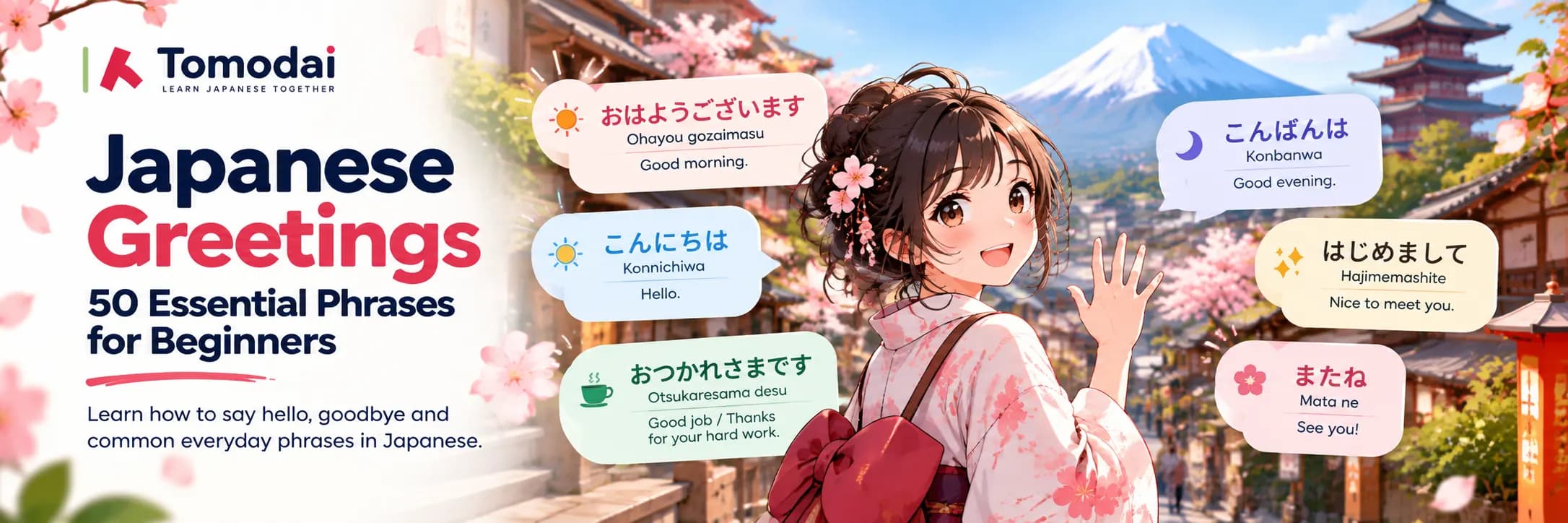
Japanese greetings (挨拶 / あいさつ, aisatsu) are social tools that establish politeness, set social distance, and signal situational awareness. Unlike English expressions that often translate word-for-word, Japanese greetings strictly vary depending on time of day, social hierarchy and intimacy, physical setting (home, office, or dining), and paired responses (such as いってきます and いってらっしゃい).
Learning Japanese often starts with familiar words such as こんにちは (Hello) and ありがとう (Thank you). However, Japanese greetings are far more than literal translations of English phrases. The expression you choose shifts dramatically based on the time of day, your relationship with the listener, and the exact physical setting.
For instance, walking into a classroom or office requires polite speech:
Standard polite form for teachers, managers, and coworkers.
Reserved exclusively for close peers and family members.
In this guide, you will explore 50 essential Japanese greetings and everyday expressions across nine functional categories. You do not need to memorize all 50 in a single afternoon. Focus on the 10 most essential expressions first, understand how they behave in conversation pairs, and add situational phrases as your Japanese expands.
Why Are Japanese Greetings Important?
In Japanese culture, greetings (挨拶 / あいさつ) are not optional pleasantries. They serve as social glue, demonstrating respect, mutual consideration, and awareness of group harmony.
1 Time-of-Day Distinction
English speakers frequently use "hello" or "hi" throughout the entire day. Japanese rigorously divides the clock into morning, afternoon, evening, and bedtime phrases.
2 Unique Situational Markers
Japanese features specialized formulas for situations English leaves unmarked—such as leaving home (いってきます), entering someone's house (お邪魔します), or finishing work (お疲れさまです).
How Japanese Greetings Work: The 4 Core Factors
Before learning individual phrases, keep these four governing dynamics in mind:
Time of Day
Morning uses おはよう, daytime uses こんにちは, and nighttime uses こんばんは.
Social Relationship
Use casual phrases with peers and family; use honorific or polite speech with seniors and strangers.
Formality Level
When in doubt, choose the polite form. A polite greeting never offends, but an accidental casual greeting might.
Paired Responses
Many Japanese greetings come in mandatory call-and-response sets (e.g., ただいま → お帰りなさい).
The 10 Japanese Greetings Beginners Should Learn First
Do not try to memorize all 50 phrases today. Master these 10 foundational expressions first—they cover 90% of beginner daily interactions:
The 50 Essential Japanese Greetings by Category
Explore all 50 greetings grouped into logical conversational scenarios, with native Kanji, Kana readings, Romaji, and practical usage tips:
Daily Time-of-Day Greetings (1–6)
General daytime greeting (approx. 10:30 AM to late afternoon). Safe with acquaintances and strangers. The ending は is pronounced "wa".
Standard polite morning greeting used with teachers, managers, and coworkers upon first arriving at school or the workplace.
Informal morning greeting. Use strictly with family members, classmates, and close friends.
Used when greeting someone after sunset. Note: Do not confuse with おやすみなさい (said right before sleeping).
Very casual, relaxed greeting between close male friends or peers. Example: やあ、元気? (Hey, how are you?).
Multi-purpose conversational buffer. Can mean a quick informal "hi," a casual "thanks," or "pardon me" when passing someone.
First Meetings & Introductions (7–9)
Used only the very first time you meet someone. Never repeat it during subsequent meetings.
No single English equivalent. Communicates goodwill: "Please treat me well / I look forward to working with you."
"I'm glad to meet you." Adds personal warmth and sincerity to a first meeting or introduction.
Checking In & Reconnecting (10–13)
Used when you haven't seen someone in a while, or in written letters/emails.
The casual counterpart. Said with a rising intonation to close friends.
"It's been a long time." Polite phrase when reconnecting after weeks or months.
Casual version of #12, frequently heard among reunited friends.
Goodbyes & Parting Expressions (14–20)
Has a sense of finality or distance. Not used for casual daily goodbyes.
Standard friendly goodbye among peers and classmates.
Casual contraction of "well then, see you later."
Natural parting phrase when meeting again the following day.
Polite parting phrase showing eagerness to meet again.
Respectful, business-appropriate way to say "let's meet again."
Said to someone departing for home or heading on a journey. Polite form: お気をつけて (#31).
Home & Daily Routine Expressions (21–26)
Said before retiring to bed. Different from こんばんは (evening greeting).
Casual bedtime greeting for close friends and family.
Person leaving says Ittekimasu; person staying behind responds with Itterasshai.
Visiting Others & Formal Etiquette (27–31)
"How are you doing?" Highly formal, aristocratic or high-business inquiry.
Spoken when entering an office room, taking a seat, or interrupting someone.
"Excuse me for intruding." Spoken at the genkan door when entering another person's home.
"Thank you for having me." Spoken when stepping out of someone's home at departure.
The respectful, polite form of #20 (気をつけて). Spoken to guests or superiors leaving an event.
Workplace & Professional Japanese (32–39)
The cornerstone of Japanese work culture. Greets colleagues in hallways, opens emails, and acknowledges teamwork during the workday.
Said when a meeting, shift, project, or entire workday has finished.
Mandatory etiquette when clocking out while your colleagues are still on duty. Colleagues respond with #33 (お疲れさまでした).
Universal opening greeting in business phone calls and client emails. Acknowledges ongoing partnership.
Warning: Used exclusively by senior figures toward junior staff. Never say this to your boss or client.
Customary expression when answering a caller on hold or arriving for an appointment.
Used at elevator doors, narrow doorways, or checkout counters when letting someone proceed first.
Said politely to a sick colleague or someone leaving work early to recover.
Meals, Gratitude & Social Courtesy (40–46)
Spoken with hands together before meals, expressing gratitude for ingredients and preparation.
Said after meals to the host or restaurant chef ("Thank you for the delicious feast").
Polite universal thank you. Use casual ありがとう only with close peers.
Standard response to thanks. (In casual speech, friends often simply reply with いいえ or a nod).
Use when someone drops something, looks unwell, or trips.
Friendly greeting when seeing an acquaintance after an absence.
Heard at airports, city borders, or events (e.g., 日本へようこそ! — Welcome to Japan!). Note: Stores use いらっしゃいませ instead.
Casual Greetings & Celebrations (47–50)
Relaxed question among friends regarding health, work, or general vibe.
Super-short, natural parting phrase used over text and in person.
Casual version of お疲れさまです between close peers and club members.
"Congratulations!" Casual form: おめでとう. Used for birthdays, new years, and passing exams.
50 Japanese Greetings at a Glance
Use this complete reference matrix to quickly look up pronunciation, Kana orthography, and meanings:
| # | Japanese Kanji / Kana | Hiragana | Romaji | English Meaning |
|---|---|---|---|---|
| 01 | こんにちは | こんにちは | Konnichiwa | Hello / Good afternoon |
| 02 | おはようございます | おはようございます | Ohayō gozaimasu | Good morning (polite) |
| 03 | おはよう | おはよう | Ohayō | Morning! (casual) |
| 04 | こんばんは | こんばんは | Konbanwa | Good evening |
| 05 | やあ | やあ | Yā | Hi / Hey (casual) |
| 06 | どうも | どうも | Dōmo | Thanks / Hi (flexible) |
| 07 | はじめまして | はじめまして | Hajimemashite | Nice to meet you (first time) |
| 08 | よろしくお願いします | よろしくおねがいします | Yoroshiku onegaishimasu | Please treat me well / Good relationship |
| 09 | お会いできてうれしいです | おあいできてうれしいです | Oai dekite ureshii desu | I'm glad to meet you |
| 10 | お元気ですか | おげんきですか | Ogenki desu ka | How are you? (polite) |
| 11 | 元気? | げんき? | Genki? | How are you? (casual) |
| 12 | お久しぶりです | おひさしぶりです | Ohisashiburi desu | It's been a long time (polite) |
| 13 | 久しぶり | ひさしぶり | Hisashiburi | Long time no see! (casual) |
| 14 | さようなら | さようなら | Sayōnara | Goodbye (formal / distant) |
| 15 | またね | またね | Mata ne | See you (casual) |
| 16 | じゃあね | じゃあね | Jā ne | See ya (casual) |
| 17 | また明日 | またあした | Mata ashita | See you tomorrow |
| 18 | また会いましょう | またあいましょう | Mata aimashō | Let's meet again (polite) |
| 19 | またお会いしましょう | またおあいしましょう | Mata oai shimashō | Let's meet again (formal) |
| 20 | 気をつけて | きをつけて | Ki o tsukete | Take care / Be careful |
| 21 | おやすみなさい | おやすみなさい | Oyasuminasai | Good night (polite) |
| 22 | おやすみ | おやすみ | Oyasumi | Good night (casual) |
| 23 | いってきます | いってきます | Ittekimasu | I'm heading out (said by person leaving) |
| 24 | いってらっしゃい | いってらっしゃい | Itterasshai | Take care (response to Ittekimasu) |
| 25 | ただいま | ただいま | Tadaima | I'm home! (said by returning person) |
| 26 | お帰りなさい | おかえりなさい | Okaerinasai | Welcome home (response to Tadaima) |
| 27 | ご機嫌いかがですか | ごきげんいかがですか | Gokigen ikaga desu ka | How are you? (ultra-formal) |
| 28 | 失礼します | しつれいします | Shitsurei shimasu | Excuse me / Pardon me |
| 29 | お邪魔します | おじゃまします | Ojama shimasu | Excuse me for intruding (entering home) |
| 30 | お邪魔しました | おじゃましました | Ojama shimashita | Thank you for having me (leaving home) |
| 31 | お気をつけて | おきをつけて | Oki o tsukete | Please take care (polite) |
| 32 | お疲れさまです | おつかれさまです | Otsukaresama desu | Good work (during ongoing work) |
| 33 | お疲れさまでした | おつかれさまでした | Otsukaresama deshita | Thank you for your work (finished) |
| 34 | お先に失礼します | おさきにしつれいします | Osaki ni shitsurei shimasu | Excuse me for leaving first |
| 35 | お世話になっております | おせわになっております | Osewa ni natte orimasu | Thank you for your continued support |
| 36 | ご苦労様でした | ごくろうさまでした | Gokurōsama deshita | Thank you for your hard work (boss to sub) |
| 37 | お待たせしました | おまたせしました | Omatase shimashita | Sorry to keep you waiting |
| 38 | お先にどうぞ | おさきにどうぞ | Osaki ni dōzo | Please go ahead |
| 39 | お休みください | おやすみください | Oyasumi kudasai | Please get some rest |
| 40 | いただきます | いただきます | Itadakimasu | Thank you for the food (before meal) |
| 41 | ごちそうさまでした | ごちそうさまでした | Gochisōsama deshita | Thank you for the meal (after meal) |
| 42 | ありがとうございます | ありがとうございます | Arigatō gozaimasu | Thank you very much |
| 43 | どういたしまして | どういたしまして | Dō itashimashite | You're welcome |
| 44 | 大丈夫ですか | だいじょうぶですか | Daijōbu desu ka | Are you okay? |
| 45 | しばらくですね | しばらくですね | Shibaraku desu ne | It's been a while, hasn't it? |
| 46 | ようこそ | ようこそ | Yōkoso | Welcome (to a country / place) |
| 47 | 調子どう? | ちょうしどう? | Chōshi dō? | How's it going? (casual) |
| 48 | じゃ、また | じゃ、また | Ja, mata | Well then, see you (casual) |
| 49 | お疲れ | おつかれ | Otsukare | Good work / Later (casual) |
| 50 | おめでとうございます | おめでとうございます | Omedetō gozaimasu | Congratulations! |
Formal vs. Casual Japanese Greetings
Choosing between polite speech (丁寧語 / teineigo) and casual speech (タメ口 / tameguchi) is one of the most critical skills in Japanese:
| English Concept | Polite / Formal (Teachers, Bosses, Strangers) | Casual (Friends, Peers, Family) |
|---|---|---|
| Good morning | おはようございます | おはよう |
| How are you? | お元気ですか | 元気? / 調子どう? |
| Goodbye / See you | また明日 / またお会いしましょう | またね / じゃあね |
| Good night | おやすみなさい | おやすみ |
| Thank you | ありがとうございます | ありがとう |
| Good work / Effort | お疲れさまです | お疲れ |
| Congratulations | おめでとうございます | おめでとう |
Real Japanese Greeting Mini-Conversations
Study how Japanese speakers combine these phrases naturally in daily life:
6 Common Japanese Greeting Mistakes to Avoid
Using さようなら Daily
さようなら carries heavy finality (like "farewell"). Use また明日 or またね instead.
Saying こんにちは at 8:00 AM
こんにちは is exclusively a daytime greeting. Always greet people in the morning with おはようございます.
Saying ご苦労様 to Your Boss
ご苦労様でした is patronizing if spoken up the hierarchy. Superiors must always be thanked with お疲れさまでした.
Repeating はじめまして
はじめまして comes from 初め (the beginning). Saying it to someone you met last week implies you forgot them completely.
Translating よろしく Literally
Do not search for a literal English translation. Treat it as an essential gesture of goodwill and shared responsibility.
Using Casual Speech with Superiors
Dropping ございます or using casual お疲れ with teachers or supervisors sounds disrespectful. Default to polite speech.
Practice Quiz: Test Your Greeting Instincts
Test yourself on real-life scenarios. Click each card to reveal the natural Japanese response:
1. You meet your teacher at 8:30 AM. ▼
Teachers require polite morning greetings, not casual おはよう.
2. You bump into a classmate at 2:00 PM. ▼
Standard daytime greeting or casual check-in with a peer.
3. You pack up and leave work at 6:00 PM. ▼
Colleagues still working will respond: お疲れさまでした!
4. You meet someone for the first time. ▼
The essential first-meeting introduction formula.
5. You open your front door after work. ▼
Family inside will reply: お帰りなさい (Okaerinasai).
6. You say goodbye to a close friend. ▼
Natural, everyday casual goodbyes among friends.
Frequently Asked Questions
What is the most common greeting in Japanese? ▼
こんにちは (Konnichiwa) is the most widely recognized daytime greeting. However, in workplace settings, お疲れさまです (Otsukaresama desu) is spoken far more frequently throughout the working day.
How do you say goodbye naturally without sounding final? ▼
Avoid さようなら for daily partings. With friends, say またね (Mata ne) or じゃあね (Jā ne). With coworkers, say お先に失礼します when leaving the office or また明日 when seeing them the next morning.
Why is は pronounced "wa" in こんにちは and こんばんは? ▼
Historically, こんにちは was the beginning of an extended sentence: "Konnichi wa, gokigen ikaga desu ka" ("As for today, how are you feeling?"). Because the character は served as the grammatical topic marker particle (which is pronounced "wa"), the spelling was preserved even though the sentence became a standalone greeting.
Do Japanese people bow while greeting? ▼
Yes. Bowing (お辞儀 / ojigi) often accompanies formal and polite greetings. A slight nod (15°) is common for casual acknowledgments, a 30° bow is standard for polite business greetings (おはようございます, よろしくお願いします), and deeper bows express deep gratitude or apologies.
Key Takeaways
- • Japanese greetings depend on time, hierarchy, setting, and pairing.
- • When in doubt, use polite forms (e.g., おはようございます).
- • Never use ご苦労様でした toward supervisors or customers.
- • Learn greetings in paired sets (いってきます ↔ いってらっしゃい).
- • Save はじめまして strictly for the first time you meet someone.
- • Master the top 10 greetings first before tackling specialized workplace terms.
Practice Authentic Japanese Greetings on Tomodai
Do not just memorize word lists. Practice real greetings in lifelike scenarios with Tomodai's AI Conversation Partner, interactive audio quizzes, and structured N5 grammar lessons.
Learn with confidence. Practice with purpose. Grow one lesson at a time.
Pass the JLPT & Speak Confidently
Learn with structured N5–N1 grammar lessons, intelligent SRS flashcards, and instant real-time conversational practice with AI Sensei.