Japanese Alphabet Explained: Hiragana, Katakana & Kanji
 Emma Collins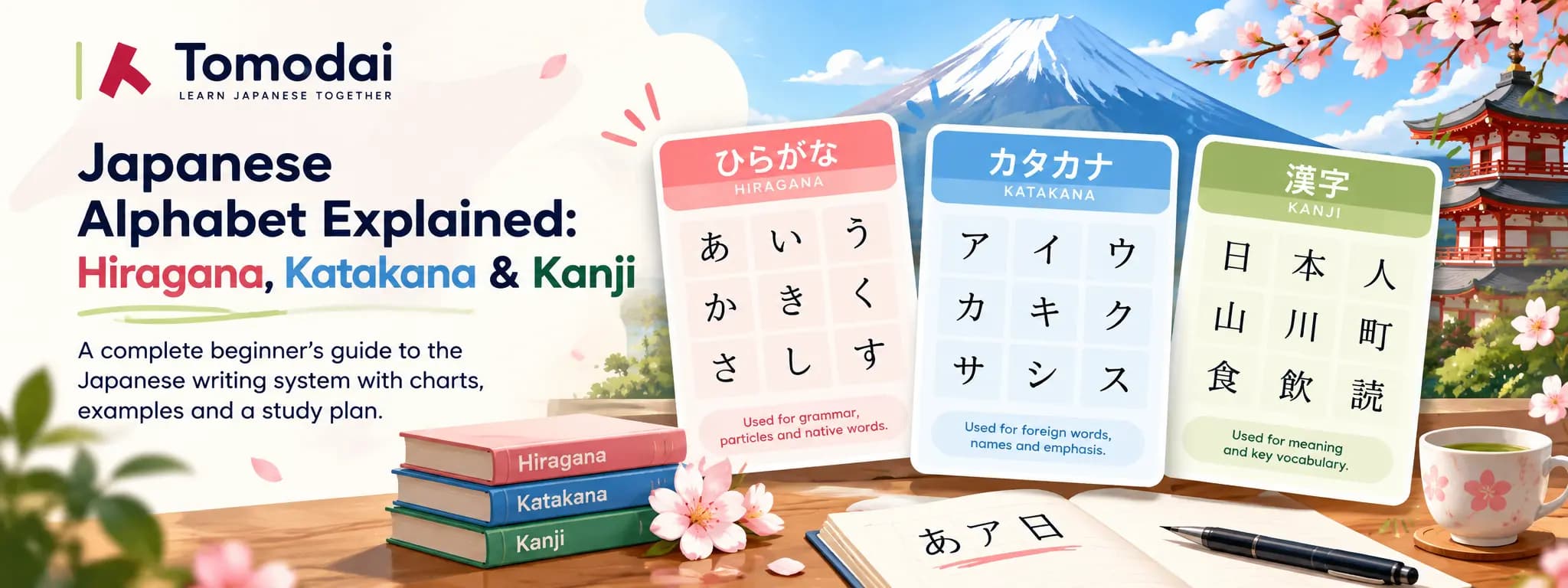
Japanese uses three main writing systems: Hiragana, Katakana, and Kanji. Hiragana handles grammatical inflections and native vocabulary, Katakana writes foreign loanwords and adds emphasis, and Kanji represents core conceptual word roots. Romaji uses Latin letters primarily as a pronunciation aid for beginners.
Imagine opening a Japanese website or menu for the first time and encountering this sentence:
At first glance, it can look like an intimidating mix of curved strokes, sharp angles, and intricate ideograms. However, modern Japanese is not an arbitrary assortment of symbols—it is a logical, balanced tripartite system where each script performs a specific role.
You do not need to memorize thousands of characters before you can begin reading. The proven progression is simple: master Hiragana first, integrate Katakana shortly after, and gradually introduce high-frequency Kanji alongside everyday vocabulary and grammar.
The Three Main Parts of the Japanese Writing System
Rather than thinking "Japanese has three alphabets," think: "Japanese uses three scripts, and each script has a distinct job."
Hiragana
Phonetic moraic syllabary. Used for grammar particles, verb/adjective inflections, and native Japanese words.
Katakana
Angular phonetic syllabary. Used for foreign loanwords, international names, technical terms, and onomatopoeia.
Kanji
Logographic characters of Chinese origin. Represents core semantic root meanings for nouns, verbs, and adjectives.
What Is Hiragana? (ひらがな)
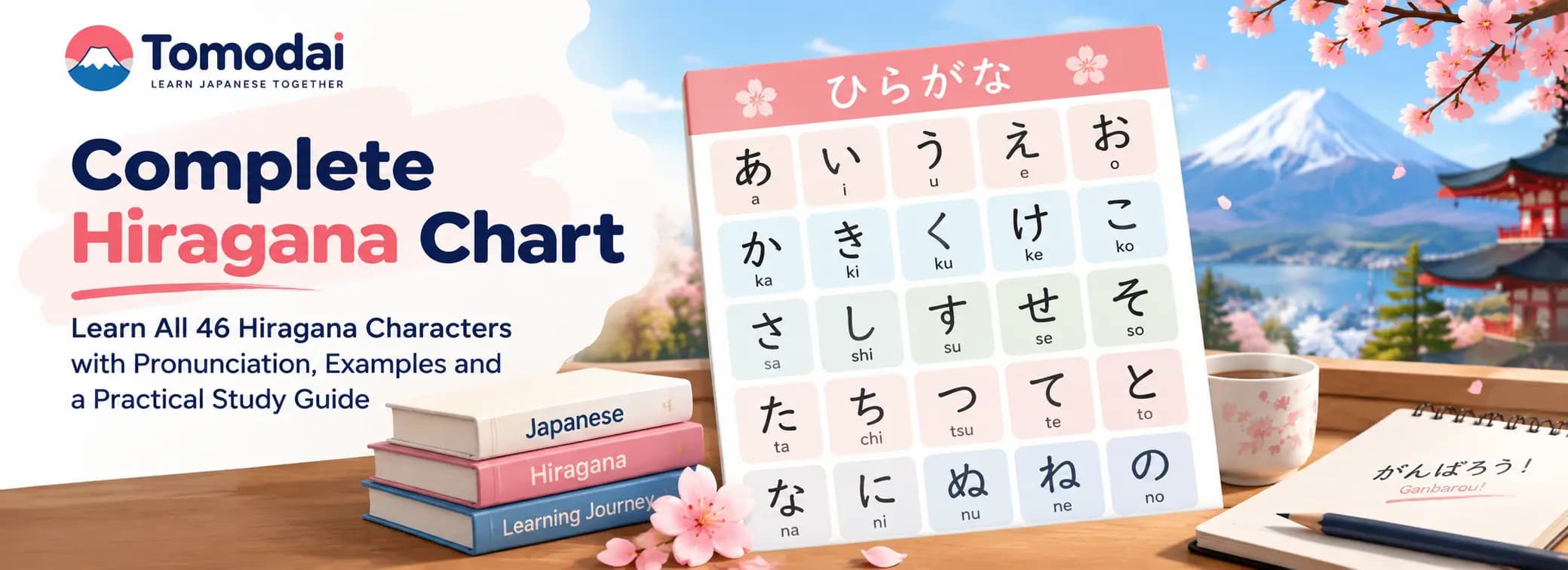
Hiragana is the primary script every learner must conquer first. It contains 46 basic characters organized according to the traditional Gojūon (50 sounds) grid. Each symbol corresponds to a single rhythmic mora.
| Row | -a | -i | -u | -e | -o |
|---|---|---|---|---|---|
| Vowels | あ a | い i | う u | え e | お o |
| K-Row | か ka | き ki | く ku | け ke | こ ko |
| S-Row | さ sa | し shi* | す su | せ se | そ so |
| T-Row | た ta | ち chi* | つ tsu* | て te | と to |
| N-Row | な na | に ni | ぬ nu | ね ne | の no |
| H-Row | は ha | ひ hi | ふ fu* | へ he | ほ ho |
| M-Row | ま ma | み mi | む mu | め me | も mo |
| Y-Row | や ya | — | ゆ yu | — | よ yo |
| R-Row | ら ra | り ri | る ru | れ re | ろ ro |
| W/N Row | わ wa | — | — | — | を o/wo* |
| Syllabic N | ん (n) - Stands alone as its own mora | ||||
*Special phonetic notes: し (shi), ち (chi), つ (tsu), and ふ (soft fu/hu) have irregular consonants. を is pronounced identically to お (o) in modern Japanese and functions almost solely as the direct object particle.
What Is Katakana? (カタカナ)
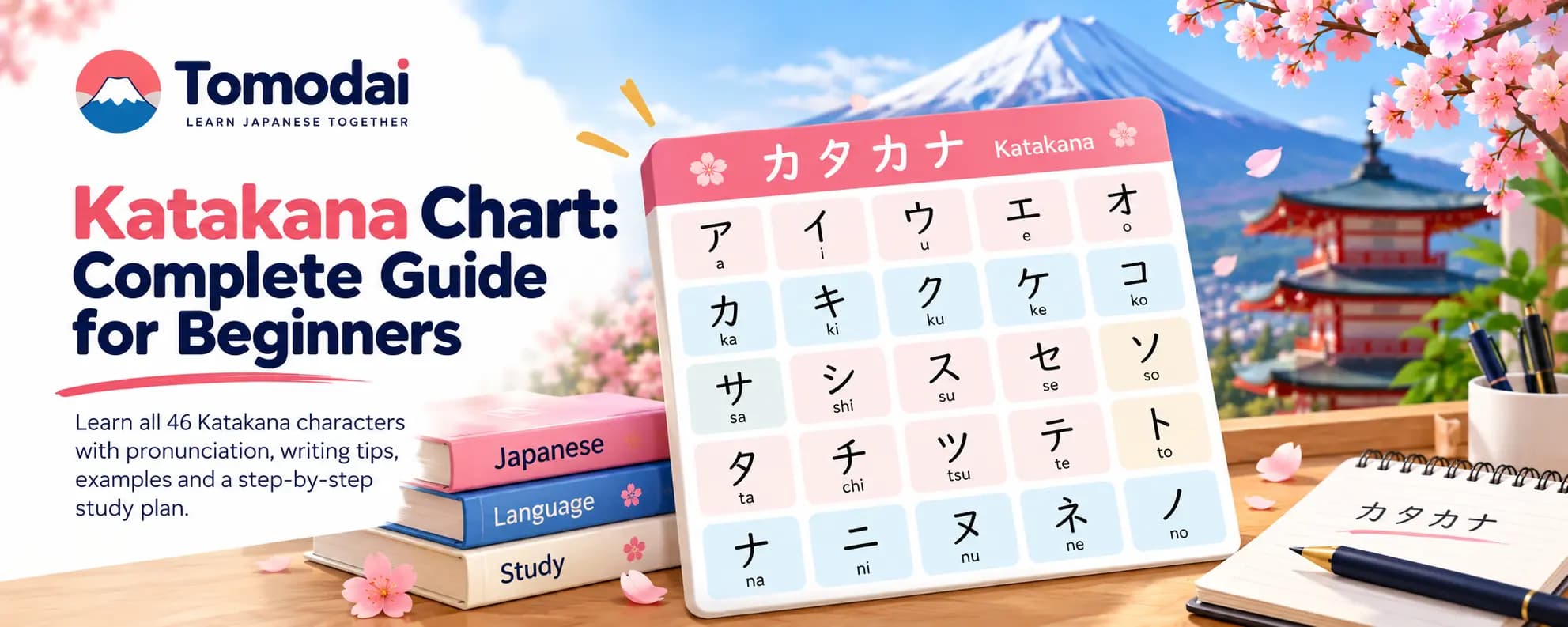
Katakana covers the identical 46 sounds as Hiragana but features angular, sharp strokes. In everyday modern Japanese, Katakana acts as visual highlighting—identifying imported concepts, restaurant menus, international names, and onomatopoeia.
| Row | -a | -i | -u | -e | -o |
|---|---|---|---|---|---|
| Vowels | ア a | イ i | ウ u | エ e | オ o |
| K-Row | カ ka | キ ki | ク ku | ケ ke | コ ko |
| S-Row | サ sa | シ shi* | ス su | セ se | ソ so |
| T-Row | タ ta | チ chi* | ツ tsu* | テ te | ト to |
| N-Row | ナ na | ニ ni | ヌ nu | ネ ne | ノ no |
| H-Row | ハ ha | ヒ hi | フ fu* | ヘ he | ホ ho |
| M-Row | マ ma | ミ mi | ム mu | メ me | モ mo |
| Y-Row | ヤ ya | — | ユ yu | — | ヨ yo |
| R-Row | ラ ra | リ ri | ル ru | レ re | ロ ro |
| W/N Row | ワ wa | — | — | — | ヲ wo/o |
| Syllabic N | ン (n) | ||||
What Is Kanji? (漢字)
Unlike Hiragana and Katakana, which strictly represent sounds, Kanji are logographic ideograms imported historically from China. Each character carries inherent semantic meaning and can have multiple pronunciations depending on context.
On'yomi (音読み) — Sino-Japanese Reading
The historical Chinese-derived pronunciation. Typically used when a Kanji is compounded directly with another Kanji (e.g., 富士山 — Fuji-san).
Kun'yomi (訓読み) — Native Japanese Reading
The native Japanese word attached to the character's meaning. Frequently used when a Kanji stands alone as an independent noun (e.g., 山 — yama / mountain).
| Kanji | Meaning | On'yomi | Kun'yomi | Common Word |
|---|---|---|---|---|
| 山 | Mountain | サン (san) | やま (yama) | 富士山 (Mt. Fuji) |
| 水 | Water | スイ (sui) | みず (mizu) | 水 (Water) |
| 人 | Person | ジン, ニン | ひと (hito) | 日本人 (Japanese person) |
| 日 | Sun / Day | ニチ, ジツ | ひ, か | 日曜日 (Sunday) |
| 学 | Study / Learn | ガク (gaku) | まなぶ (manabu) | 学生 (Student) |
How Hiragana, Katakana, and Kanji Work Together
This is the moment Japanese clicks for most beginners. These three scripts do not compete; they synchronize to make reading faster and unambiguous.
Why Japanese Doesn't Use Spaces
Because Japanese has no spaces between words, combining scripts provides instant visual boundaries:
With Kanji & Kana: 母は花を買いました。 (Instantly scannable: Mother bought flowers.)
In Hiragana alone: ははははなをかいました。 (A confusing wall of "ha-ha-ha-ha-na...")
Hiragana vs. Katakana vs. Kanji
| Feature | Hiragana | Katakana | Kanji |
|---|---|---|---|
| Type | Phonetic Kana | Phonetic Kana | Logographic (Ideograms) |
| Primary Role | Grammar & native words | Foreign loanwords & emphasis | Core vocabulary & roots |
| Character Count | 46 basic | 46 basic | 2,136 (Jōyō list) |
| Representation | Sounds only | Sounds only | Meaning + contextual sounds |
| Visual Style | Curved & flowing | Angular & straight | Complex geometric strokes |
| When to Learn | Day 1 (Immediate) | Week 2–3 (Early) | Gradual (Long term) |
What Is Romaji? (ローマ字)
Romaji refers to the transcription of Japanese sounds into the Latin/Roman alphabet. While useful during your first few days to understand basic pronunciation and keyboard input, relying on Romaji for weeks creates a dangerous learning bottleneck.
The Transition Bridge
Think of Romaji as training wheels. The moment you recognize Hiragana, remove the Romaji:
A Simple 30-Day Japanese Writing Study Plan
A sustainable 20-to-30 minute daily routine beats an exhausting weekend cram session. Follow this balanced 4-week roadmap:
Learn 5 to 10 characters daily in Gojūon order. Practice stroke order by hand and read simple native pairs like あか (red) and ねこ (cat).
Master Dakuten (゛), Handakuten (゜), contracted sounds (きゃ, しゃ), and small っ. Practice reading 20 everyday beginner vocabulary words entirely in Hiragana.
Tackle the 46 Katakana characters. Focus on tricky lookalikes (シ vs. ツ, ソ vs. ン) and practice reading familiar borrowed terms from menus and signs.
Introduce 10 essential Kanji (日, 本, 人, 山, 水, etc.) through full words. Read complete sentences that harmonize Kanji, Hiragana, and Katakana together.
20 Essential Beginner Words (Week 2 Practice)
| Japanese | Hiragana | Romaji | English |
|---|---|---|---|
| こんにちは | こんにちは | Konnichiwa | Hello |
| ありがとう | ありがとう | Arigatou | Thank you |
| 日本語 | にほんご | Nihongo | Japanese language |
| 学生 | がくせい | Gakusei | Student |
| 先生 | せんせい | Sensei | Teacher |
| 水 | みず | Mizu | Water |
| 人 | ひと | Hito | Person |
| 山 | やま | Yama | Mountain |
| 本 | ほん | Hon | Book |
| 猫 | ねこ | Neko | Cat |
| 犬 | いぬ | Inu | Dog |
| 名前 | なまえ | Namae | Name |
| 食べる | たべる | Taberu | To eat |
| 飲む | のむ | Nomu | To drink |
| 行く | いく | Iku | To go |
| 見る | みる | Miru | To see / watch |
| 話す | はなす | Hanasu | To speak |
| 聞く | きく | Kiku | To listen / ask |
| 読む | よむ | Yomu | To read |
| 勉強 | べんきょう | Benkyou | Study |
10 Real Japanese Practice Sentences
Test your recognition across all three scripts with these graded examples:
10 Common Beginner Mistakes to Avoid
1. Thinking Japanese Has "Three Alphabets"
It is one integrated writing system composed of two phonetic syllabaries (Kana) and one ideographic script (Kanji).
2. Relying on Romaji Too Long
Romaji hinders character recognition and causes unnatural English-style accent habits. Drop it by Week 2.
3. Memorizing Hundreds of Kanji Upfront
Treating Kanji like flashcard art leads to quick burnout. Learn Kanji through useful vocabulary words.
4. Memorizing Symbols Without Words
Characters are tools to read words. Always connect new characters to practical, real-world vocabulary.
5. Neglecting Native Pronunciation
Japanese pitch and rhythm units (mora) matter. Always vocalize characters aloud while learning.
6. Confusing Hiragana & Katakana
They represent the same sounds. Master Hiragana first before adding Katakana to prevent cognitive cross-talk.
7. Studying Charts Without Reading Sentences
Isolated chart drills don't teach syntax. Read short sentences as early as Week 2.
8. Memorizing Isolated Kanji Readings
Never memorize lists of On/Kun readings in isolation. Learn them naturally inside words like 学生.
9. Skipping Handwriting Entirely
Even if your primary goal is typing, hand-writing Kana reinforces muscle memory and character balance.
10. Collecting Too Many Apps & Textbooks
Stick to one structured foundational curriculum and one spaced-repetition tool rather than spreading effort thin.
Frequently Asked Questions
What is the Japanese alphabet? ▼
"Japanese alphabet" is a search term used by beginners, but Japanese does not have one alphabet like English. Instead, Japanese writing uses three combined scripts: Hiragana, Katakana, and Kanji, with Romaji used as a temporary phonetic aid.
Should I learn Hiragana or Katakana first? ▼
Always learn Hiragana first. Hiragana appears in all basic grammatical elements, verb endings, and beginner materials. Once comfortable with Hiragana, Katakana follows naturally.
Can I learn Japanese without Kanji? ▼
You can start speaking and read elementary dialogues without Kanji, but you cannot read natural Japanese without it. Kanji provides essential word boundaries and distinguishes homophones.
How many Kanji do I need to learn for JLPT N5? ▼
The official JLPT organization does not publish fixed Kanji lists for any level. However, most foundational beginner resources target approximately 80 to 100 high-frequency characters for N5 proficiency.
How long does it take to learn the Japanese writing system? ▼
With 20 minutes of daily deliberate practice, most learners master Hiragana in 7 to 10 days and Katakana in another 7 days. Kanji is a gradual, ongoing journey integrated into regular vocabulary acquisition over months.
Key Takeaways
- • Japanese uses three collaborative scripts, not three alphabets.
- • Hiragana handles grammar endings, particles, and native words.
- • Katakana marks foreign loanwords and adds visual emphasis.
- • Kanji anchors core vocabulary meaning and creates visual word boundaries.
- • Drop Romaji early to protect your pronunciation and reading pace.
- • Consistency over 30 days builds an enduring, functional foundation.
Continue Your Japanese Journey with Tomodai
Ready to take the next step? Practice Hiragana and Katakana with interactive drills, master high-frequency vocabulary, dive into beginner Kanji, and practice real-world speaking with our AI Conversation Partner.
Learn with confidence. Practice with purpose. Grow one lesson at a time.
Pass the JLPT & Speak Confidently
Learn with structured N5–N1 grammar lessons, intelligent SRS flashcards, and instant real-time conversational practice with AI Sensei.