Katakana Chart: Complete Guide for Beginners
 Emma Collins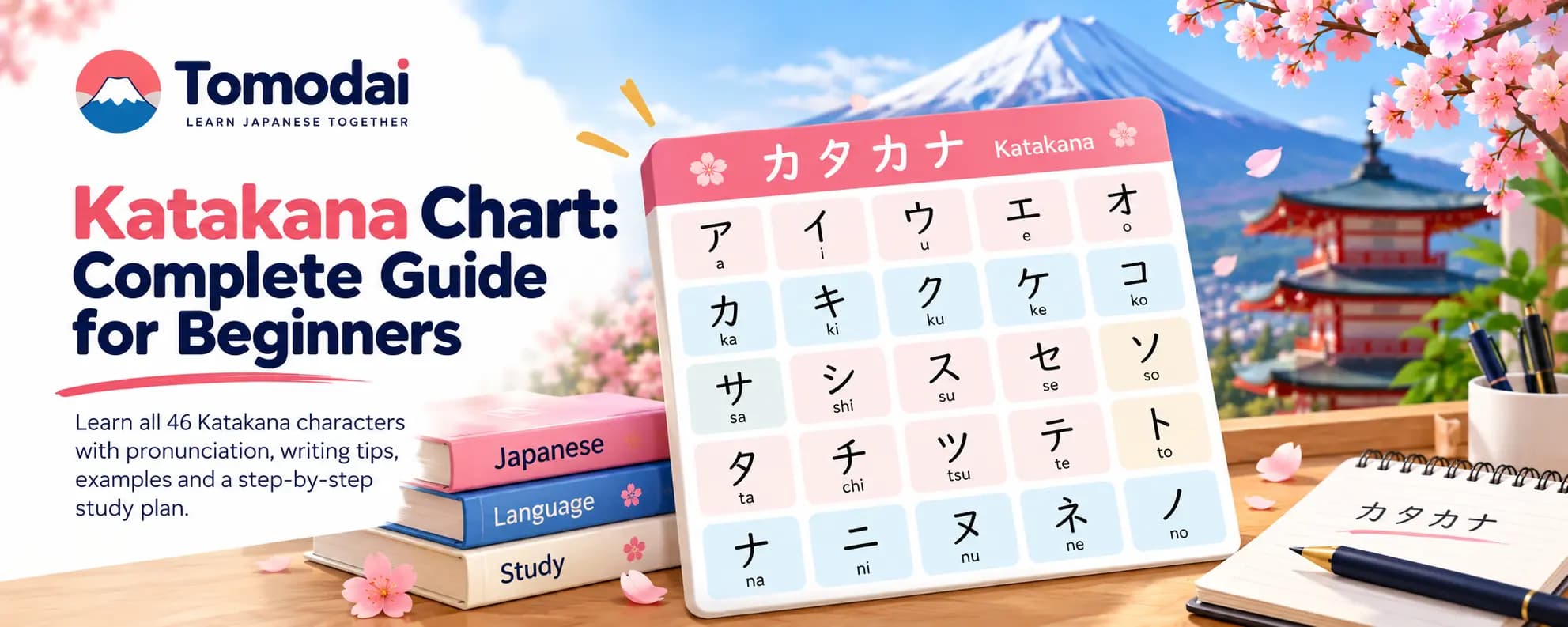
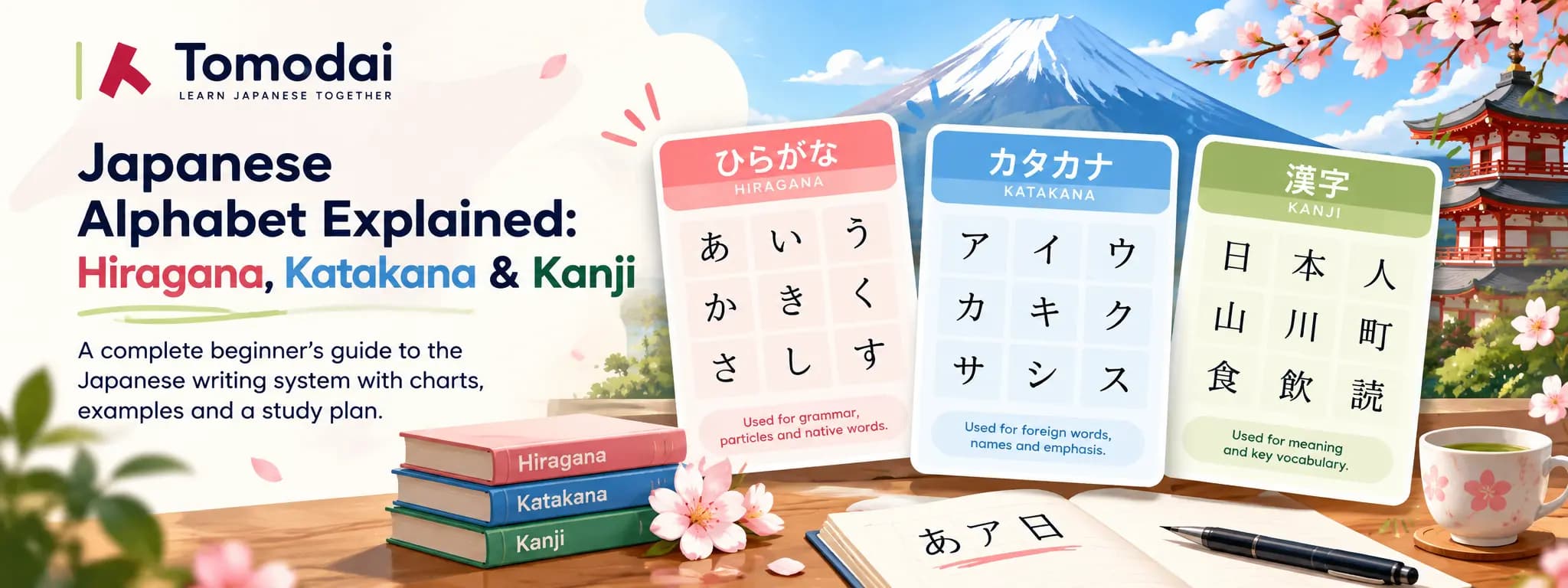
Katakana is one of Japan's two phonetic kana syllabaries, consisting of 46 basic angular characters that represent the exact same sounds as Hiragana. It is used primarily for foreign loanwords (e.g., ホテル hoteru), foreign names, menus, brand names, technical terminology, onomatopoeia, and visual emphasis. Master Katakana by progressing through the standard Gojūon rows, noticing stroke differences in lookalike characters (シ / ツ and ソ / ン), and applying the script directly to everyday words.
You may already recognize a few Japanese words from anime, travel, games, or Japanese restaurants. Then you see words such as:
コンビニ
konbini • Convenience store
ホテル
hoteru • Hotel
レストラン
resutoran • Restaurant
They look distinctively sharper and more angular than the rounded Hiragana characters you may have studied before. These characters are Katakana (カタカナ).
Katakana is one of the main kana writing systems used in modern Japanese. The Japan Foundation teaches Katakana as an integral pillar of beginner Japanese, providing dedicated learning resources for everyday communication.
The good news is that Katakana is much more manageable when you learn it in a clear, compounding order. The goal is not simply to memorize 46 abstract symbols in isolation. The goal is to move smoothly from:
What Is Katakana & When Is It Used?
Modern Japanese combines three distinct scripts alongside the Latin alphabet:
Curved characters used for native words, verb endings, and grammar particles.
Angular characters used for foreign loanwords, names, and visual emphasis.
Logographic characters of Chinese origin representing roots, nouns, and core meanings.
English letters used for train signage, brand abbreviations, and learner training wheels.
Historically, Katakana developed as shorthand fragments taken directly from pieces of Chinese characters (Kanji). Today, Katakana has a clear, functional set of roles:
コーヒー (coffee), パン (bread)
アメリカ (America), overseas personal names
アップル (Apple), スターバックス (Starbucks)
Biological animal, bird, plant, and mineral names
Sound effects in manga, comic bubbles, and daily speech
Functions like English italics or boldface in advertising
While ホテル originates from English "hotel," Japanese phonetics shape it into three distinct beats: ho - te - ru. Katakana words follow Japanese syllable patterns, not English spelling!
Katakana vs. Hiragana: The Key Differences
Hiragana and Katakana represent the exact same basic phonetic sound system. Do not think of Katakana as a new set of sounds—think of it as a different font for specific vocabulary roles:
| Feature | Hiragana (ひらがな) | Katakana (カタカナ) |
|---|---|---|
| Primary Function | Native Japanese vocabulary & grammar endings | Foreign loanwords, foreign names & emphasis |
| Visual Appearance | Curved, flowing, cursive lines | Sharp, straight, geometric angles |
| Classic Example | こんにちは (konnichiwa) | コーヒー (kōhī / coffee) |
| Beginner Priority | Step 1: Grammar and basic sentence structure | Step 2: Menus, signs, technology & loanwords |
か ↔ カ
Hiragana vs Katakanaさ ↔ サ
Hiragana vs Katakanaた ↔ タ
Hiragana vs Katakanaな ↔ ナ
Hiragana vs Katakanaま ↔ マ
Hiragana vs KatakanaThe Complete 46-Character Katakana Chart
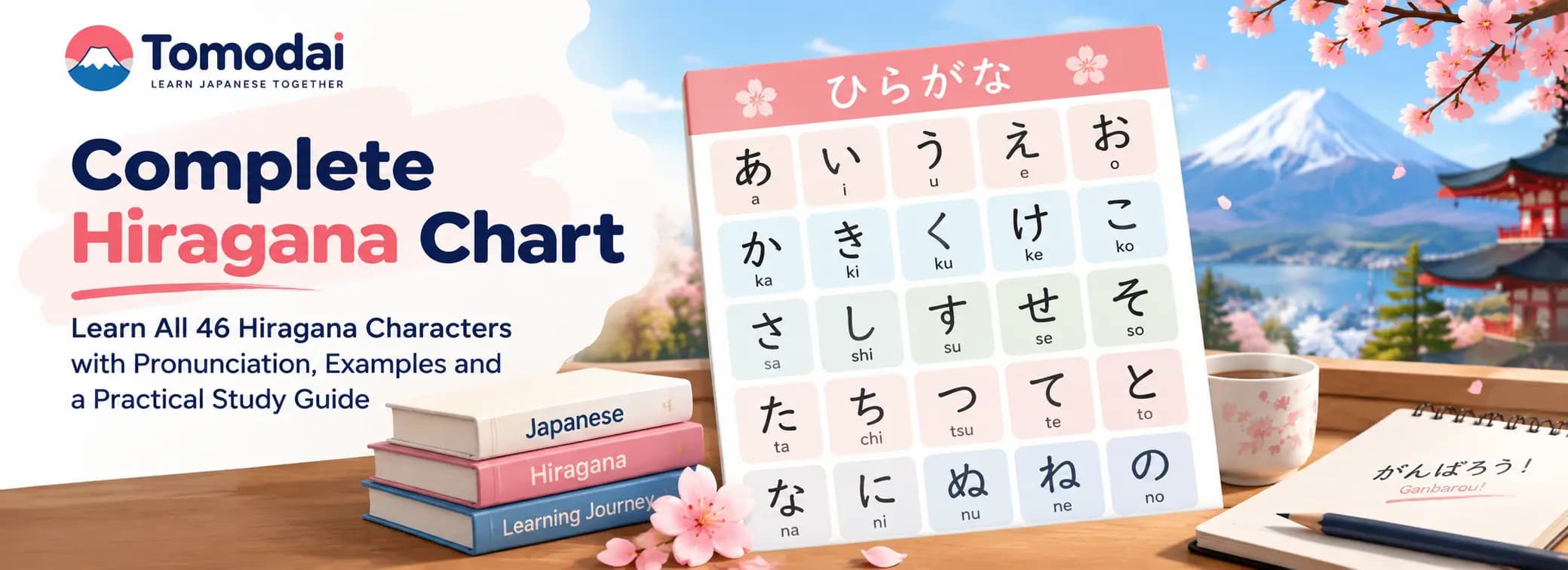
The 46 standard Katakana characters follow the traditional Gojūon layout. Learn them row by row across the five core vowel sounds:
| Row | -a (ア) | -i (イ) | -u (ウ) | -e (エ) | -o (オ) |
|---|---|---|---|---|---|
| ア行 (Vowels) | アa (あ) | イi (い) | ウu (う) | エe (え) | オo (お) |
| カ行 (K) | カka (か) | キki (き) | クku (く) | ケke (け) | コko (こ) |
| サ行 (S) | サsa (さ) | シshi* (し) | スsu (す) | セse (せ) | ソso (そ) |
| タ行 (T) | タta (た) | チchi* (ち) | ツtsu* (つ) | テte (て) | トto (と) |
| ナ行 (N) | ナna (な) | ニni (に) | ヌnu (ぬ) | ネne (ね) | ノno (の) |
| ハ行 (H) | ハha (は) | ヒhi (ひ) | フfu* (ふ) | ヘhe (へ) | ホho (ほ) |
| マ行 (M) | マma (ま) | ミmi (み) | ムmu (む) | メme (め) | モmo (も) |
| ヤ行 (Y) | ヤya (や) | — | ユyu (ゆ) | — | ヨyo (よ) |
| ラ行 (R) | ラra (ら) | リri (り) | ルru (る) | レre (れ) | ロro (ろ) |
| ワ行 (W) | ワwa (わ) | — | — | — | ヲwo / o* (を) |
| 撥音 (Nasal) | ン (n / ん) — Standalone moraic nasal beat. | ||||
* Note: ヲ is primarily used for the grammatical direct object particle (conventionally written in Hiragana as を) and is pronounced o in modern Japanese.
Katakana Pronunciation & The Power of Rhythm
The five vowels are the steady anchor of Katakana. Keep them short, clean, and unglided:
| Katakana | Hiragana | Romaji | Approximate English Sound |
|---|---|---|---|
| ア | あ | a | Open "ah" sound (like father) |
| イ | い | i | Crisp "ee" sound (like meet) |
| ウ | う | u | Short unrounded "oo" sound (lips relaxed) |
| エ | え | e | Short "eh" sound (like pet) |
| オ | お | o | Pure "oh" sound (like boat without glide) |
Japanese operates on equal-length beats (mora). In a word like コーヒー (coffee), the long vowel marks (ー) each receive a full beat: ko-o-hi-i (4 beats). If you rush through them or drop the length, the word becomes unnatural or unintelligible.
Pronouncing Each Katakana Row
カ行 (K-Row)
ka ki ku ke koカ キ ク ケ コ
Simple consonant pattern: k + vowel. Extremely regular.
サ行 (S-Row) • Special: シ
sa shi su se soサ シ ス セ ソ
Exception: シ is pronounced shi (like "she"), never "si".
タ行 (T-Row) • Special: チ, ツ
ta chi tsu te toタ チ ツ テ ト
チ is chi (like "cheese"); ツ is tsu (like the ts in "cats" + u).
ナ行 (N-Row)
na ni nu ne noナ ニ ヌ ネ ノ
Very regular sound flow across all five vowels.
ハ行 (H-Row) • Special: フ
ha hi fu he hoハ ヒ フ ヘ ホ
フ is a soft bilabial breath. Do not bite your lower lip like English "food".
マ行 (M-Row)
ma mi mu me moマ ミ ム メ モ
Clean consonant pattern across all vowels.
ヤ行 (Y-Row)
ya yu yo (3 kana)ヤ • ユ • ヨ
No modern standard yi or ye characters.
ラ行 (R-Row) • Light Tap
ra ri ru re roラ リ ル レ ロ
A light alveolar tap between English r, l, and d.
Dakuten & Handakuten in Katakana
Adding the two small diacritical marks modifies unvoiced consonants into voiced sounds (゛ dakuten) or creates the "P" sound row (゜ handakuten):
| K → G | カ キ ク ケ コ | ガ ギ グ ゲ ゴ | ga gi gu ge go |
| S → Z | サ シ ス セ ソ | ザ ジ ズ ゼ ゾ | za ji zu ze zo |
| T → D | タ チ ツ テ ト | ダ ヂ ヅ デ ド | da ji zu de do |
| H → B | ハ ヒ フ ヘ ホ | バ ビ ブ ベ ボ | ba bi bu be bo |
| H → P | ハ ヒ フ ヘ ホ | パ ピ プ ペ ポ | pa pi pu pe po |
Katakana Combination Sounds (Yōon & Extended)
Katakana combines base characters with miniature ャ, ュ, ョ for traditional contracted sounds, as well as extended combinations created specifically to capture foreign sounds:
| Base | -ya (ャ) | -yu (ュ) | -yo (ョ) |
|---|---|---|---|
| K-Row | キャ (kya) | キュ (kyu) | キョ (kyo) |
| S-Row | シャ (sha) | シュ (shu) | ショ (sho) |
| T-Row | チャ (cha) | チュ (chu) | チョ (cho) |
| N-Row | ニャ (nya) | ニュ (nyu) | ニョ (nyo) |
| H-Row | ヒャ (hya) | ヒュ (hyu) | ヒョ (hyo) |
| M-Row | ミャ (mya) | ミュ (myu) | ミョ (myo) |
| R-Row | リャ (rya) | リュ (ryu) | リョ (ryo) |
Extended Katakana for Modern Foreign Sounds
Small ッ (Sokuon) & The Long Vowel Mark (ー)
Small ッ (Sokuon • Pause)
ッThe small ッ is not pronounced as "tsu". Instead, it creates a glottal stop or brief catch in your breath, doubling the following consonant:
Long Vowel Mark (長音符 • ー)
ーIn Katakana, long vowels are written with the horizontal line ー (or vertical in tategaki), adding one full beat to the preceding vowel:
25 Everyday Katakana Words You Should Know
Do not memorize characters forever in isolation. Connect Katakana immediately to everyday Japanese vocabulary:
| Katakana | Hiragana Reading | Romaji | Meaning |
|---|---|---|---|
| パン | ぱん | pan | Bread (Portuguese origin) |
| ケーキ | けーき | kēki | Cake |
| コーヒー | こーひー | kōhī | Coffee |
| ジュース | じゅーす | jūsu | Juice |
| ホテル | ほてる | hoteru | Hotel |
| レストラン | れすとらん | resutoran | Restaurant |
| コンビニ | こんびに | konbini | Convenience store |
| スーパー | すーぱー | sūpā | Supermarket |
| テレビ | てれび | terebi | Television |
| ラジオ | らじお | rajio | Radio |
| ペン | ぺん | pen | Pen |
| バッグ | ばっぐ | baggu | Bag |
| カメラ | かめら | kamera | Camera |
| スマートフォン | すまーとふぉん | sumātofon | Smartphone (スマホ) |
| コンピューター | こんぴゅーたー | konpyuutaa | Computer |
| タクシー | たくしー | takushī | Taxi |
| バス | ばす | basu | Bus |
| チケット | ちけっと | chiketto | Ticket |
| シャツ | しゃつ | shatsu | Shirt |
| ドア | どあ | doa | Door |
| テーブル | てーぶる | tēburu | Table |
| ビール | びーる | bīru | Beer |
| ホーム | ほーむ | hōmu | Train platform / home |
| アニメ | あにめ | anime | Animation / Anime |
| メニュー | めにゅー | menyū | Menu |
Katakana Inside Real Japanese Sentences
Katakana rarely appears by itself. In native Japanese, Katakana words sit directly alongside Hiragana particles and Kanji verbs. Notice where the Katakana begins and ends:
コーヒーを飲みます。
Kōhī o nomimasu • "I drink coffee."
Katakana noun + Hiragana particle (を) + Kanji verb.
ホテルに泊まります。
Hoteru ni tomarimasu • "I stay at a hotel."
Katakana location + destination particle (に).
コンビニに行きます。
Konbini ni ikimasu • "I go to the convenience store."
High-frequency everyday verb combination.
レストランで食べます。
Resutoran de tabemasu • "I eat at a restaurant."
Context particle (で) marks the action's location.
Mastering Confusing Lookalike Characters
Katakana is famous for pairs of characters that look almost identical at first glance. The difference lies in stroke direction and horizontal vs. vertical alignment:
Strokes sweep upwards from bottom-left
Strokes drop downwards from top-right
Memory Hook: In シ, the person looks up at "she". In ツ, rain drops down like a "tsunami".
Upper slash drops downward
Lower stroke flicks upward
Memory Hook: ソ aligns with the downward angle of ツ; ン shares the upward sweep of シ.
The 7-Day Katakana Mastery Roadmap
Dedicate 15 to 30 focused minutes each day to build automaticity without burnout:
| Day | Focus Rows | Characters | Daily Milestone |
|---|---|---|---|
| Day 1 | ア行 + カ行 | アイウエオ • カキクケコ | Master the 5 vowels; review in random flashcard order. |
| Day 2 | サ行 + タ行 | サシスセソ • タチツテト | Pay special attention to writing angles for シ and ツ. |
| Day 3 | ナ行 + ハ行 | ナニヌネノ • ハヒフヘホ | Master the soft breath sound of フ (fu); review Days 1–2. |
| Day 4 | マ行 + ヤ行 + ラ行 | マミムメモ • ヤユヨ • ラリルレロ | Practice light tongue-tap mechanics for R-sounds with audio. |
| Day 5 | ワ行 + ン & Review | ワ ヲ ン | Contrast ソ vs ン; run through all 46 basic characters. |
| Day 6 | Dakuten & Combos | ガ・ザ・ダ・バ・パ • キャ・シュ・ティ | Practice voiced shifts, handakuten, and foreign extended sounds. |
| Day 7 | Real Words & Sentences | Full Vocabulary Application | Read 20 loanwords and 5 sentences without looking at Romaji! |
8 Common Katakana Pitfalls to Avoid
Practice them side-by-side: ソ drops downward from the top; ン sweeps upward from the bottom.
シ has more horizontal alignment; ツ has vertical strokes pointing downward.
ク has two strokes with an angled bend; ケ has three distinct strokes with a vertical drop.
Never ignore ー; changing vowel duration alters word meaning completely (e.g., ビル building vs ビール beer).
Do not say "ba-tsu-gu" for バッグ. Treat it as a silent pause before the next consonant (bag-gu).
Do not pronounce Katakana words with English vowels. Read them strictly according to Japanese mora rules.
Cover up the Romaji column by Day 5. Train your optical reflexes to process native kana directly.
Memorizing 46 shapes in isolation causes rapid decay. Always attach characters to real words like ホテル.
Katakana and the JLPT N5 Benchmark
The official Japanese-Language Proficiency Test (JLPT) requires candidates at the N5 beginner level to comfortably read typical expressions and short sentences written in Hiragana, Katakana, and basic Kanji.
Avoid the "Official N5 Word List" Trap
The Japan Foundation and JEES do not publish an official fixed vocabulary list for the modern JLPT. Instead of trying to memorize an arbitrary 300-word "N5 Katakana list" found on unofficial websites, focus on developing fluent reading comfort with high-frequency everyday nouns (food, transit, lodging, digital devices). That functional ability will effortlessly cover orthography questions on the test.
What to Learn After Katakana
Once both Hiragana and Katakana are comfortable, you unlock the entire landscape of authentic Japanese. Your learning skills should now overlap and compound:
Frequently Asked Questions
What is Katakana mainly used for?
Katakana is used primarily for foreign-origin loanwords (コーヒー, ホテル), non-Japanese personal and place names, international brands, onomatopoeia, technical vocabulary, and stylistic emphasis in advertising.
Is Katakana harder to learn than Hiragana?
Not phonetically, as both scripts represent the exact same sounds. However, Katakana can feel more challenging initially because several characters share similar stroke geometries—especially シ / ツ and ソ / ン. Practice with real words eliminates this hurdle quickly.
Should I learn Hiragana before Katakana?
Yes. Hiragana forms the backbone of Japanese grammar, particles, and verb endings. Once you can read Hiragana comfortably, introduce Katakana directly. You do not need to wait until Hiragana is "100% perfect" before starting Katakana.
What does the horizontal line (ー) mean in Katakana?
The symbol ー is the chōonpu (long vowel mark). It tells you to hold the preceding vowel for an extra beat (e.g., ケーキ kēki / cake, コーヒー kōhī / coffee).
How does small ッ change the pronunciation?
Small ッ (sokuon) represents a silent glottal stop or brief catch in breath before the next consonant. In Romaji, it is written by doubling the consonant (e.g., バッグ baggu / bag).
📌 Key Takeaways for Katakana Mastery
- • Katakana has 46 basic modern characters in Gojūon order.
- • It shares the exact same phonetic sounds as Hiragana.
- • Learn Katakana inside real words like ホテル and コンビニ.
- • Pay close attention to stroke angles in シ / ツ and ソ / ン.
- • Master dakuten (゛) and handakuten (゜) sound shifts.
- • Small ッ creates a doubled consonant catch; ー extends vowel length.
- • Phase out Romaji completely by Day 5 of your study routine.
- • A 20-minute daily habit beats occasional weekend cramming.
Ready to Master Katakana & Beyond?
Take your Japanese from isolated symbols to real conversational confidence. Continue with Tomodai's interactive Katakana quizzes, JLPT N5 curriculum, vocabulary drills, and 24/7 AI Conversation Practice.
Pass the JLPT & Speak Confidently
Learn with structured N5–N1 grammar lessons, intelligent SRS flashcards, and instant real-time conversational practice with AI Sensei.