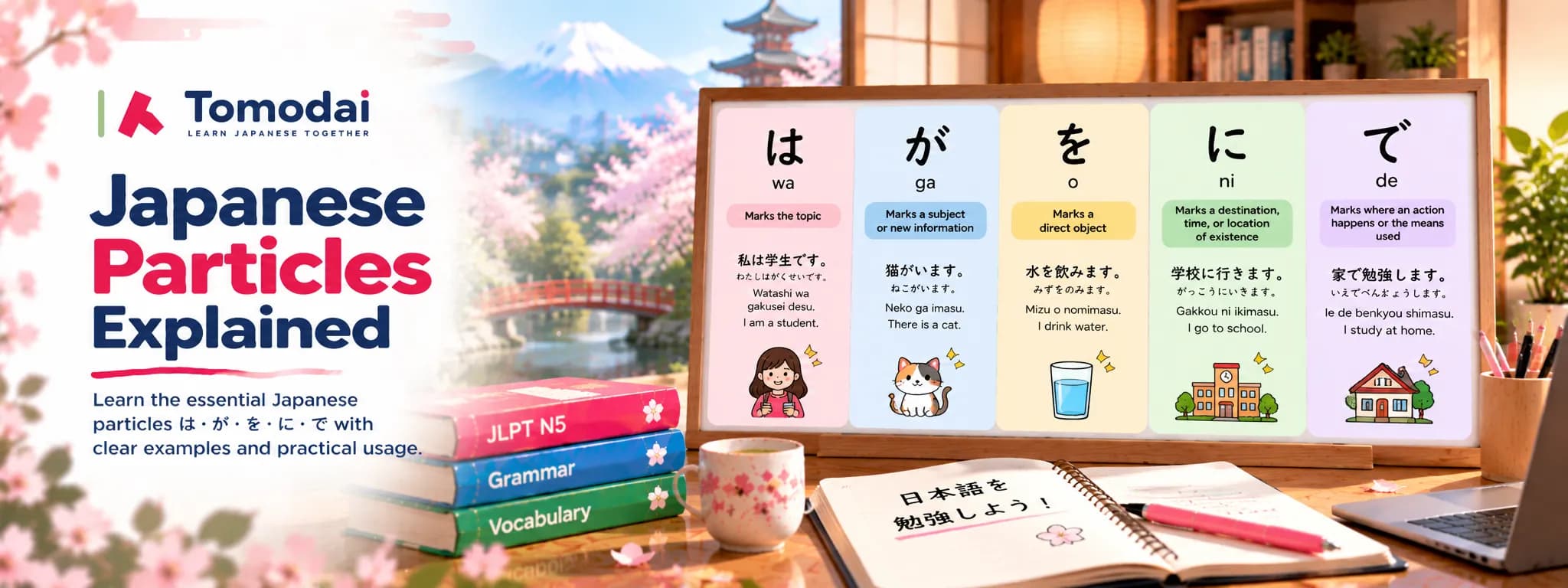
Japanese particles (助詞) are small functional markers that connect words and designate their syntactic job in a clause: は (wa) sets the sentence topic ("as for..."); が (ga) specifies the grammatical subject or information focus; を (o) marks the direct object receiving an action; に (ni) indicates a target destination, specific time, or location of existence; and で (de) marks the arena where an active event occurs or the tool/transportation used.
1. Introduction: Why Japanese Particles Matter
The grammatical glue that transforms isolated words into natural thoughts
Imagine you have learned some basic Japanese words. You know 私 ("I"), 学生 ("student"), 水 ("water"), and 学校 ("school"). You also know the verb 行きます ("go"). But how do you connect them into a coherent, natural thought? That is where Japanese particles come in.
The kana character は is normally read as ha in vocabulary words (like 花 hana), but whenever it functions as the grammatical topic marker, it is strictly pronounced wa. Similarly, the particle written as を is typed wo but pronounced cleanly as o in standard contemporary Japanese.
2. What Are Japanese Particles?
Postpositional markers and why English speakers find them challenging
English relies heavily on word position: "The dog sees the cat" means something completely different from "The cat sees the dog." In Japanese, word order is flexible because postpositional particles explicitly tag the role of each element:
"There is a cat."
As communicative frameworks from the Japan Foundation highlight, particles give Japanese sentences grammatical flexibility without losing semantic clarity.
No 1:1 English Equivalent
A single particle like に can mark a destination ("to"), a clock time ("at"), or a location of existence ("in").
Contextual Nuance
Both は and が can attach to the same person, but they frame focus and given vs. new information completely differently.
Literal Translation Trap
Translating directly from English prepositions leads to severe errors like using で for existence or dropping necessary case markers.
3. The Five Essential Japanese Particles at a Glance
Quick reference matrix for core everyday beginner patterns
| Particle | Reading | Main Beginner Function | Simple Example | English Meaning |
|---|---|---|---|---|
| は | wa | Marks the sentence topic ("as for...") | 私は学生です。 | I am a student. |
| が | ga | Marks grammatical subject or information focus | 猫がいます。 | There is a cat. |
| を | o | Marks direct object of a transitive verb | 水を飲みます。 | Drink water. |
| に | ni | Destination, specific time, or existence location | 学校に行きます。 | Go to school. |
| で | de | Action location or tool/means used | 家で勉強します。 | Study at home. |
4. Japanese Particle は (wa) — Marking the Topic
Establishing the conversational signpost
The particle は informs the listener what the sentence is about. Think of は as a conversational signpost: “Speaking of X, here is the new detail about it.”
"I am Rani."
"This is a book."
"I study every day."
"I drink coffee, but I do not drink tea."
5. Japanese Particle が (ga) — Subject & Specific Focus
Marking grammatical subjects, existence, likes, and abilities
The particle が marks the immediate grammatical subject performing an action or answers the question of who or what is involved.
"The dog runs."
"There is a cat in the park."
"I like cats."
"My younger sister understands Japanese."
6. は vs が — What Is the Difference?
Topic marker vs. Subject identifier
は (wa): Sets the Topic
Answers: "What or who are we talking about?"
The focus rests on the predicate following は. The listener already knows who "I" am; the new information being shared is that I am a student.
が (ga): Pinpoints the Actor
Answers: "Who is the specific one doing the action?"
The focus rests on the noun preceding が. If someone asks "Who will go?", 私が pinpoints me as the specific actor.
7. Japanese Particle を (o) — Marking the Direct Object
Designating the noun receiving the transitive action
8. Particles に (ni) & で (de) — Direction, Time & Action
The crucial difference between static location/target and active location/tools
-
学校に行きます。DestinationGakkō ni ikimasu.
-
7時に起きます。Specific TimeShichiji ni okimasu.
-
教室にいます。ExistenceKyōshitsu ni imasu.
-
図書館で勉強します。Action LocationToshokan de benkyō shimasu.
-
電車で会社に行きます。TransportationDensha de kaisha ni ikimasu.
-
ペンで名前を書きます。Tool / InstrumentPen de namae o kakimasu.
9. Common Japanese Particle Mistakes to Avoid
Critical traps in JLPT testing, speech, and composition
Pronouncing は as "ha"
When marking the topic, 私は is pronounced watashi wa, never *watashi ha.
Using で with いる or ある
*部屋で猫がいます is incorrect. Stating static presence requires に: 部屋に猫がいます.
Adding に to relative times
Do not add に after words like 毎日 (every day), 今日 (today), or 明日 (tomorrow).
Pronouncing を as "wo"
In standard modern spoken Japanese, を is pronounced purely as o.
Using に for action places
*図書館に勉強します is ungrammatical. Active verbs take で: 図書館で勉強します.
Treating は & が as interchangeable
は defines the known general topic; が introduces brand new information or marks the specific subject focus.
10. Complete 20-Question Practice Quiz
Click any question to check your answer and see the grammatical breakdown
01 私( )学生です。 ▼
02 水( )飲みます。 ▼
03 毎日、学校( )行きます。 ▼
04 図書館( )勉強します。 ▼
05 部屋( )猫がいます。 ▼
06 7時( )起きます。 ▼
07 パン( )食べます。 ▼
08 これ( )本です。 ▼
09 電車( )会社に行きます。 ▼
10 机の上( )本があります。 ▼
11 私は日本語( )好きです。 ▼
12 ペン( )名前を書きます。 ▼
13 公園( )歩きます。 ▼
14 友達( )プレゼントをあげます。 ▼
15 駅( )友達に会います。 ▼
16 猫( )います。 ▼
17 日曜日( )日本語を勉強します。 ▼
18 私( )行きます。 ▼
19 レストラン( )昼ご飯を食べます。 ▼
20 毎日、本( )読みます。 ▼
11. A Simple Seven-Day Practice Plan
A 15-minute daily drill to build instinctive particle mastery
Self-Introduction & Topics
Write 5 sentences introducing yourself and framing topics about your job and hobbies.
Identification & Likes
Practice identifying people, things that exist (います/あります), and items you like (好き).
Everyday Transitive Verbs
Form 5 daily sentences describing what you eat, drink, read, and buy.
Destinations & Clock Times
Practice destinations (行きます), times of day (7時に), and locations of existence.
Action Places & Tools
Describe where you study/work and the methods or transport you use (電車で, パソコンで).
Side-by-Side Comparisons
Compare は vs が and に vs で side-by-side using the same location or noun.
Paragraph Writing & Speaking
Combine all 5 particles in a single cohesive paragraph describing your trip to a cafe or library: where you went (に), what you drank (を), where you studied (で), and who was there (が).
12. Frequently Asked Questions
Clarifications for common learner questions
What is the difference between に and で for locations? ▼
Use に (ni) for static existence (where someone or something exists with いる or ある, e.g., 家にいます). Use で (de) where an active event or physical activity takes place (e.g., 家で勉強します).
Why is は pronounced “wa”? ▼
While the kana は is pronounced ha in everyday vocabulary words (like hana - flower), historical sound evolution preserved the archaic wa pronunciation specifically when functioning as the grammatical topic marker.
Can particles ever be omitted in Japanese? ▼
Yes. In casual spoken Japanese among friends, particles are frequently dropped when context makes the grammatical relationship obvious (e.g., これ食べる? instead of これを食べますか). However, beginners should always learn the complete, explicit structures first.
Are these 5 particles enough for JLPT N5? ▼
These five particles form the core foundation of N5 grammar, but as outlined by the official JLPT, the exam also tests additional essential particles including の (no) for possession/modification, も (mo) for "also", と (to) for "with/and", へ (e) for direction, and か (ka) for questions.
Key Takeaways for Japanese Learners
- • Learn particles in full sentence contexts, never as isolated one-word translations.
- • Pronounce topic は as "wa" and object を as "o".
- • Use に for where something exists (います/あります) and で for where an activity occurs.
- • Use を to mark the direct recipient of transitive verbs (飲みます、食べます、読みます).
- • Relative time expressions like 毎日 and 今日 do not take に.
- • Use が with expressions of like/dislike (好きです) and ability (わかります).
Related Tomodai Lessons & Guides
Curriculum RoadmapLearn Japanese with Confidence on Tomodai
Continue learning with structured lessons, interactive quizzes, spaced repetition, and real-time AI conversation practice.

Emma Collins
Emma Collins specializes in helping beginners build a strong foundation in Japanese. She creates clear, step-by-step lessons covering Hiragana, Katakana, essential grammar, vocabulary, and effective study techniques. Her writing focuses on making Japanese approachable through practical examples and structured learning paths that help new learners gain confidence from their very first lesson. Areas of Expertise Beginner Japanese Hiragana & Katakana Basic Grammar Study Roadmaps Learning Strategies
Pass the JLPT & Speak Confidently
Join thousands of learners mastering JLPT N5–N1 grammar with structured native breakdowns, intelligent spaced-repetition flashcards, and instant voice conversations with AI Sensei.