Hiragana Chart: Complete Guide with Pronunciation
 Emma Collins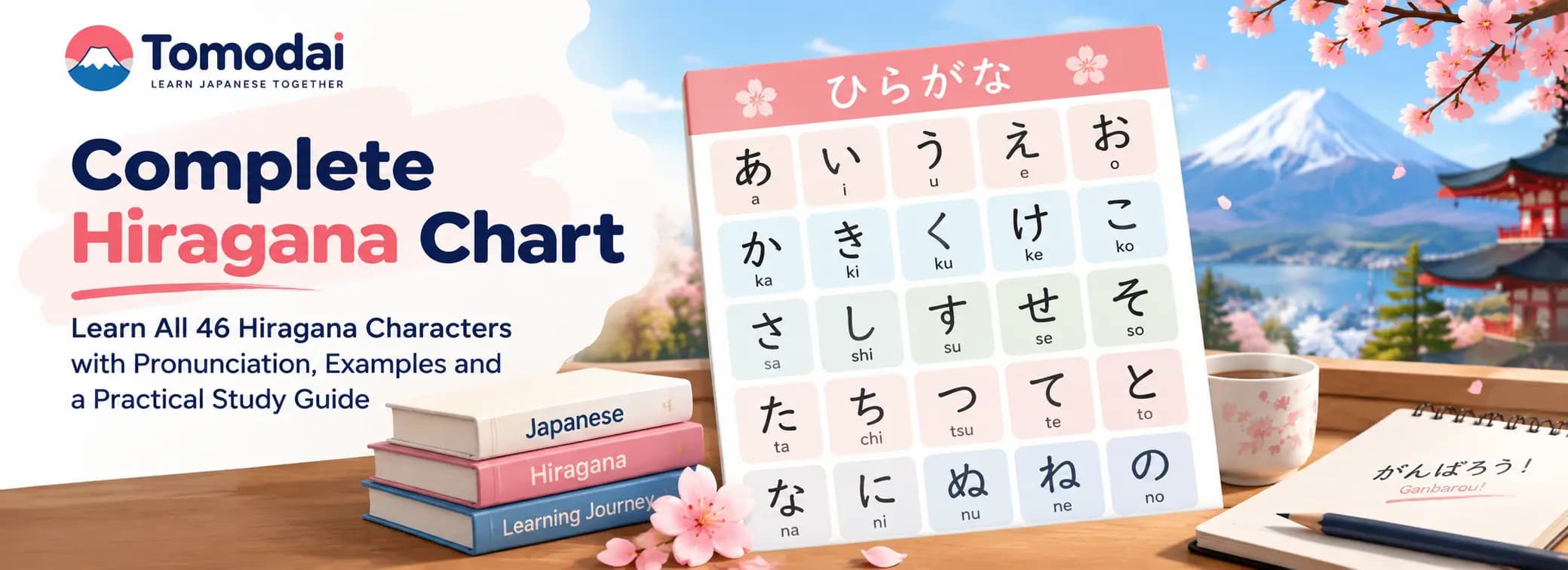
The first time you see Japanese writing, it can look like a collection of unfamiliar symbols. You might see characters such as あ, か, さ, or ね and wonder how anyone knows what they mean.
The good news is that you do not need to memorize hundreds of symbols to get started. Hiragana gives you a small, organized set of characters that you can learn one group at a time. Once you understand the pattern, Japanese writing becomes much less mysterious.
This Hiragana chart is designed as a practical reference for complete beginners. You will learn the 46 basic Hiragana characters, how to pronounce them, how the sound patterns work, and what changes when you add marks such as ゛ or ゜.
You will also see Hiragana in real Japanese words, learn about small っ and combined sounds, and get a realistic practice routine. The goal is not to memorize everything in one sitting. The goal is to recognize the characters quickly enough that reading Japanese starts to feel natural.
1. What Is Hiragana?
Hiragana is one of the three main writing systems used in modern Japanese. The other two are Katakana and Kanji. Hiragana is a phonetic writing system. In simple terms, its characters represent sounds rather than ideas. For example:
Example 1 あ Romaji: a English: the sound “a”
Example 1 あ Romaji: a English: the sound “a”
Hiragana is one of the three main writing systems used in modern Japanese. The other two are Katakana and Kanji. Hiragana is a phonetic writing system. In simple terms, its characters represent sounds rather than ideas. For example:
- Japanese grammar endings and verb conjugations
- Grammatical particles (such as は, を, and に)
- Native Japanese words when Kanji is not used
- Words written for young children
- Furigana, small kana printed above or beside Kanji to show pronunciation
- Beginner Japanese learning materials
How Hiragana and Kanji Work Together: 食べる → たべる (taberu / "to eat") Here, 食 is Kanji representing the core concept ("eat"), while べる is Hiragana supplying the grammatical verb ending.
Katakana has a different role: it is commonly used for foreign loanwords, non-Japanese names, and stylistic emphasis. So, although Hiragana is only one part of Japanese writing, it appears everywhere.
2. Why Do Beginners Learn Hiragana First?
Hiragana gives you a foundation for reading Japanese without depending on English letters. If you only use Romaji, you may learn that neko means cat. But eventually, you need to recognize the actual Japanese writing:
Native Script Romaji / Meaning ねこ neko • "cat"
For example, か is ka, き is ki, く is ku, け is ke, and こ is ko. You begin to see that Japanese sounds follow regular, predictable grids. That pattern is one of the most useful features of the Hiragana chart.
For example, か is ka, き is ki, く is ku, け is ke, and こ is ko. You begin to see that Japanese sounds follow regular, predictable grids. That pattern is one of the most useful features of the Hiragana chart.
3. The Complete 46-Character Hiragana Chart
The 46 basic Hiragana characters are traditionally organized according to the gojūon order. The chart starts with the five pure vowels and then groups consonant sounds into rows:
Row | -a (あ) | -i (い) | -u (う) | -e (え) | -o (お) |
|---|---|---|---|---|---|
Vowels | あ a | い i | う u | え e | お o |
K-Row | か ka | き ki | く ku | け ke | こ ko |
S-Row | さ sa | し shi* | す su | せ se | そ so |
T-Row | た ta | ち chi* | つ tsu* | て te | と to |
N-Row | な na | に ni | ぬ nu | ね ne | の no |
H-Row | は ha | ひ hi | ふ fu* | へ he | ほ ho |
M-Row | ま ma | み mi | む mu | め me | も mo |
Y-Row | や ya | — | ゆ yu | — | よ yo |
R-Row | ら ra | り ri | る ru | れ re | ろ ro |
W-Row | わ wa | — | — | — | を wo (o)* |
Syllabic N | ん (n) — Solo nasal beat; does not pair directly with vowels. | ||||
* を is usually pronounced close to o in modern standard Japanese and is mainly used as a grammatical particle.
Notice that the や, ゆ, よ group has only three basic characters. The same is true for わ and を.
The chart may look large at first, but it becomes easier when you learn it row by row instead of trying to memorize all 46 characters at once.
4. How Japanese Vowel Sounds Work
The five Japanese vowels are the foundation of the entire Hiragana chart:
Hiragana | Romaji | Basic Sound Guide |
|---|---|---|
あ | a | Open “a” sound (like father) |
い | i | “ee” sound (like meet) |
う | u | Short “u” sound (unrounded lips, like flute without puckering) |
え | e | “eh” sound (like pet) |
お | o | “oh” sound (pure single vowel, like boat without glide) |
Japanese vowels are generally more consistent than English vowels. English spelling can make the letter a sound very different in different words (e.g., cat, father, late). Japanese does not work in the same way. The sound represented by あ stays consistent.
The important thing is not to force an English accent onto Japanese vowels. Keep them short, clear, and steady.
Daily Vocal Drill: あ → い → う → え → お | a → i → u → e → o
5. How to Pronounce Each Hiragana Row
The chart becomes much easier once you understand that many rows follow a simple consonant-plus-vowel pattern.
The K-Row か き く け こ ka ki ku ke ko The consonant stays k, while the vowel changes. This pattern appears throughout the chart.
hart becomes much easier once you understand that many rows follow a simple consonant-plus-vowel pattern.
The H-Row は ひ ふ へ ほ ka ki ku ke ko The consonant stays k, while the vowel changes. This pattern appears throughout the chart.
Pronunciation Note on ふ: It is often written as fu, but the Japanese sound is not exactly the same as the strong English f in "food." It is produced with both lips and a light breath, somewhere between an English f and h sound without biting your bottom lip.
The M-Row か き く け こ ka ki ku ke ko The consonant stays k, while the vowel changes. This pattern appears throughout the chart.
The Y-Row か き く け こ ka ki ku ke ko The consonant stays k, while the vowel changes. This pattern appears throughout the chart.
The R-Row か き く け こ ka ki ku ke ko The consonant stays k, while the vowel changes. This pattern appears throughout the chart.
The W-Row か き く け こ ka ki ku ke ko The consonant stays k, while the vowel changes. This pattern appears throughout the chart.
6. Dakuten and Handakuten
Once you know the basic Hiragana, you will notice two small marks:
゛— dakuten (tenten)゜— handakuten (maru)
These marks change unvoiced sounds into voiced or plosive equivalents (e.g., か ka → が ga).
Base | With Dakuten | Sound Shift |
|---|---|---|
か き く け こ | が ぎ ぐ げ ご | ka, ki, ku, ke, ko → ga, gi, gu, ge, go |
さ し す せ そ | ざ じ ず ぜ ぞ | sa, shi, su, se, so → za, ji, zu, ze, zo |
た ち つ て と | だ ぢ づ で ど | ta, chi, tsu, te, to → da, ji, zu, de, do |
は ひ ふ へ ほ | ば び ぶ べ ぼ | ha, hi, fu, he, ho → ba, bi, bu, be, bo |
Base | With Handakuten | Sound Shift |
|---|---|---|
は ひ ふ へ ほ | ぱ ぴ ぷ ぺ ぽ | ha, hi, fu, he, ho → pa, pi, pu, pe, po |
You may also encounter ゔ (vu) in some modern writing for foreign sounds, but it is not part of the traditional basic 46-character set.
7. What Are Combined Hiragana Sounds?
Japanese also uses small ゃ, ゅ, and ょ to create combined contracted sounds (yōon). Compare:
The R-Row か き く け こ ka ki ku ke ko The consonant stays k, while the vowel changes. This pattern appears throughout the chart.
The R-Row か き く け こ ka ki ku ke ko The consonant stays k, while the vowel changes. This pattern appears throughout the chart.
Row | -ya | -yu | -yo |
|---|---|---|---|
K | きゃ (kya) | きゅ (kyu) | きょ (kyo) |
S | しゃ (sha) | しゅ (shu) | しょ (sho) |
T | ちゃ (cha) | ちゅ (chu) | ちょ (cho) |
N | にゃ (nya) | にゅ (nyu) | にょ (nyo) |
H | ひゃ (hya) | ひゅ (hyu) | ひょ (hyo) |
M | みゃ (mya) | みゅ (myu) | みょ (myo) |
R | りゃ (rya) | りゅ (ryu) | りょ (ryo) |
You will also encounter voiced combinations such as ぎゃ (gya), じゃ (ja), and びょ (byo). The important point is visual: train yourself to notice the physical size of the kana!
8. What Is Small つ?
The small っ (sokuon) indicates a doubled consonant. It does not normally sound like a full "tsu"; instead, it creates a short pause before the next consonant sound:
Common Beginner Mistake: Do not say ki-tsu-te for きって. Instead, make a brief pause before the t sound: kit-te.
9.How Do Long Vowels Work in Hiragana?
Japanese distinguishes strictly between short and long vowel sounds. The length can affect pronunciation and completely change the meaning of a word:
Common patterns include あ + あ (long a), い + い (long i), and う + う (long u). Give extended vowels their proper length rather than rushing through them.
10. Hiragana in Real Japanese Words
A chart becomes much more useful when you start seeing characters inside real vocabulary:
11. Common Hiragana Pronunciation Mistakes
- Treating Japanese vowels like English vowels English vowel spelling is unpredictable; Japanese vowels remain pure and consistent. Master the five base vowels first.
- Pronouncing ふ like a strong English "F" Japanese ふ is softer. Keep lips relaxed and use a light breath without biting your lower lip.
- Confusing し and ち し is shi (like she); ち is chi (like cheese). Practice writing and sounding them side-by-side.
- Struggling with つ (tsu) Start with the ts at the end of cats and smoothly add u. Don't pronounce it as "tu".
- Using an English R for the R-row The Japanese R is a light dental tap against the roof of the mouth, not a rolled "rr" or English retroflex "r".
12. How to Memorize Hiragana Faster
13. A Simple 10-Day Hiragana Practice Routine
Keep each daily session to 15–20 focused minutes:
Day | Focus Rows | Characters | Daily Practice Target |
|---|---|---|---|
Day 1 | あ-row | あいうえお | Learn clean pure vowel sounds; write each 5 times. |
Day 2 | か-row | かきくけこ | Learn K-row and review Day 1 vowels. |
Day 3 | さ-row | さしすせそ | Focus on irregular し (shi); review previous rows. |
Day 4 | た-row | たちつてと | Practice dental mechanics of ち and つ carefully. |
Day 5 | な-row | なにぬねの | Learn regular N-row; distinguish ぬ and ね. |
Day 6 | は-row | はひふへほ | Master soft breath for ふ (fu); review previous rows. |
Day 7 | ま + や rows | まみむめも / やゆよ | Learn M-row and the 3-kana Y-row. |
Day 8 | ら-row | らりるれろ | Train quick tongue-tap mechanics behind upper teeth. |
Day 9 | わ + ん | わ を ん | Review full 46-character chart without looking at Romaji. |
Day 10 | Reading Practice | Real Words | Read words without Romaji; test recall on Tomodai quizzes. |
14. Should You Learn Hiragana Before Kanji?
Yes, Hiragana is a useful starting point, but you do not need to treat Japanese writing systems as completely separate isolated stages. A typical beginner path looks like this:
Hiragana → Katakana → Basic vocabulary & grammar → Beginner Kanji
Eventually, you will use all three systems together:
日本語を勉強します。 にほんごをべんきょうします。 Nihongo o benkyou shimasu. • I study Japanese. Kanji carries core vocabulary, while Hiragana provides grammatical endings and reading clarity.
15. What Should You Learn After Hiragana?
16. Frequently Asked Questions
How many Hiragana characters are there?
There are 46 basic Hiragana characters in the standard modern set. Additional sounds are created using dakuten, handakuten, and combined kana.
Is Hiragana the Japanese alphabet?
Hiragana is sometimes called part of the Japanese alphabet by beginners, but technically Japanese does not use an alphabet in the same way English does. Hiragana is a kana syllabary used to represent Japanese sounds.
How long does it take to learn Hiragana?
With regular daily practice, many beginners can learn to recognize the basic characters over several days or weeks. Recognition, writing, pronunciation, and reading speed develop at different rates.
Should I memorize Romaji with Hiragana?
Use Romaji as a temporary support, not as your main reading system. The goal is to look at Japanese and recognize the sound directly.
What is the hardest Hiragana character?
Many beginners find し, ち, つ, ふ, and the R-row more difficult because their pronunciation does not map neatly to familiar English sounds.
Do I need to learn stroke order?
Yes. Stroke order helps character balance and allows you to recognize handwritten Japanese and Kanji later.
Should I stop using Romaji?
Gradually remove it. Study a new word with Japanese, Romaji, and English first; then cover the Romaji and read the Japanese yourself.
Pass the JLPT & Speak Confidently
Learn with structured N5–N1 grammar lessons, intelligent SRS flashcards, and instant real-time conversational practice with AI Sensei.