Japanese Days, Months & Dates: Complete Beginner’s Guide
 Sophia Martinez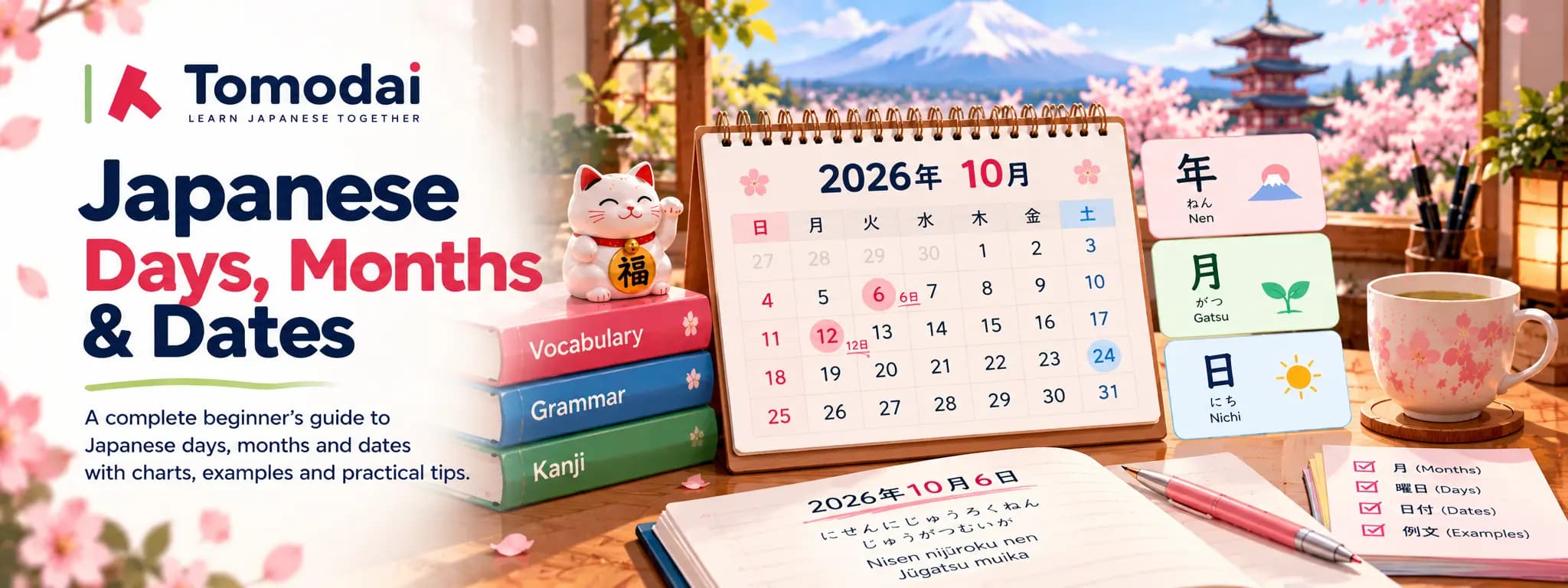
Japanese dates strictly follow the macro-to-micro hierarchical order: Year (年) → Month (月) → Day (日). For example, October 6, 2026 is written as 2026年10月6日 (にせんにじゅうろくねん じゅうがつ むいか). Months simply combine a number with 月, while days 1–10, 14, 20, and 24 use special native Japanese readings.
Dates appear surprisingly often when you use Japanese outside a textbook. Whether you are booking a Tokyo hotel, reserving a table at an izakaya, scheduling Shinkansen train tickets, stating your birthday, or reading a JLPT N5 listening prompt, knowing how to express calendar dates accurately is essential.
For beginner and JLPT N5 learners, dates are an incredible milestone because they synthesize multiple foundational skills: counting systems, Kanji recognition, phonetic sound-shifts, counters, and natural conversational cadence. The secret to mastering Japanese dates is not memorizing 31 isolated words at once. Instead, anchor yourself to the core formula, master the months, and isolate the small group of traditional day readings.
The Golden Rule of Japanese Dates
Always organize from largest to smallest unit
Where You Will Use Japanese Dates
Dates are embedded in everyday real-world interactions throughout Japan:
How Japanese Dates Work
In English, date order varies wildly: American English prefers Month/Day/Year (e.g., October 6, 2026), while British English prefers Day/Month/Year (6 October 2026). Japanese, however, is strictly uniform and follows ISO standard logical progression:
Japanese Months 1–12 (月)
Base: Number + がつUnlike English, which uses distinct Latin names (January, February, March...), Japanese months are wonderfully simple: Number (1–12) + 月 (gatsu). You only need to memorize three pronunciation exceptions: April, July, and September.
| Month | Kanji | Hiragana | Romaji | Reading Notes |
|---|---|---|---|---|
| January | 1月 | いちがつ | Ichigatsu | Regular ($1 + がつ$) |
| February | 2月 | にがつ | Nigatsu | Regular ($2 + がつ$) |
| March | 3月 | さんがつ | Sangatsu | Regular ($3 + がつ$) |
| April | 4月 | しがつ | Shigatsu | ⚠️ Special: Uses shi (Never say "yongatsu") |
| May | 5月 | ごがつ | Gogatsu | Regular ($5 + がつ$) |
| June | 6月 | ろくがつ | Rokugatsu | Regular ($6 + がつ$) |
| July | 7月 | しちがつ | Shichigatsu | ⚠️ Special: Uses shichi (Never say "nanagatsu") |
| August | 8月 | はちがつ | Hachigatsu | Regular ($8 + がつ$) |
| September | 9月 | くがつ | Kugatsu | ⚠️ Special: Uses ku (Never say "kyūgatsu") |
| October | 10月 | じゅうがつ | Jūgatsu | Regular ($10 + がつ$) |
| November | 11月 | じゅういちがつ | Jūichigatsu | Regular ($11 + がつ$) |
| December | 12月 | じゅうにがつ | Jūnigatsu | Regular ($12 + がつ$) |
Although 4 is usually よん (yon), April exclusively takes the Sino-Japanese reading し (shi). Never say "yongatsu".
Although 7 is often なな (nana), July strictly uses しち (shichi). Never say "nanagatsu".
Although 9 is usually きゅう (kyū), September uses the shorter reading く (ku). Never say "kyūgatsu".
Days of the Week (曜日)
Formula: [Kanji] + 曜日The suffix for day of the week is 曜日 (yōbi). The seven days correspond to celestial bodies and the five classical elements (wood, fire, earth, metal, water). Connecting each weekday with its natural element makes memorization virtually effortless:
How to Ask About Weekdays: 何曜日
"What day of the week is it today?"
"What day of the week is tomorrow?"
Japanese Days of the Month: 1st–31st
13 Irregular DaysHere is the core crux of Japanese calendar learning. While standard days use [Number] + 日 (nichi), the days from the 1st to the 10th, plus the 14th, 20th, and 24th, preserve traditional native Japanese (Yamato kotoba) readings:
| Date | Kanji | Hiragana | Romaji | Type | Date | Kanji | Hiragana | Romaji | Type |
|---|---|---|---|---|---|---|---|---|---|
| 1st | 1日 | ついたち | Tsuitachi | ⚠️ Special | 17th | 17日 | じゅうしちにち | Jūshichi-nichi | Regular |
| 2nd | 2日 | ふつか | Futsuka | ⚠️ Special | 18th | 18日 | じゅうはちにち | Jūhachi-nichi | Regular |
| 3rd | 3日 | みっか | Mikka | ⚠️ Special | 19th | 19日 | じゅうくにち | Jūku-nichi | Regular |
| 4th | 4日 | よっか | Yokka | ⚠️ Special | 20th | 20日 | はつか | Hatsuka | ⚠️ Special |
| 5th | 5日 | いつか | Itsuka | ⚠️ Special | 21st | 21日 | にじゅういちにち | Nijūichi-nichi | Regular |
| 6th | 6日 | むいか | Muika | ⚠️ Special | 22nd | 22日 | にじゅうににち | Nijūni-nichi | Regular |
| 7th | 7日 | なのか | Nanoka | ⚠️ Special | 23rd | 23日 | にじゅうさんにち | Nijūsan-nichi | Regular |
| 8th | 8日 | ようか | Yōka | ⚠️ Special | 24th | 24日 | にじゅうよっか | Nijūyokka | ⚠️ Special (yokka) |
| 9th | 9日 | ここのか | Kokonoka | ⚠️️ Special | 25th | 25日 | にじゅうごにち | Nijūgo-nichi | Regular |
| 10th | 10日 | とおか | Tōka | ⚠️ Special | 26th | 26日 | にじゅうろくにち | Nijūroku-nichi | Regular |
| 11th | 11日 | じゅういちにち | Jūichi-nichi | Regular | 27th | 27日 | にじゅうしちにち | Nijūshichi-nichi | Regular |
| 12th | 12日 | じゅうににち | Jūni-nichi | Regular | 28th | 28日 | にじゅうはちにち | Nijūhachi-nichi | Regular |
| 13th | 13日 | じゅうさんにち | Jūsan-nichi | Regular | 29th | 29日 | にじゅうくにち | Nijūku-nichi | Regular |
| 14th | 14日 | じゅうよっか | Jūyokka | ⚠️ Special (yokka) | 30th | 30日 | さんじゅうにち | Sanjū-nichi | Regular |
| 15th | 15日 | じゅうごにち | Jūgo-nichi | Regular | 31st | 31日 | さんじゅういちにち | Sanjūichi-nichi | Regular |
| 16th | 16日 | じゅうろくにち | Jūroku-nichi | Regular | |||||
Do not tackle 1–31 in a single unorganized block. Split them into 3 bite-sized rhyming subsets:
How to Say Complete Dates Aloud
When putting together a complete date, simply read each block in sequence: Year + 年 → Month + 月 → Day + 日. Notice how irregular day readings retain their unique pronunciations:
Asking About Dates & Days
A critical mistake beginners make is confusing 何日 (which date) with 何曜日 (which weekday). Master this clear distinction:
"What is today's date?" (e.g., 10月6日です / It is October 6th).
"What day of the week is it today?" (e.g., 火曜日です / It is Tuesday).
"When is your birthday?"
"What date is the meeting scheduled for?"
5 Real-Life Japanese Date Dialogues
Observe how dates naturally appear in everyday conversations across Japan:
"What is today's date?"
"It is October 6th."
"When is your birthday?"
"It is August 20th."
"What date is the reservation?"
"June 14th."
"When is the event?"
"It is May 8th."
"Is your reservation date October 24th?"
"Yes, that is correct."
9 Common Date Mistakes to Avoid
Reading 1日 as "Ichi-nichi"
Wrong: 1月1日 = ichigatsu ichi-nichi.
Fix: The 1st day of the month is always 一日 (Tsuitachi). Ichi-nichi means "one day duration."
Saying "Yongatsu" for April
Wrong: 4月 = yongatsu.
Fix: April exclusively uses 四月 (Shigatsu).
Saying "Nanagatsu" for July
Wrong: 7月 = nanagatsu.
Fix: July is exclusively 七月 (Shichigatsu).
Saying "Kyūgatsu" for September
Wrong: 9月 = kyūgatsu.
Fix: September is 九月 (Kugatsu) with the short sound.
Confusing 何日 & 何曜日
Wrong: Treating both as interchangeable.
Fix: 何日 asks for the numeric date; 何曜日 asks for the weekday.
Confusing 日 and 曜日
Wrong: Mixing the character markers.
Fix: 日 is date/sun; 曜日 specifically denotes the full weekday (e.g. 月曜日).
Guessing Days 1–10 Mechanically
Wrong: Saying *san-nichi* or *roku-nichi*.
Fix: Memorize the native set: tsuitachi, futsuka, mikka, yokka, itsuka, muika, nanoka, yōka, kokonoka, tōka.
Missing 14, 20, and 24 Exceptions
Wrong: Saying *jūyon-nichi* or *nijū-nichi*.
Fix: 14日 = じゅうよっか; 20日 = はつか; 24日 = にじゅうよっか.
Reversing the Macro Order
Wrong: Speaking Month before Year (e.g. 10月2026年).
Fix: Japanese strictly orders Year → Month → Day (2026年10月6日).
Essential Japanese Date & Time Vocabulary
JLPT N5 Core| Kanji | Hiragana | Romaji | English Meaning |
|---|---|---|---|
| 年 | ねん | Nen | Year |
| 月 | つき / がつ | Tsuki / Gatsu | Month / Moon |
| 日 | ひ / にち | Hi / Nichi | Day / Sun / Date |
| 曜日 | ようび | Yōbi | Day of the week |
| 今日 | きょう | Kyō | Today |
| 昨日 | きのう | Kinō | Yesterday |
| 明日 | あした | Ashita | Tomorrow |
| 今週 | こんしゅう | Konshū | This week |
| 来週 | らいしゅう | Raishū | Next week |
| 先週 | せんしゅう | Senshū | Last week |
| 今月 | こんげつ | Kongetsu | This month |
| 来月 | らいげつ | Raigetsu | Next month |
| 先月 | せんげつ | Sengetsu | Last month |
| 今年 | ことし | Kotoshi | This year |
| 来年 | らいねん | Rainen | Next year |
| 去年 | きょねん | Kyonen | Last year |
| 誕生日 | たんじょうび | Tanjōbi | Birthday |
| 予定 | よてい | Yotei | Plan / Schedule |
| 平日 | へいじつ | Heijitsu | Weekday |
| 休日 | きゅうじつ | Kyūjitsu | Holiday / Day off |
| 予約 | よやく | Yoyaku | Reservation / Booking |
| 生年月日 | せいねんがっぴ | Seinengappi | Date of birth (Official forms) |
Practice: Can You Read & Say These Dates?
Test your recall without looking back at the reference tables. Click each card to reveal the authentic answer:
Q1: January in Japanese? Reveal ▼
Q2: July in Japanese? ⚠️ Reveal ▼
Q3: Monday in Japanese? Reveal ▼
Q4: How do you read 3日? ⚠️ Reveal ▼
Q5: How do you read 8日? ⚠️ Reveal ▼
Q6: How do you read 14日? ⚠️ Reveal ▼
Q7: How do you read 20日? ⚠️ Reveal ▼
Q8: How do you read 24日? ⚠️ Reveal ▼
Q9: Meaning of 10月? Reveal ▼
Q10: Meaning of 金曜日? Reveal ▼
Q11: Translate "今日は何曜日ですか" Reveal ▼
Q12: Translate "今日は何月何日ですか" Reveal ▼
Q13: "October 6, 2026" in Japanese? Reveal ▼
Q14: "August 20, 2026" in Japanese? Reveal ▼
Q15: "My birthday is Aug 20th" Reveal ▼
The 7-Day Japanese Dates Mastery Plan
Spend 10 to 15 focused minutes each day to lock Japanese dates permanently into your long-term memory:
| Day | Daily Focus | Action Steps & Drills |
|---|---|---|
| Day 1 | Months (1月–12月) | Recite 1–12 with がつ. Emphasize the 3 exceptions: 4月 (shigatsu), 7月 (shichigatsu), 9月 (kugatsu). |
| Day 2 | Weekdays (曜日) | Memorize the 7 elemental Kanji (Moon, Fire, Water, Wood, Gold, Earth, Sun) and recite 月曜日 through 日曜日. |
| Day 3 | Days 1st to 10th | Isolate native readings: tsuitachi, futsuka, mikka, yokka, itsuka, muika, nanoka, yōka, kokonoka, tōka. |
| Day 4 | Days 11th to 31st | Learn standard number + にち patterns. Lock down the 3 outliers: 14日 (jūyokka), 20日 (hatsuka), 24日 (nijūyokka). |
| Day 5 | Years & Full Dates | Practice full [Year]年 [Month]月 [Day]日 formulas aloud for your birthday and major Japanese holidays. |
| Day 6 | Asking Date Questions | Drill asking 何月何日ですか and 何曜日ですか. Answer aloud immediately. |
| Day 7 | Live Speed Drills | Open a blank calendar. Point to 10 random squares and state the complete Japanese date without pausing. |
Frequently Asked Questions
1. How do you say dates in Japanese? ▼
Japanese dates follow the hierarchical sequence: Year (年) → Month (月) → Day (日). For example, October 6, 2026 is expressed as 2026年10月6日 (Nisen nijūroku-nen jūgatsu muika).
2. What is the standard written Japanese date format? ▼
The standard format is YYYY年MM月DD日. You will see this format across Japanese hotel confirmations, receipts, calendars, and government immigration forms.
3. How do you say January to December in Japanese? ▼
4. How do you say Monday through Sunday in Japanese? ▼
5. Why are some Japanese dates irregular? ▼
Days 1 through 10, plus 14, 20, and 24, preserve traditional native Japanese (Yamato kotoba) vocabulary that existed before Sino-Chinese counting was imported into Japan. That is why the 1st is tsuitachi rather than ichi-nichi.
6. How do you say the 1st of the month in Japanese? ▼
The 1st of any month is 一日 (Tsuitachi), derived historically from tsukitachi (moon rising). Never read calendar dates as ichi-nichi (which strictly means a duration of "one day").
7. How do you say the 20th in Japanese? ▼
The 20th is 二十日 (Hatsuka). It is one of the most distinctive irregular dates and must be memorized as an independent vocabulary word.
8. How do you ask today's date in Japanese? ▼
Ask: 今日は何月何日ですか。 (Kyō wa nan-gatsu nan-nichi desu ka?).
9. What is the difference between 何日 (nan-nichi) and 何曜日 (nan-yōbi)? ▼
何日 (なんにち) asks for the numeric day of the month (e.g., the 6th, the 14th). 何曜日 (なんようび) asks for the specific day of the week (e.g., Monday, Friday).
10. Do I need to memorize all 31 Japanese date readings at once? ▼
No! Prioritize the 13 special readings first: 1–10, 14, 20, and 24. All remaining days follow a predictable number + nichi formula.
11. How do you state your birthday in Japanese? ▼
Use the pattern: 誕生日は [Month]月 [Day]日 です。 For example: 誕生日は8月20日です (Tanjōbi wa hachigatsu hatsuka desu / My birthday is August 20th).
12. What order are dates written in Japanese? ▼
Japanese dates consistently proceed from broadest to most specific: Year → Month → Day (e.g., 2026年10月6日).
Key Takeaways
- • Japanese dates strictly follow Year → Month → Day (年 → 月 → 日).
- • Months simply use [Number] + 月, with 3 exceptions: 4月 (shigatsu), 7月 (shichigatsu), and 9月 (kugatsu).
- • Weekdays follow the [Kanji] + 曜日 formula based on celestial elements.
- • Days 1–10, 14, 20, and 24 use special native Japanese readings.
- • 何日 asks for the calendar date; 何曜日 asks for the weekday.
- • Saying today's full date aloud every morning turns abstract memory into spontaneous fluency.
Related Tomodai Lessons
Turn Japanese Dates into Fluent Conversation
Step beyond memorization. Experience Tomodai's interactive Japanese lessons, JLPT preparation pathways, AI speech practice, and personalized daily flashcards.
Learn with Confidence. Practice with Purpose. Grow One Lesson at a Time.
Pass the JLPT & Speak Confidently
Learn with structured N5–N1 grammar lessons, intelligent SRS flashcards, and instant real-time conversational practice with AI Sensei.