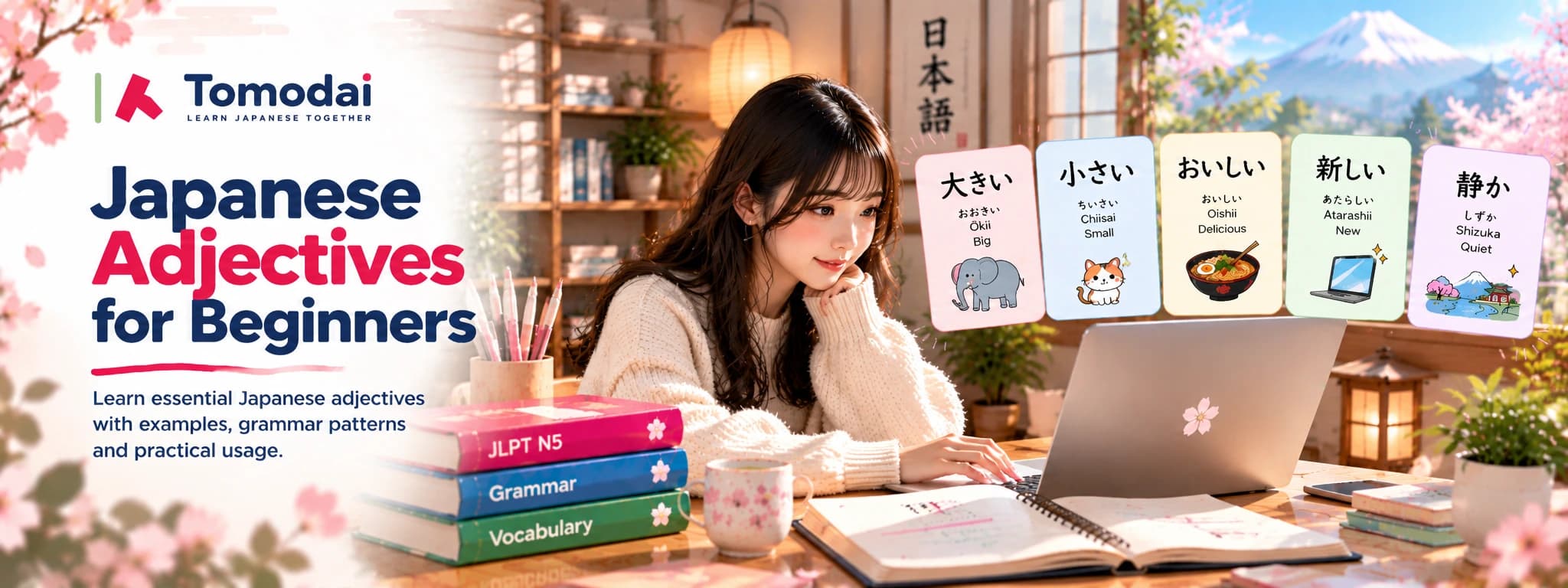
Japanese adjectives are divided into two distinct grammatical classes: い-adjectives (such as 大きい and 高い) and な-adjectives (such as 静か and 便利). い-adjectives attach directly to nouns and conjugate by altering their ending (〜くない, 〜かった), whereas な-adjectives require the connective particle な before a noun and change their following auxiliary verb (ではありません, でした).
1. What Are Japanese Adjectives?
Moving beyond basic labeling into nuanced personal expression
In Japanese, an adjective describes a person, place, physical object, taste, feeling, or past experience. Without adjectives, your speech is limited to bare identification: "This is a book." With adjectives, your Japanese immediately gains color and accuracy: "This is an interesting book," "Yesterday's ramen was delicious," or "Kyoto is quiet and beautiful."
Japanese adjectives function in two structural positions: they can modify a noun directly (attributive position) or act as the predicate at the end of a clause (predicative position). As detailed by communicative frameworks from the Japan Foundation, learning an adjective's grammatical category alongside its meaning is the secret to natural sentence generation.
"This book is new."
"This town is quiet." (Note: No な before です!)
2. The Two Main Types: い-Adjectives vs. な-Adjectives
Understanding structural behavior, morphology, and irregular exceptions
2.1 い-Adjectives (形容詞)
い-adjectives end in the native okurigana syllable い (i) in dictionary form. They function almost like verbs: the adjective itself inflects to express negation (〜くない) and past tense (〜かった).
2.2 な-Adjectives (形容動詞)
な-adjectives are linguistically adjectival nouns. The root itself does not change. When placed directly before a noun, you must insert the connective particle な (na). Their tenses are formed by conjugating the auxiliary copula (でした, ではありません).
While the present dictionary form is いい (ii), all inflections revert to its classical historical root 良い (yoi):
Is good
Not *ikunai
Was good
Do not classify adjectives solely by the final English letter "i". Words like きれい (kirei / 綺麗) and 嫌い (kirai) end with the sound "i", but they are strictly な-adjectives:
3. How to Use Japanese Adjectives Before Nouns
Attributive positioning: Direct attachment vs. the connective な
Place the dictionary form directly before the noun. Never insert な:
The connective particle な acts as grammatical glue between the adjectival stem and the noun:
4. Complete Adjective Conjugation Matrices
Mastering the 4 core tense-polarity states: Positive, Negative, Past, Past-Negative
| Tense & Polarity | い-Adjective: 高い (Expensive) | な-Adjective: 静か (Quiet) | Inflection Rule |
|---|---|---|---|
| Present Positive (Is...) | 高いです takai desu | 静かです shizuka desu | Root + です |
| Present Negative (Is not...) | 高くないです takakunai desu | 静かではありません shizuka dewa arimasen | い → くない / な → ではない |
| Past Positive (Was...) | 高かったです takakatta desu | 静かでした shizuka deshita | い → かった / です → でした |
| Past Negative (Was not...) | 高くなかったです takakunakatta desu | 静かではありませんでした shizuka dewa arimasen deshita | い → くなかった / ではありませんでした |
5. 36 High-Frequency Adjectives (By Category)
Core vocabulary tested across JLPT N5 and everyday Japanese travel
5.1 Size & Appearance
| Adjective | Romaji | English | Type |
|---|---|---|---|
| 大きい | ōkii | Big; large | い |
| 小さい | chiisai | Small; little | い |
| 長い | nagai | Long | い |
| 短い | mijikai | Short | い |
| 新しい | atarashii | New | い |
| 古い | furui | Old (objects) | い |
| きれい | kirei | Beautiful; clean | な |
| かわいい | kawaii | Cute; adorable | い |
5.2 Feelings & Personality
| Adjective | Romaji | English | Type |
|---|---|---|---|
| 楽しい | tanoshii | Fun; enjoyable | い |
| 悲しい | kanashii | Sad | い |
| 優しい | yasashii | Kind; gentle | い |
| 忙しい | isogashii | Busy | い |
| 元気 | genki | Energetic; well | な |
| 静か | shizuka | Quiet; peaceful | な |
| 好き | suki | Liked; fond of | な |
| 嫌い | kirai | Disliked; hated | な |
5.3 Food & Taste
| Adjective | Romaji | English | Type |
|---|---|---|---|
| おいしい | oishii | Delicious | い |
| まずい | mazui | Bad-tasting | い |
| 甘い | amai | Sweet | い |
| 辛い | karai | Spicy; hot | い |
| 苦い | nigai | Bitter | い |
| 熱い | atsui | Hot (food/touch) | い |
| 冷たい | tsumetai | Cold (food/touch) | い |
5.4 Price & Quality
| Adjective | Romaji | English | Type |
|---|---|---|---|
| 高い | takai | Expensive; high | い |
| 安い | yasui | Inexpensive; cheap | い |
| 簡単 | kantan | Easy; simple | な |
| 難しい | muzukashii | Difficult; hard | い |
| 面白い | omoshiroi | Interesting; funny | い |
| つまらない | tsumaranai | Boring | い |
| 便利 | benri | Convenient | な |
| 有名 | yūmei | Famous | な |
5.5 Weather & Everyday Life
| Adjective | Romaji | English | Nuance & Usage Note | Type |
|---|---|---|---|---|
| 暑い | atsui | Hot (weather/climate) | Used for environmental air temperature (contrast with 熱い) | い |
| 寒い | samui | Cold (weather/climate) | Used for winter weather (contrast with 冷たい) | い |
| 暖かい | atatakai | Pleasantly warm | Spring weather or warm hospitality | い |
| 涼しい | suzushii | Pleasantly cool | Refreshing autumn breeze | い |
| いい(良い) | ii / yoi | Good; fine; pleasant | Irregular: negative is よくない, past is よかった | い (変) |
| 悪い | warui | Bad; poor; inferior | Opposite of いい | い |
| 大変 | taihen | Tough; serious; grave | Describes difficult hardships or hectic situations | な |
| 親切 | shinsetsu | Kind; accommodating | Used for helpful people, doctors, or locals | な |
6. How to Build Japanese Sentences with Adjectives
Four modular syntax formulas for daily conversation
The topic particle は (wa) marks the subject being described:
Omit the な syllable when the な-adjective sits directly before the polite copula です:
Embed the description directly inside a noun phrase:
Turn any adjectival statement into an inquiry without altering word order:
7. Adjectives in Realistic Everyday Conversations
Practical dialogues showing inflection in dining, shopping, and travel
8. 10 Common Adjective Mistakes to Avoid
Critical traps in JLPT testing, speech, and composition
Adding な after an い-adjective
大きいな犬 is incorrect. い-adjectives modify directly: 大きい犬 (ōkii inu).
Forgetting な before a noun
便利アプリ lacks the connective glue. Say 便利なアプリ (benri na apuri).
Adding な before です
この町は静かなです is ungrammatical. Drop な before copulas: 静かです.
Treating きれい as an い-adjective
きれい ends in "i", but its Kanji is 綺麗. It is a な-adjective: きれいな花, not *きれいくない.
Conjugating いい as いくない
*いくない does not exist. The negative of いい is always よくないです (yokunai desu).
Using くない on な-adjectives
*静かくない is wrong. な-adjectives use copula negatives: 静かではありません.
9. Useful Adjective Patterns for Fluent Everyday Speech
Connecting multiple descriptors and adding intensity
Drop the final い and add くて (kute) to link multiple qualities:
Attach で (de) directly to the な-adjective stem:
10. Practice Exercises & Verified Answer Key
Click any exercise card to reveal the authentic answer and grammatical breakdown
01 Exercise 1: Identify the Adjective Type (高い, 静か, きれい, おいしい, 便利) ▼
Answer: 1. 高い = い-adjective | 2. 静か = な-adjective | 3. きれい = な-adjective (Ends in "i" but is な!) | 4. おいしい = い-adjective | 5. 便利 = な-adjective.
02 Exercise 2: Complete the Sentence (新しくな vs 新しい / 静かな vs 静か) ▼
6. この本は 新しい (a) です。 (Directly before です)
7. この町は 静か (b) です。 (Remove な before です)
8. この料理は おいしくない (a) です。 (Negative い-adjective form)
9. 昨日は 寒かった (b) です。 (Past tense of 寒い)
03 Exercise 3 & 4: Convert to Negative & Past Tenses ▼
11. このかばんは高いです。 → このかばんは高くないです。 (takakunai desu)
12. この部屋は広いです。 → この部屋は広くないです。 (hirokunai desu)
13. この町は静かです。 → この町は静かではありません。 (shizuka dewa arimasen)
14. このケーキはおいしいです。 → このケーキはおいしかったです。 (oishikatta desu)
15. この店は便利です。 → この店は便利でした。 (benri deshita)
04 Exercise 8: Reading Comprehension Mini-Passage ▼
Q1: Is the room big or small? → Small (小さい).
Q2: Is the desk new? → Yes, it is new (新しい机).
Q3: Is the room noisy or quiet? → It is quiet (静かで、とても便利).
Q4: Identify one い-adj and one な-adj: → い-adj: 小さい / 新しい; な-adj: きれい / 静か / 便利.
11. Seven-Day Japanese Adjectives Study Plan
A structured 15-minute daily progression to permanent grammar mastery
Positive Forms & Attributes
Master 10 core い-adjectives. Describe 5 objects in your immediate room using [Noun] は [Adj] です.
Connective な & Predicates
Practice 静か, 便利, 有名, and きれい. Pair each with a noun (静かな部屋) and as a predicate (部屋は静かです).
Side-by-Side Distinction
Review both groups together. Write 5 noun phrases with い-adjectives and 5 with な-adjectives without mixing rules.
Inflecting 〜くない vs 〜ではない
Convert 5 positive statements into negative polite form. Pay close attention to irregular よくないです.
Past Positive & Past Negative
Inflect words into 〜かったです and 〜でした. Describe yesterday's weather, dinner, and study session.
Connecting with 〜くて & 〜で
Read Section 7 dialogues aloud. Combine two descriptors into compound clauses (広くて明るい).
Live Oral Review
Without looking at notes: conjugate 3 い-adjectives and 3 な-adjectives across all 4 tenses, then describe your day aloud in 5 sentences.
12. Frequently Asked Questions
Authoritative explanations for common grammatical dilemmas
What is the fundamental difference between い-adjectives and な-adjectives? ▼
い-adjectives act like verbs; they conjugate by altering the adjective's final okurigana syllable (高くない, 高かった). な-adjectives act as adjectival nouns; the word stem remains unchanged while the following auxiliary copula inflects (静かではありません, 静かでした).
Why is いい (ii) irregular when conjugated? ▼
The modern word いい derives historically from 良い (yoi). While the present affirmative can use ii, all inflected forms strictly utilize the yoi stem: negative is よくないです and past is よかったです. Forms like *ikunai do not exist.
Why does きれい (kirei) take な before a noun? ▼
Because きれい (Kanji: 綺麗) is grammatically a な-adjective despite ending in the sound "i". When directly describing a noun, it strictly requires the connective particle: きれいな部屋 (a clean/beautiful room).
Can Japanese adjectives be used without です? ▼
Yes. In casual Japanese speech among friends, 暑い! (Hot!) forms a complete predicate sentence on its own. For な-adjectives in casual speech, the plain copula だ replaces です (静かだ).
Key Takeaways for Japanese Learners
- • Always memorize an adjective's grammatical class (い vs な) alongside its English meaning.
- • い-adjectives modify nouns directly (大きい犬); な-adjectives require な (静かな町).
- • Never place な before です (静かです, not *静かなです).
- • Inflect い-adjectives directly: drop い for 〜くない (negative) and 〜かった (past).
- • Remember the two major traps: いい → よくない, and きれい → な-adjective.
- • Connect descriptions naturally using 〜くて for い-adjectives and 〜で for な-adjectives.
Related Tomodai Lessons & Guides
Curriculum RoadmapLearn Japanese with Confidence on Tomodai
Continue learning with structured lessons, interactive quizzes, spaced repetition, and real-time AI conversation practice.

Alex Chen
Alex Chen develops comprehensive study resources for learners preparing for the Japanese Language Proficiency Test (JLPT). His content covers grammar, vocabulary, kanji, mock tests, and exam strategies from JLPT N5 through N1. His goal is to help learners study efficiently while building practical Japanese skills beyond the exam. Areas of Expertise JLPT N5–N1 Exam Preparation Study Plans Mock Tests Curriculum Design
Pass the JLPT & Speak Confidently
Join thousands of learners mastering JLPT N5–N1 grammar with structured native breakdowns, intelligent spaced-repetition flashcards, and instant voice conversations with AI Sensei.