How to Learn Japanese: The Complete Beginner's Guide (2026)
 Emma Collins
Learning Japanese can look overwhelming at first glance.
Between three distinct writing systems, grammar structures that differ fundamentally from English, politeness levels, and thousands of Kanji characters, it is easy to wonder where to even begin.
The secret is simple: you do not need to learn everything at once.
A beginner needs a structured path far more than an avalanche of study materials. When you know what to tackle first, what to save for later, and how to practice consistently, Japanese becomes approachable and deeply rewarding.
This guide provides a comprehensive roadmap to take you from absolute zero to functional everyday communication and JLPT N5 readiness.
Why Are You Learning Japanese?
Your primary motivation will define how you should structure your study sessions:
- Travelers: Prioritize practical conversational phrases, directions, numbers, and basic listening comprehension.
- JLPT Aspirants: Focus on systematic grammar progression, vocabulary lists, Kanji recognition, and timed reading practice.
- Anime & Manga Fans: Emphasize listening comprehension, conversational nuance, and everyday casual expressions.
- Professionals: Concentrate on business etiquette, formal honorifics (Keigo), and workplace-specific vocabulary.
Action Tip: Write down your single primary reason for learning Japanese in one sentence. Keep it pinned near your study desk to maintain focus.
How Japanese Differs from English
Understanding these two core structural differences early will save you hours of confusion:
1. Three Writing Systems
Japanese combines three scripts:
- Hiragana: Used for grammatical particles, verb and adjective endings, and native Japanese words.
- Katakana: Used primarily for loanwords from other languages, foreign names, and onomatopoeia.
- Kanji: Logographic characters adopted from Chinese that represent whole words or root concepts.
Example:
- Japanese: 日本語(にほんご)
- Hiragana: にほんご
- Romaji: Nihongo
- Meaning: Japanese language
2. Sentence Structure (SOV)
English follows a Subject–Verb–Object order, whereas Japanese typically places the verb at the very end (Subject–Object–Verb):
- Japanese: 私は学生です。
- Hiragana: わたしはがくせいです。
- Romaji: Watashi wa gakusei desu.
- Literal order: I + student + am
- Meaning: I am a student.
Instead of translating word-by-word from English, learn to think directly in Japanese sentence patterns.
Step-by-Step Learning Roadmap
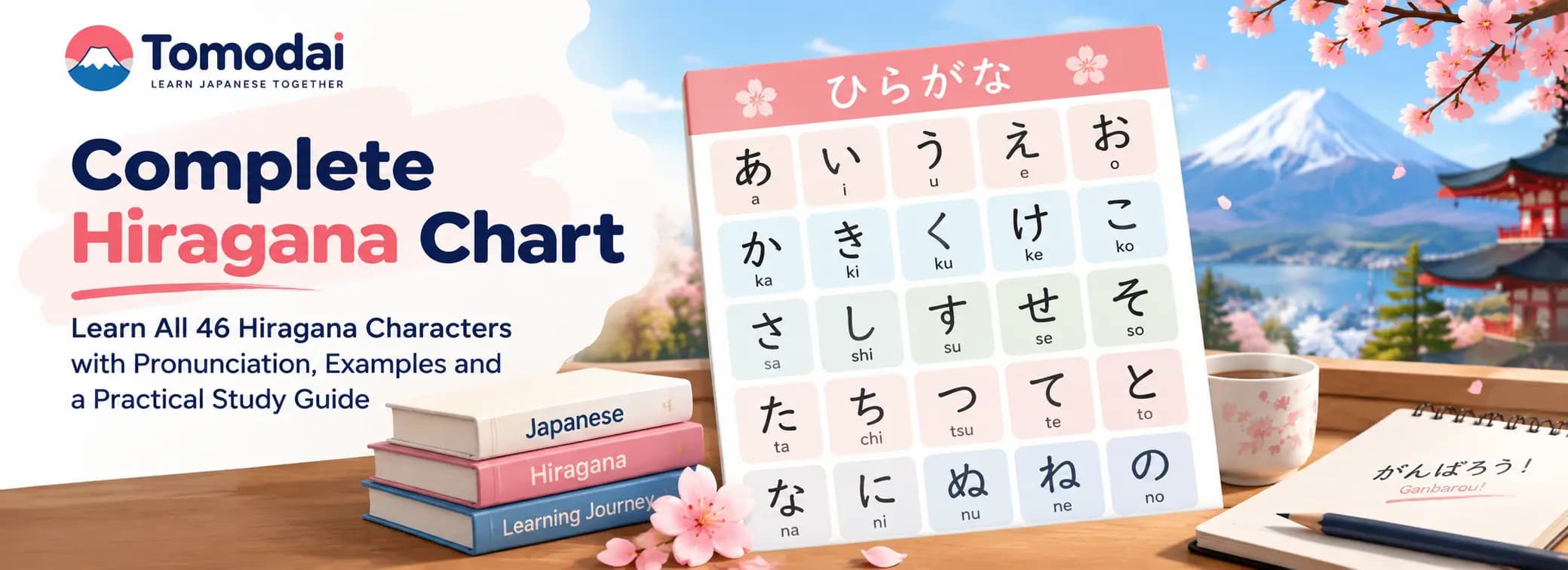
Step 1: Master Hiragana
Hiragana is the foundational phonetic alphabet of Japanese.
- How to learn: Tackle 5 to 10 characters per day. Write them by hand, pronounce each syllable aloud, and read simple words immediately rather than just staring at the chart.
- Goal: Aim for instant character recognition without needing to hesitate or translate through Romaji.
Step 2: Learn Katakana
Once Hiragana feels natural, move straight into Katakana. Katakana covers foreign loanwords that you will encounter constantly on menus, packaging, and digital interfaces.
- テレビ (terebi) — Television
- コンピューター (konpyuutaa) — Computer
Practice reading loanwords aloud; once you recognize the phonetic rules, Katakana becomes intuitive.
Step 3: Build Essential Daily Vocabulary
Avoid trying to memorize thousands of abstract terms right away. Group your vocabulary into practical categories:
Japanese | Hiragana | Romaji | Meaning |
日本語 | にほんご | Nihongo | Japanese language |
学生 | がくせい | Gakusei | Student |
先生 | せんせい | Sensei | Teacher |
友達 | ともだち | Tomodachi | Friend |
家 | いえ | Ie | House |
学校 | がっこう | Gakkou | School |
水 | みず | Mizu | Water |
食べる | たべる | Taberu | To eat |
飲む | のむ | Nomu | To drink |
行く | いく | Iku | To go |
見る | みる | Miru | To see / watch |
話す | はなす | Hanasu | To speak |
Pro Tip: Always study words inside simple sentences rather than in isolation:
- Sentence: 水を飲みます。 (Mizu o nomimasu.) — "I drink water."
Step 4: Learn Core Grammar Patterns
Do not get bogged down in dense academic terminology. Focus on simple, modular patterns:
- Stating identity / Equating things:
- 私はラギブです。 (Watashi wa Raghibu desu.) — "I am Raghib."
- Pattern:
[Topic] は [Description] です
- Indicating motion / Destination:
- 日本へ行きます。 (Nihon e ikimasu.) — "I am going to Japan."
- Pattern:
[Place] へ 行きます
Step 5: Introduce Kanji Organically
Do not try to memorize thousands of characters through rote brute-force. Learn Kanji through the words they form:
- 学 (Study / Learning)
- 学生 (gakusei) — Student
- 学校 (gakkou) — School
By studying Kanji within actual vocabulary, you learn the character, its contextual reading, and its real-world application simultaneously.
Step 6: Practice Active Listening & Shadowing
Reading skills often develop faster than listening comprehension. Balance this by practicing shadowing:
- Listen to a short, authentic audio line (e.g., おはようございます — "Good morning").
- Repeat it aloud immediately after the speaker, mimicking their pitch and rhythm.
- Keep audio sessions short, focused, and deliberate rather than relying only on passive background noise.
Step 7: Speak Early and Often
Do not wait until you feel "ready" to begin speaking. Train yourself to express basic thoughts with simple prompt-and-response questions:
- What did I eat today? $\rightarrow$ パンを食べました。 ("I ate bread.")
- Where am I going? $\rightarrow$ 学校へ行きます。 ("I am going to school.")
Step 8: Read Leveled Content
Reinforce vocabulary and syntax with graded reading:
- Begin with children's dialogues, bilingual graded readers, and simplified daily articles.
- Focus on grasping the overall context first before looking up every unfamiliar character.
A Realistic 40-Minute Daily Study Routine
Duration | Focus Area | Activity |
10 min | Spaced Repetition (SRS) | Review vocabulary and Kanji flashcards |
10 min | Grammar | Study one pattern and create 3 original sentences |
10 min | Listening | Shadowing practice with short dialogues |
5 min | Reading | Read a short passage, menu, or beginner dialogue |
5 min | Speaking | Speak aloud about your day using learned structures |
The 90-Day Beginner Plan
- Days 1–30 (Foundation): Master Hiragana and Katakana, basic pronunciation, greetings, numbers, and basic
A は B ですsentences. - Days 31–60 (Communication): Learn the top 30 common verbs, essential adjectives, foundational particles (
は,を,に,で,へ), and your first 50 Kanji. - Days 61–90 (Application): Read graded stories, practice short spoken self-introductions, write a daily two-sentence diary in Japanese, and begin JLPT N5 practice questions.
Frequently Asked Questions
Can I learn Japanese effectively on my own?
Yes. With structured resources, digital flashcards, spaced repetition systems, and audio tools, self-study is entirely practical. The key is staying consistent and producing output (speaking/writing), not just passive reading.
Should I rely on Romaji when starting out?
Use Romaji only for the first week to understand the sound system. Transition entirely to Hiragana as quickly as possible; relying on Romaji will significantly slow down your reading speed and pronunciation development.
Is passing JLPT N5 enough to hold a conversation?
JLPT N5 evaluates reading and listening comprehension, but it does not test active speaking or writing production. To become conversational, supplement your test prep with regular speaking and conversation practice.
Continue Learning with Tomodai
Ready to take your next step? Begin with Hiragana, progress through Katakana, and build your everyday Japanese toolkit with confidence.
Tomodai supports your path with:
- Structured, bite-sized lessons designed for steady retention
- Interactive vocabulary and Kanji practice
- Targeted grammar breakdowns and quizzes
- AI conversation practice to build spoken confidence from day one
Start your journey today and grow your Japanese one lesson at a time.
Pass the JLPT & Speak Confidently
Learn with structured N5–N1 grammar lessons, intelligent SRS flashcards, and instant real-time conversational practice with AI Sensei.