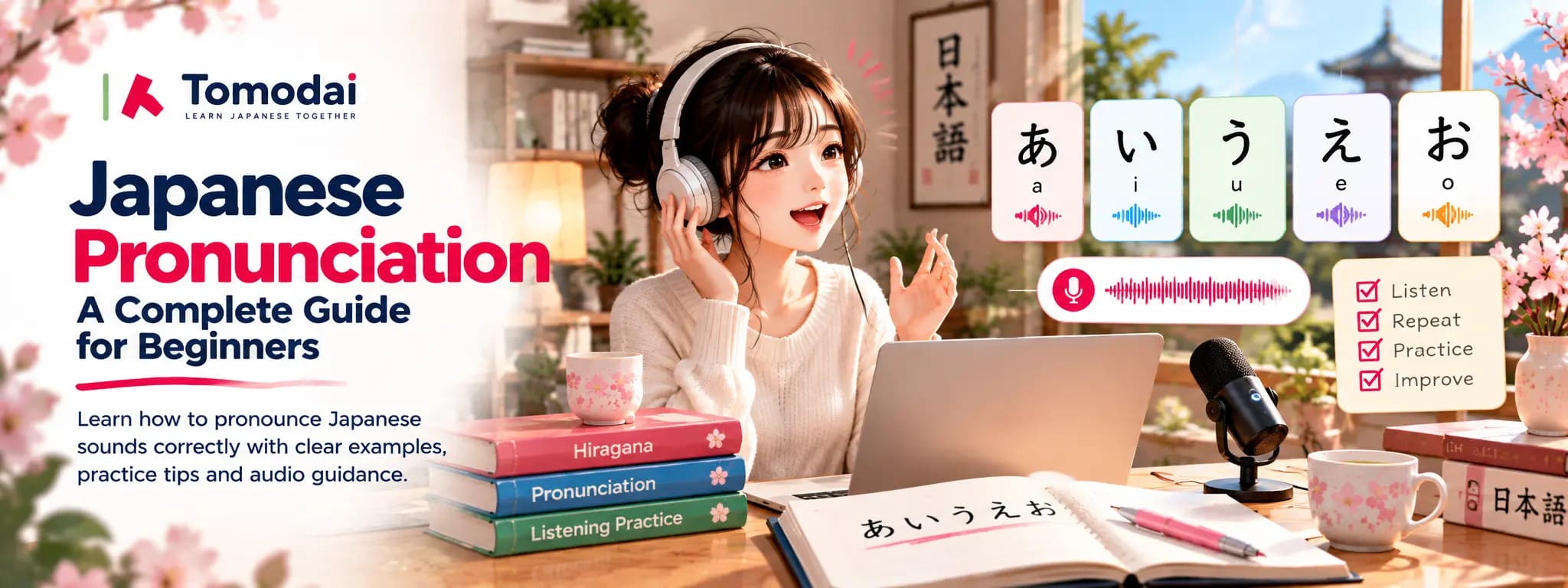
Japanese pronunciation is built upon five pure, steady vowels (あ, い, う, え, お) combined with regular consonants. Rather than English-style stress accent, Japanese speech relies on equal mora (拍) timing and high/low pitch patterns. Clear Japanese does not require imitating rapid native speech immediately; it requires holding pure vowels, honoring vowel lengths (長音), pausing for the small っ, and treating ん as a full beat of time.
You can memorize hundreds of Japanese vocabulary words and still feel nervous when you open your mouth to speak. You might read こんにちは (Konnichiwa) in a textbook, yet when a native speaker says it at a cafe in Shibuya, it sounds noticeably smoother, lighter, and rhythmic compared to an English speaker reading Roman letters aloud.
The reason is straightforward: Japanese pronunciation is not simply reading Romaji through English habits. English relies on heavily stressed syllables and changing vowel glides. Japanese, by contrast, uses a compact sound system where every syllable receives equal rhythmic weight. The secret to sounding clear is not having a "perfect accent" on day one—it is mastering five steady vowels, keeping your rhythm consistent, and respecting small pauses.
The Golden Rule of Japanese Pronunciation
Give every sound unit equal time and keep vowels completely steady
Why Japanese Pronunciation Matters
Timing = MeaningIn English, if you stretch a vowel or speak quickly, the word usually retains its core meaning. In Japanese, timing and sound length determine the dictionary definition. Altering the duration of a vowel or dropping a tiny pause turns one word into an entirely different concept:
Accidentally shortening the vowel turns someone's grandmother into their aunt!
The brief silence held in the small っ changes the verb into a physical postal stamp.
Dropping the crisp "ts" sound turns the moon into an expression of affection.
What Makes Japanese Pronunciation Approachable?
Despite these timing differences, Japanese is widely considered one of the cleanest phonetic languages in the world for beginners to pick up:
Only 5 Vowels
Unlike English, which contains over 15 to 20 vowel sounds and gliding diphthongs, Japanese operates with just five pure, unchanging vowels.
Phonetic Hiragana
Once you know Hiragana, you can sound out virtually any Japanese word accurately. Letters don't suddenly change sounds based on unpredictable spelling rules.
Consistent Grid Structure
Sounds follow a predictable Consonant + Vowel structure ($k + a = ka$, $s + a = sa$). There are no silent consonant clusters like English "knight" or "pterodactyl".
Manageable Challenges
The phonetic trouble spots are specific and finite: the ら-row, つ, ふ, small っ, and ん. Master these, and the entire phonetic system unlocks.
The Five Pure Vowels (母音)
Bedrock of All Japanese SoundsEvery single Japanese word (apart from the standalone nasal ん) ends in one of five vowels. In English, speakers constantly glide vowels (diphthongs), changing mouth shape halfway through the sound (e.g., "no" becomes "noh-oo"). Japanese vowels are completely pure, monophthongal, and steady from start to finish.
Open your mouth relaxed and vertical. Keep it clean, bright, and steady. Never turn it into the "a" in "cat" or "day".
Corners of the mouth pulled slightly outward. Short and crisp. Never glide into a trailing "y" sound.
Do not purse your lips forward like English "boot". Keep lips relaxed, flat, and unrounded with teeth lightly parted.
Crisp, mid-open vowel. Avoid letting it glide into "ay" like "play". Cut the sound off cleanly without shifting mouth shape.
Slightly round your lips, but do not curl them into an English "oh-oo" (boat). Produce a pure, static open "o".
When you see the Roman letter "a" on a page, your brain is conditioned to cycle through multiple English sounds (cat, car, came, call). In Japanese, "a" ALWAYS equals あ. The sooner you transition from Romanized letters to native Kana, the faster your mouth will produce genuine, natural Japanese sounds without foreign inflection.
The 5 Consonant Trouble Spots
Targeted ArticulationMost Japanese consonants ($k, s, t, n, h, m, y, w$) are intuitive for English speakers. However, five specific sounds require a different tongue or lip position. Mastering these five will instantly make your pronunciation sound natural to native speakers:
Never curl your tongue backward into your throat (retroflex) like the American word "red".
Never press the flat blade of your tongue against your front teeth for a sustained "L" like "light".
Lightly tap the tip of your tongue against the roof of your mouth just behind your upper teeth (the gum ridge), identical to the "tt" in American English "watter" or "butter".
Do not bite your lower lip with your upper teeth like English "food". Instead, bring your upper and lower lips close together without touching, and blow air gently through the slit—like blowing out a birthday candle.
Never say "too"! Beginners often drop the initial "ts" burst. It begins with the crisp dental release you make at the end of the English word "cats" or "heats", blending seamlessly into the unrounded Japanese vowel う.
Japanese does not have a "si" sound in its standard native syllabary. The tongue is positioned flat against the hard palate behind the upper teeth. It is softer and flatter than the rounded English "she".
There is no "ti" sound in standard Japanese. ち is produced with the tongue flat against the palate, making a crisp sound like "cheese" blended cleanly into the vowel い.
Long Vowels (長音) & Small っ (促音)
Timing ArchitectureTwo of the most crucial elements of clear Japanese pronunciation relate directly to holding or pausing sound. When native speakers listen to foreigners, shortened vowels and skipped pauses are the primary reasons words become unintelligible.
1. Long Vowels: Double the Beat
A long vowel must be held for exactly two full beats of time, never rushed. In Hiragana, this is represented by an additional vowel character (e.g., お父さん uses お・と・う・さ・ん = 5 beats). In Katakana, it is represented by the horizontal dash mark (ー).
2. Small っ (促音): The Glottal Stop
The miniature っ is silent. It acts as a musical rest—a glottal catch in your throat that doubles the following consonant and consumes one full beat of silence.
The Mysterious Sound ん (撥音)
One Full BeatThe character ん is the only consonant in Japanese that stands alone without a vowel. English speakers naturally try to pronounce it as a hard English "N" in every scenario. However, in authentic Japanese phonetics, ん adapts its mouth position depending on the sound immediately following it:
Lips close completely. さんぽ (Sanpo) sounds like "Sampo"; しんぶん (Shinbun) sounds like "Shimbum".
Tongue contacts the alveolar ridge behind teeth. せんせい (Sensei) sounds like a crisp "Sensei".
Back of the tongue contacts the soft palate (velar nasal). まんが (Manga) sounds like "Mahng-ga"; りんご (Ringo) like "Reeng-go".
Mouth remains slightly open while sound vibrates through nasal passage. 本 (Hon) and 日本 (Nihon).
Japanese Rhythm: The Metronome of Mora (拍)
Isochronous TimingEnglish is a stress-timed language: syllables contract and squeeze together to maintain a beat (e.g., "in-ter-est-ing" compresses to 3 beats). Japanese is a mora-timed language (モーラ拍): every single unit of sound receives an identical slice of time, like a ticking metronome.
Beat 1
Beat 2
Beat 3
Beat 1
Beat 2 (Silence!)
Beat 3
Beat 1
Beat 2 (Hold)
Beat 3
Beat 4 (Extension)
Pitch Accent (高低アクセント) for Beginners
High vs Low MelodyEnglish uses stress accent (making one syllable louder, longer, and heavier). Japanese uses pitch accent, where syllables are spoken with varying musical notes (High vs. Low pitch). While complex pitch dictionaries exist, beginners should never get paralyzed by technical notation. Use these practical guidelines:
Two Universal Rules of Tokyo Standard Pitch:
- • Rule 1: The 1st and 2nd morae of a word almost never have the same pitch. If beat 1 is Low, beat 2 is High (L-H). If beat 1 is High, beat 2 drops Low (H-L).
- • Rule 2: Once the pitch drops from High to Low inside a word, it never rises back up within that same word.
How Beginners Should Practice Pitch:
Follow the Japan Foundation's Irodori pedagogy: Listen → Notice the Melody → Shadow aloud. Do not stress about making errors in pitch; context ensures native speakers understand you 99% of the time as long as your vowel lengths and mora beats are accurate!
10 Common Pronunciation Mistakes to Avoid
Gliding English Vowels
Wrong: Turning "neko" into "neh-koh-oo".
Fix: Cut vowels cleanly. Stop all mouth movement immediately once the vowel sounds.
Shortening Long Vowels
Wrong: Saying "Tōkyō" as 2 fast beats (*Tok-yo*).
Fix: Give it all 4 full beats: と・う・きょ・う.
Skipping the Small っ Pause
Wrong: Pronouncing きって as continuous *kite*.
Fix: Freeze your tongue and vocal cords for one beat before the "te".
Retroflex English "R"
Wrong: Curling the tongue back for ラーメン.
Fix: Use the quick flap/tap on the gum ridge like "butter".
Pronouncing つ as "Too"
Wrong: Reading つき as *too-kee*.
Fix: Emphasize the "ts" affricate burst (like the end of cats).
Biting Lip for ふ
Wrong: Biting your lower lip like English "food".
Fix: Bring both lips close and blow softly through the center.
Heavy English Syllable Stress
Wrong: Punching one syllable loud (e.g., *a-RI-ga-to*).
Fix: Keep volume and duration even across all morae.
Treating ん as Fast English N
Wrong: Cutting ほん short in half a beat.
Fix: Allow ん its own independent rhythmic beat.
Permanent Romaji Crutch
Wrong: Reading Roman spellings for months.
Fix: Read pure Kana immediately to wire natural Japanese sounds.
Rushing Speech for "Fluency"
Wrong: Trying to speak rapid-fire before rhythm is stabilized.
Fix: Speak deliberately and at moderate speed. Clear timing is 100x more intelligible to native speakers than mumbled speed.
The 6-Step Pronunciation Practice Workflow
Active Audio DrillsDo not repeat a word 30 times without conscious listening. Use this proven 6-step loop supported by the Japan Foundation:
Audio only. No speaking.
Spot long vowels or っ.
Ditch Romaji text.
Tap the mora beat.
Speak along in unison.
Compare with model.
20 Essential Practice Words for Every Sound Feature
JLPT N5 Core Vocabulary| Kanji | Hiragana | Romaji | English Meaning | Key Pronunciation Focus |
|---|---|---|---|---|
| 日本 | にほん | Nihon | Japan | 3 even beats (ni-ho-n) |
| 日本語 | にほんご | Nihongo | Japanese language | ん acts as velar nasal before ご |
| こんにちは | こんにちは | Konnichiwa | Hello | Ending は is pronounced "wa" (5 beats) |
| ありがとう | ありがとう | Arigatō | Thank you | とう = long "o" (5 beats) |
| すみません | すみません | Sumimasen | Excuse me / Sorry | Even volume; no loud stress |
| 叔母さん | おばさん | Obasan | Aunt | Short vowel: 4 morae |
| 祖母さん | おばあさん | Obāsan | Grandmother | Long vowel: 5 morae |
| きて | きて | Kite | Come / Coming | Flowing 2 beats |
| 切手 | きって | Kitte | Stamp | Glottal pause on small っ (3 beats) |
| 学校 | がっこう | Gakkō | School | Contains both small っ and long vowel (4 beats) |
| 本 | ほん | Hon | Book | 2 full beats (ho-n) |
| 先生 | せんせい | Sensei | Teacher | 4 beats: se-n-se-i |
| りんご | りんご | Ringo | Apple | Light alveolar tap on "ri" (3 beats) |
| 月 | つき | Tsuki | Moon / Month | Crisp "tsu" release |
| 好き | すき | Suki | Like / Fond of | Vowel "u" is devoiced/whispered |
| 冬 | ふゆ | Fuyu | Winter | Soft bilabial breath on "fu" |
| これ | これ | Kore | This | Quick tongue flick on "re" |
| ラーメン | らーめん | Rāmen | Ramen | 4 beats: ra - [ー] - me - n |
| コーヒー | こーひー | Kōhī | Coffee | 4 beats: ko - [ー] - hi - [ー] |
| 東京 | とうきょう | Tōkyō | Tokyo | Contracted きょ counts as 1 beat; う adds 1 beat |
10 Real-Life Pronunciation Examples in Action
Observe how native speakers construct cadence across everyday expressions:
"Good morning." — Hold the よう as a two-beat long vowel. Don't say "oh-hi-yo".
"Thank you very much." — Ensure the とう is held long; keep volume level across all 10 beats.
"I speak Japanese." — Notice the nasal ん before ご. Never drop the particle を (pronounced "o").
"I am going to school." — Glottal stop in がっこう; directional particle へ is pronounced "e".
"Coffee, please." — Exactly 4 beats on コーヒー (ko-o-hi-i); do not pronounce like English "coffee".
"Hello, teacher." — せんせい is 4 beats. Give ん its own beat of time.
"The moon is beautiful, isn't it?" — Crisp initial "tsu" release on つき.
"Winter is cold." — Gentle bilabial breath on ふ; do not bite lip with teeth.
"I eat ramen." — Light gum-ridge tongue tap on ら, followed by the long vowel mark ー.
"What is this?" — Light alveolar flick on れ; question particle か has rising pitch intonation.
Interactive Pronunciation Self-Checks
Test Your RecallTest your understanding of sound mechanics and timing. Click each card to reveal the authentic answer:
Q1: How many beats is おばあさん? Reveal ▼
The extra あ gives grandmother one more beat than おばさん (4 beats).
Q2: What sound does small っ make? Reveal ▼
It does not make a "tsu" sound. It is a glottal pause holding one full beat of time before the following consonant.
Q3: How to position tongue for ら? Reveal ▼
Tap the tongue tip quickly against the gum ridge behind the upper teeth (like "tt" in American "butter"). Never curl the tongue like English R.
Q4: Why is つ different from す? Reveal ▼
つ begins with a tongue-tip stop against the teeth like the end of "cats". す is a smooth continuous "s" hiss.
Q5: How many beats is コーヒー? Reveal ▼
Both long vowel marks consume a full beat of rhythmic time.
Q6: How to pronounce ふ cleanly? Reveal ▼
Bring both lips near each other without touching and blow softly. Do not let upper teeth touch lower lip like English "f".
The 7-Day Japanese Pronunciation Action Plan
Spend 10 to 15 focused minutes each day to permanently rewire your articulators for natural Japanese:
| Day | Daily Focus | Action Steps & Drills |
|---|---|---|
| Day 1 | The 5 Pure Vowels | Recite あ・い・う・え・お. Check in mirror: eliminate mouth gliding; keep vowels completely steady. Record and listen. |
| Day 2 | The ら-Row Tap | Practice ら・り・る・れ・ろ using the gum ridge flap. Drill words: Rāmen, Kore, Sakura, Renraku. |
| Day 3 | Tricky Consonants (つ & ふ) | Drill つ (dental burst) vs す (hiss), and soft ふ (candle blow). Practice Tsuki, Tsukue, Fuyu, Tōfu. |
| Day 4 | Long Vowels (長音) | Drill pairs: 叔母さん (4) vs 祖母さん (5). Tap your desk once per beat. Hold vowels across Katakana words like コーヒー. |
| Day 5 | Small っ & Nasal ん | Drill glottal stops: きて (2) vs きって (3). Practice 学校 (4 beats). Hold ん as its own full timing unit. |
| Day 6 | Mora Rhythm & Shadowing | Select short native audio (e.g., おはようございます). Shadow immediately behind the speaker at equal volume without stress accent. |
| Day 7 | Self-Recording Audit | Record 5 complete sentences. Playback alongside native audio. Identify your two weakest sounds and repeat targeted drills. |
Frequently Asked Questions
1. Is Japanese pronunciation difficult for English speakers? ▼
Japanese pronunciation is actually very approachable because it has only five pure vowels and highly regular syllables. The main challenge for English speakers is adjusting to equal mora rhythm (timing), holding long vowels, and mastering the quick flap of the ら-row.
2. How many vowel sounds does Japanese have? ▼
Japanese has exactly five core vowels: あ (a), い (i), う (u), え (e), お (o). Unlike English vowels, which shift and glide mid-syllable, Japanese vowels are pure, steady monophthongs.
3. What is the Japanese ら (ra) sound, and how do I pronounce it? ▼
The Japanese ら-row is an alveolar tap. It is neither the American curled "R" nor the flat "L". It is produced by flicking the tip of the tongue lightly against the gum ridge behind the upper teeth, identical to the fast "tt" in the American pronunciation of "butter".
4. How do I pronounce つ (tsu) correctly? ▼
つ is an affricate consonant. Start with the "ts" burst you make at the end of English words like "cats" or "hits", and blend it directly into the unrounded Japanese vowel う. Never drop the "ts" sound into a simple "too".
5. What is the difference between ふ and English "fu"? ▼
English "F" requires your upper teeth to touch your lower lip. Japanese ふ is a bilabial fricative: your teeth do not touch your lip at all. You bring both lips close together and blow air gently through the center, as if blowing out a candle.
6. What does the small っ (sokuon) do? ▼
The small っ is silent. It represents a glottal stop—a rhythmic catch in your breath that doubles the consonant that follows and consumes one full beat of silence (e.g., きて = 2 beats; きって = 3 beats).
7. Why are Japanese long vowels so important? ▼
In Japanese, vowel length determines dictionary meaning. A short vowel takes 1 mora beat, while a long vowel takes 2 mora beats. Shortening a long vowel changes words completely (e.g., おばさん = aunt, whereas おばあさん = grandmother).
8. What is a "mora" (拍 / haku)? ▼
A mora is the fundamental unit of Japanese rhythm. Every basic Kana character, as well as the small っ, standalone ん, and long vowel extensions, counts as one equal beat of time on an imaginary metronome.
9. Does Japanese have pitch accent? ▼
Yes. Japanese uses pitch accent (patterns of high and low musical pitch) rather than English-style loud syllable stress. Beginners should build steady vowels and mora timing first, then develop pitch naturally through shadowing and active listening.
10. Should beginners avoid Romaji? ▼
Romaji is helpful for the first few days, but relying on it long-term causes your brain to apply English phonetics to Japanese words. Transitioning to Hiragana and Katakana within your first two weeks dramatically improves pronunciation accuracy.
11. What is "shadowing" and how does it help? ▼
Shadowing is an audio exercise where you speak aloud along with a native audio recording with a split-second delay. It trains your articulators, muscle memory, natural sentence cadence, and pitch melody simultaneously.
12. How does ん change depending on the word? ▼
ん naturally shifts mouth shape based on what follows: it sounds like "m" before $m, b, p$ (さんぽ / sampo), like "n" before $t, d, n$ (せんせい / sensei), and like "ng" before $k, g$ (りんご / ringo).
13. Do I need a perfect accent to be understood in Japan? ▼
No! Perfection is never the goal. Japanese speakers are remarkably patient and accommodating. As long as your vowels are steady and your mora rhythm is clear, you will be easily understood in everyday conversation.
14. What is the fastest way to improve daily? ▼
Record your voice for two minutes daily using your phone, tap out the beats on your desk, and compare your recording directly with native audio models. Self-monitoring bridges the gap between what you hear and what you say.
Japanese Pronunciation Cheat Sheet & Key Takeaways
Core Formula- 5 Pure Vowels: あ・い・う・え・お (Never glide into diphthongs).
- ら-row: Light alveolar tap behind teeth (like American butter).
- ふ: Bilabial breath (blowing out a candle; no teeth on lip).
- つ: Crisp affricate dental release ("ts" in cats).
- Equal Mora Timing: Every sound unit receives identical duration.
- Long Vowels (ー): Must be held for exactly 2 beats of time.
- Small っ: Consumes 1 beat of complete silence before a consonant.
- Nasal ん: Occupies its own beat and adapts phonetically.
Related Tomodai Lessons
Put Your Japanese Pronunciation into Practice
Step beyond memorization. Experience Tomodai's interactive Japanese lessons, JLPT preparation pathways, AI speech practice, and personalized daily flashcards.
Learn with Confidence. Practice with Purpose. Grow One Lesson at a Time.

Sophia Martinez
Sophia Martinez creates vocabulary lessons and conversation guides designed for everyday communication. Her articles introduce useful words and expressions in context, making it easier for learners to remember and confidently use Japanese in real-world situations. Areas of Expertise Japanese Vocabulary Everyday Conversation Pronunciation Daily Expressions Speaking Practice
Pass the JLPT & Speak Confidently
Join thousands of learners mastering JLPT N5–N1 grammar with structured native breakdowns, intelligent spaced-repetition flashcards, and instant voice conversations with AI Sensei.