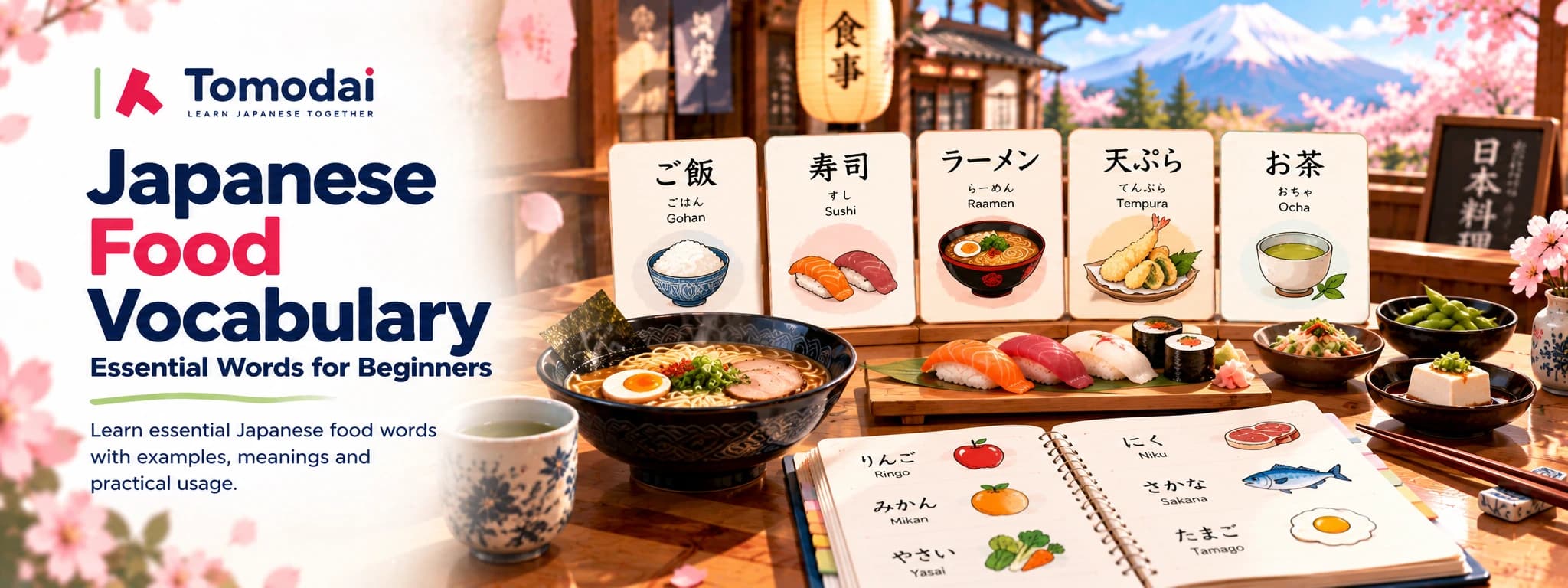
The most common Japanese food words include ご飯 (gohan, cooked rice or a meal), 水 (mizu, water), 肉 (niku, meat), 魚 (sakana, fish), 野菜 (yasai, vegetables), and 果物 (kudamono, fruit). To communicate naturally in restaurants or markets, pair these core ingredients with simple action verbs like 食べます (eat), 飲みます (drink), and polite ordering formulas like これをください (This, please).
1. Why Japanese Food Vocabulary Is Your Best Gateway to Fluency
Real-world communication starts with what is on your plate
Imagine stepping into a cozy neighborhood restaurant in Kyoto or Tokyo. You look at the menu and immediately recognize the Kanji for fresh salmon, spot your favorite soba noodles, and order iced green tea without reaching for your phone's translation app. These everyday victories make speaking Japanese feel instantly tangible and rewarding.
Learning food vocabulary is one of the fastest ways to build practical conversational confidence. Whether you are ordering lunch, shopping at Japanese supermarkets, navigating train station bento shops, or following recipes, food words tie directly into core grammar patterns and polite dining etiquette. As emphasized by language curricula from the Japan Foundation and online portals like Minato, mastering functional dining expressions equips you for authentic daily life in Japan.
The Food Learning Formula
Combine ingredient words with modular action frames
2. How Do You Say “Food” in Japanese? (The 4 Key Terms)
Understanding nuance: food, cuisine, cooked rice, and formal meals
In English, we use the word "food" for almost everything from raw apples to Michelin-star dinners. In Japanese, however, different terms capture specific culinary nuances:
The broad, everyday word for items people eat. Built from the verb 食べる (to eat) + 物 (thing).
What is your favorite food?
Refers to culinary traditions, prepared recipes, or the act of cooking when paired with する (料理をする = to cook).
I like Japanese cuisine.
Refers strictly to steamed/cooked white rice, but also stands for a "meal" in expressions like 朝ご飯 (breakfast).
I eat rice / I have a meal.
A more formal or structured term for dining or eating out, frequently seen on hotel schedules and restaurant announcements.
I have a meal / I dine.
3. Essential Japanese Food Vocabulary (By Category)
High-frequency ingredients and foods for supermarket shopping and dining
3.1 Rice, Grains & Staple Foods
Carbs & Staples| Kanji / Japanese | Hiragana | Romaji | English Meaning | Usage Note |
|---|---|---|---|---|
| 米 | こめ | kome | Uncooked raw rice | Bought in grocery bags |
| ご飯 | ごはん | gohan | Cooked rice / meal | Steamed rice served in bowls |
| パン | ぱん | pan | Bread | Loanword from Portuguese pão |
| 麺 | めん | men | Noodles (general) | Appears in ラーメン & つけ麺 |
| おにぎり | おにぎり | onigiri | Rice ball | Convenience store staple |
| うどん | うどん | udon | Thick wheat noodles | Served hot in dashi broth or chilled |
| そば | そば | soba | Buckwheat noodles | Thin, aromatic noodles |
| ラーメン | らーめん | rāmen | Ramen noodles | Written in Katakana with a long vowel |
3.2 Meat, Seafood & Eggs
Proteins| Kanji | Hiragana | Romaji | English Meaning | Example Compound |
|---|---|---|---|---|
| 肉 | にく | niku | Meat (general) | 肉料理 (meat dishes) |
| 鶏肉 | とりにく | toriniku | Chicken | 焼き鳥 (chicken skewers) |
| 牛肉 | ぎゅうにく | gyūniku | Beef | 牛丼 (beef bowl) |
| 豚肉 | ぶたにく | butaniku | Pork | 豚汁 (pork miso soup) |
| 魚 | さかな | sakana | Fish | 焼き魚 (grilled fish) |
| 鮭 | さけ / しゃけ | sake / shake | Salmon | 鮭おにぎり (salmon rice ball) |
| えび / 海老 | えび | ebi | Shrimp / Prawn | 海老天 (shrimp tempura) |
| 卵 / 玉子 | たまご | tamago | Egg | 卵焼き (rolled omelet) |
| 魚介類 | ぎょかいるい | gyokairui | Seafood (umbrella term) | Common on allergen warning labels |
3.3 Vegetables (野菜)
yasai| Japanese | Reading | English |
|---|---|---|
| にんじん | ninjin | Carrot |
| じゃがいも | jagaimo | Potato |
| 玉ねぎ | tamanegi | Onion |
| トマト | tomato | Tomato |
| キャベツ | kyabetsu | Cabbage |
| きゅうり | kyūri | Cucumber |
| きのこ | kinoko | Mushroom |
| ほうれん草 | hōrensō | Spinach |
3.4 Fruits (果物)
kudamono| Japanese | Reading | English |
|---|---|---|
| りんご | ringo | Apple |
| バナナ | banana | Banana |
| オレンジ | orenji | Orange |
| いちご | ichigo | Strawberry |
| ぶどう | budō | Grapes |
| すいか | suika | Watermelon |
| 桃(もも) | momo | Peach |
3.5 Dairy & Seasonings (調味料)
| 牛乳 | gyūnyū | Milk |
| チーズ | chīzu | Cheese |
| バター | batā | Butter |
| 豆腐 | tōfu | Tofu (soybean curd) |
| 味噌 | miso | Miso paste |
| 醤油 | shōyu | Soy sauce |
| 塩 | shio | Salt |
| 砂糖 | satō | Sugar |
3.6 Sweets & Snacks (お菓子)
| ケーキ | kēki | Cake (with long vowel ー) |
| チョコレート | chokorēto | Chocolate |
| アイスクリーム | aisukurīmu | Ice cream |
| 飴(あめ) | ame | Hard candy |
| クッキー | kukkī | Cookie (with small ッ and ー) |
| お菓子 | okashi | Sweets / snacks general |
4. 15 Popular Japanese Dishes You Will Encounter on Menus
Recognizing iconic meals on izakaya, restaurant, and festival menus
| Dish | Japanese | Romaji | Core Flavor Profile & Preparation |
|---|---|---|---|
| Sushi | 寿司 | sushi | Seasoned vinegared rice topped with seafood, egg, or vegetables. |
| Sashimi | 刺身 | sashimi | Delicately sliced premium raw fish or seafood, served with wasabi & soy sauce. |
| Ramen | ラーメン | rāmen | Wheat noodles in savory broth (shōyu, miso, tonkotsu, or shio) with toppings. |
| Udon | うどん | udon | Chewy thick wheat noodles served in mild dashi soup or chilled with dipping broth. |
| Soba | そば | soba | Thin buckwheat noodles served either steaming hot or chilled on a bamboo zaru. |
| Tempura | 天ぷら | tenpura | Seafood and fresh vegetables coated in light, crispy batter and quickly deep-fried. |
| Curry Rice | カレーライス | karē raisu | Thick, mildly sweet spiced Japanese curry stew served alongside steamed white rice. |
| Miso Soup | 味噌汁 | misoshiru | Traditional dashi soup flavored with fermented miso, wakame seaweed, and tofu. |
| Onigiri | おにぎり | onigiri | Triangular pressed rice cakes wrapped in crisp nori, stuffed with savory fillings. |
| Yakitori | 焼き鳥 | yakitori | Charcoal-grilled skewered chicken pieces basted in tare glaze or seasoned with salt. |
| Tonkatsu | とんかつ | tonkatsu | Breaded, deep-fried pork cutlet served with shredded cabbage and tangy brown sauce. |
| Okonomiyaki | お好み焼き | okonomiyaki | Savory griddled cabbage pancake customized with pork, squid, bonito flakes, and mayo. |
| Takoyaki | たこ焼き | takoyaki | Crispy spherical batter balls stuffed with tender diced octopus chunks; Osaka specialty. |
| Donburi | 丼 | donburi | Large rice bowl dish crowned with simmered beef (gyūdon), chicken & egg (oyakodon), etc. |
| Omurice | オムライス | omuraisu | Fluffy seasoned chicken-and-rice fried blend wrapped inside a delicate soft omelet blanket. |
Do not assume a dish is vegetarian simply because its primary ingredient is vegetables, seaweed, or tofu. Many authentic Japanese broths (出汁 / dashi), curry bases, and miso soups are prepared using bonito fish flakes (鰹節 / katsuobushi) or pork stock. When dietary restrictions or allergies apply, always confirm directly with the restaurant staff using the phrases in Section 11.
5. Breakfast, Lunch, Dinner & Common Beverages
Everyday expressions for talking about daily meal routines and drinks
Water
Tea (general)
Green tea
Black tea
Coffee
Milk
Juice
Beer
7. How to Order Food in Japanese (Essential Restaurant Formulas)
Polite expressions for ordering meals, drinks, and paying the bill
| Ordering Purpose | Japanese Sentence | Romaji | English Meaning |
|---|---|---|---|
| Order by pointing | これをください。 | Kore o kudasai. | This, please. |
| Ask for water | 水をお願いします。 | Mizu o onegai shimasu. | Water, please. |
| Order quantity | ラーメンを一つください。 | Rāmen o hitotsu kudasai. | One ramen, please. |
| Request the menu | メニューをお願いします。 | Menyū o onegai shimasu. | The menu, please. |
| Ask recommendation | おすすめは何ですか。 | Osusume wa nan desu ka. | What do you recommend? |
| Request the bill | お会計をお願いします。 | Okaikei o onegai shimasu. | The bill, please. |
| Ask about spice | 辛いですか。 | Karai desu ka. | Is it spicy? |
| Check for meat | 肉が入っていますか。 | Niku ga haitte imasu ka. | Does it contain meat? |
8. A Realistic Japanese Restaurant Conversation
Follow a full dining interaction from entering to requesting the bill
9. Essential Grammar Patterns for Food & Dining
Modular sentence frames for eating, drinking, and expressing preferences
The particle を (o) marks the food item being eaten by the transitive verb 食べます:
Used exclusively for beverages like water, tea, and coffee with 飲みます:
The particle が (ga) marks the target of affection or fondness. Never use を here:
The universal shopping and dining request for receiving tangible items:
11. How to Ask About Ingredients & Shopping Phrases
Navigating supermarket aisles and checking dishes for allergens
Asking About Ingredients & Content
Supermarket Aisle Navigation
13. 10 Common Beginner Food Mistakes to Avoid
Critical grammatical and dining slips
Confusing 食べ物 with 料理
食べ物 is food in general; 料理 refers to cooking, cuisine, or specific prepared recipes.
Assuming ご飯 always means rice
While it means steamed rice, native speakers constantly use ご飯 to refer to any daily meal (e.g., breakfast or dinner).
Using 食べます for drinks
Never say *kōhī o tabemasu*. Always use 飲みます (nomimasu) for beverages like water, tea, and juice.
Using を with 好きです
寿司を好きです is ungrammatical. The target of preference takes が: 寿司が好きです.
Dropping the object particle を
In proper basic sentences, state the direct object particle: 水を飲みます, not *mizu nomimasu*.
Assuming dishes are vegetarian
Many ramen and noodle broths use bonito fish flakes or pork bones even if no meat slices are visible. Always verify broth ingredients!
15. Practice Exercises & Quizzes
Click any exercise card to reveal the verified answer key
01 Exercise 1: Match the Word (水, 肉, 果物, パン, 野菜) ▼
Answer: 1-水 = Water, 2-肉 = Meat, 3-果物 = Fruit, 4-パン = Bread, 5-野菜 = Vegetables.
02 Exercise 2: Choose 食べます or 飲みます ▼
1. 水を 飲みます (nomimasu)
2. パンを 食べます (tabemasu)
3. コーヒーを 飲みます (nomimasu)
4. りんごを 食べます (tabemasu)
03 Exercise 3: Translate 4 Sentences into Japanese ▼
1. "I eat rice." → ご飯を食べます。 (Gohan o tabemasu.)
2. "I drink water." → 水を飲みます。 (Mizu o nomimasu.)
3. "I like sushi." → 寿司が好きです。 (Sushi ga suki desu.)
4. "Tea, please." → お茶をください。 (Ocha o kudasai.)
04 Exercise 4: Reading Comprehension Mini-Passage ▼
Q1: What does Tanaka eat for breakfast? → Bread (パン / pan).
Q2: What does Tanaka eat for lunch? → Ramen (ラーメン / rāmen).
Q3: What beverage does Tanaka drink? → Water (水 / mizu).
16. Seven-Day Japanese Food Vocabulary Study Plan
A structured 15-minute daily progression to restaurant fluency
Rice, Bread & Noodles
Review 米, ご飯, パン, うどん, そば, and ラーメン. Practice with を食べます.
Meat, Seafood & Eggs
Master 肉, 鶏肉, 牛肉, 豚肉, 魚, 鮭, and 卵. Group by grocery label.
Vegetables & Fruits
Learn 野菜 and 果物 vocabulary. Name 3 fruits and 3 vegetables in your kitchen.
15 Classic Meals
Read through the Japanese dishes table. Formulate 3 sentences with が好きです.
Drinks & Daily Meals
Practice 水, お茶, コーヒー, and describe your breakfast, lunch, and dinner.
Ordering Dialogue
Read the customer roleplay lines aloud. Practice asking for recommendations and the bill.
Live Oral Review
Without notes: name 10 food items, state what you ate for lunch, order 2 items politely, and check for an allergen.
17. Frequently Asked Questions
Direct answers to beginner Japanese food dilemmas
What is the difference between 食べ物 and 料理? ▼
食べ物 is food in general (anything edible). 料理 refers to cooking, cuisine (e.g., 日本料理), or a specially prepared dish.
How do you say "I like sushi" in Japanese? ▼
Say: 寿司が好きです。 (Sushi ga suki desu.). Remember that the target of preference takes the particle が, never を.
What does ご飯 mean? ▼
ご飯 means cooked/steamed rice, but it also culturally stands for a general "meal" in compounds like 朝ご飯 (breakfast) and 晩ご飯 (dinner). Uncooked grains are called 米.
How do you ask if a dish contains meat or egg? ▼
Ask: 肉が入っていますか。 (Niku ga haitte imasu ka? • Does it contain meat?) or 卵が入っていますか。 (Tamago ga haitte imasu ka? • Does it contain egg?).
Key Takeaways for Japanese Learners
- • Use 食べ物 for food in general, 料理 for prepared cuisine, and ご飯 for cooked rice/meals.
- • Always pair drinks with 飲みます, never 食べます.
- • Express food preferences using the formula: [Noun] + が好きです.
- • Order simply by pointing and saying これをください (This, please).
- • Ask for the bill using polite お会計をお願いします.
- • Always check broths and dashi for hidden fish or meat ingredients if you have dietary restrictions.
Related Tomodai Lessons & Guides
Curriculum RoadmapPut Your Japanese Food Vocabulary into Real Conversation
Step beyond static textbook charts. Experience Tomodai's interactive lessons, spaced repetition review, AI speech practice, and personalized JLPT preparation pathways.
Learn with Confidence. Practice with Purpose. Grow One Lesson at a Time.

Sophia Martinez
Sophia Martinez creates vocabulary lessons and conversation guides designed for everyday communication. Her articles introduce useful words and expressions in context, making it easier for learners to remember and confidently use Japanese in real-world situations. Areas of Expertise Japanese Vocabulary Everyday Conversation Pronunciation Daily Expressions Speaking Practice
Pass the JLPT & Speak Confidently
Join thousands of learners mastering JLPT N5–N1 grammar with structured native breakdowns, intelligent spaced-repetition flashcards, and instant voice conversations with AI Sensei.