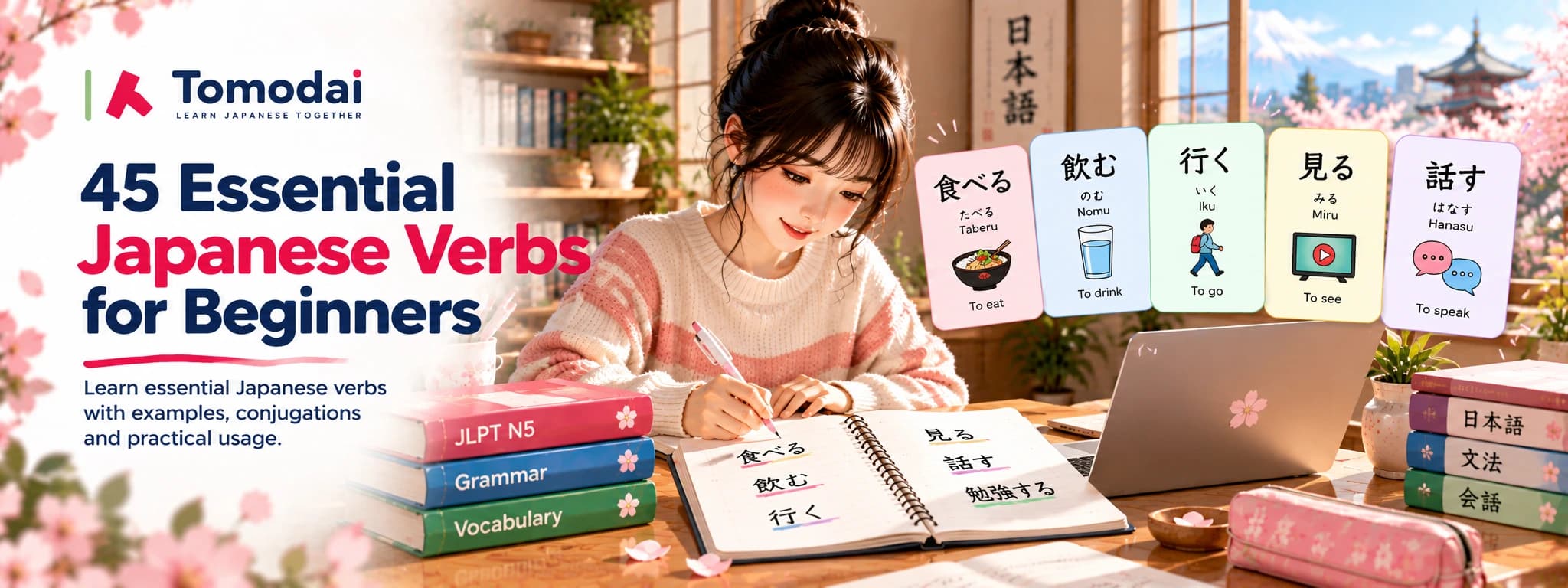
Japanese verbs describe actions, states, and changes, and always anchor the very end of a standard clause (SOV order). Unlike English, Japanese verbs do not change form based on person, gender, or singular/plural number. Every verb belongs to one of three groups: Group 1 (Godan), which shifts its final syllable; Group 2 (Ichidan), which simply drops る; and Group 3 (Irregular), containing just two verbs: する (to do) and 来る (to come).
Learning Japanese becomes significantly easier and more rewarding when you can describe what you actually do every single day. You might know nouns for food, places, friends, and everyday objects, but you need verbs to bring those concepts to life—to talk about eating breakfast, heading to work, studying Japanese, meeting up with classmates, or watching your favorite anime.
The best news for beginners is that Japanese verbs follow exceptionally regular and predictable patterns. You do not need to memorize hundreds of individual sentences from scratch. Once you internalize how verb stems combine with polite endings (ます), negatives (ません), and past tenses (ました), you can express thousands of everyday thoughts with total confidence.
The Core Verb Principle
No subject agreement, verb strictly at the end
What Is a Japanese Verb?
A verb describes an action, dynamic activity, condition, or state of existence. Consider these five high-frequency examples:
In English, the verb immediately follows the subject: "I drink water." In Japanese, the verb drops to the very end of the clause: "I [as for me] water drink."
The Three Main Japanese Verb Groups
Every Japanese verb fits into one of three conjugation families. Identify the group, and you unlock the correct conjugation rules instantly.
Group 1: Consonant-Stem Verbs
Dictionary forms end in an u-vowel kana: う, く, ぐ, す, つ, ぬ, ぶ, む, る.
Group 2: Vowel-Stem Verbs
Dictionary forms end in る (ru) preceded by an -i or -e vowel sound (〜いる / 〜える).
Group 3: Two Irregular Verbs
Japanese has only two irregular verbs: する (to do) and 来る (to come).
Not every verb ending in 〜いる or 〜える belongs to Group 2. A handful of extremely common daily verbs are actually Group 1 (Godan) verbs whose る shifts to り:
45 Essential Japanese Verbs Master Directory
Grouped into 5 intuitive thematic categories with dictionary form, reading, meaning, and group classification.
1. Everyday Actions (9 Verbs)
Core Daily Verbs| Kanji Form | Hiragana | Romaji | Polite Form (ます) | English Meaning | Group |
|---|---|---|---|---|---|
| 食べる | たべる | taberu | 食べます | To eat | G2 |
| 飲む | のむ | nomu | 飲みます | To drink | G1 |
| 寝る | ねる | neru | 寝ます | To sleep / go to bed | G2 |
| 起きる | おきる | okiru | 起きます | To wake up / get up | G2 |
| 行く | いく | iku | 行きます | To go | G1* |
| 来る | くる | kuru | 来ます | To come | G3 |
| 帰る | かえる | kaeru | 帰ります | To return / go home | G1 ⚠️ |
| する | する | suru | します | To do | G3 |
| 作る | つくる | tsukuru | 作ります | To make / create | G1 |
2. Communication & Learning (12 Verbs)
Speaking, Studying & Answering| Kanji Form | Hiragana | Romaji | Polite Form (ます) | English Meaning | Group |
|---|---|---|---|---|---|
| 話す | はなす | hanasu | 話します | To speak / talk | G1 |
| 聞く | きく | kiku | 聞きます | To listen / hear / ask | G1 |
| 答える | こたえる | kotaeru | 答えます | To answer / reply | G2 |
| 言う | いう | iu | 言います | To say | G1 |
| 読む | よむ | yomu | 読みます | To read | G1 |
| 書く | かく | kaku | 書きます | To write | G1 |
| 勉強する | べんきょうする | benkyō suru | 勉強します | To study | G3 |
| 働く | はたらく | hataraku | 働きます | To work | G1 |
| 習う | ならう | narau | 習います | To learn (from a teacher) | G1 |
| 教える | おしえる | oshieru | 教えます | To teach / instruct / tell | G2 |
| 練習する | れんしゅうする | renshū suru | 練習します | To practice | G3 |
| 分かる | わかる | wakaru | 分かります | To understand | G1 |
3. Movement & Activities (9 Verbs)
Walking, Buying & Meeting| Kanji Form | Hiragana | Romaji | Polite Form (ます) | English Meaning | Group |
|---|---|---|---|---|---|
| 歩く | あるく | aruku | 歩きます | To walk | G1 |
| 走る | はしる | hashiru | 走ります | To run | G1 ⚠️ |
| 待つ | まつ | matsu | 待ちます | To wait | G1 |
| 会う | あう | au | 会います | To meet (a person) | G1 |
| 買う | かう | kau | 買います | To buy | G1 |
| 売る | うる | uru | 売ります | To sell | G1 |
| 使う | つかう | tsukau | 使います | To use | G1 |
| 入る | はいる | hairu | 入ります | To enter | G1 ⚠️ |
| 出る | でる | deru | 出ます | To leave / exit | G2 |
4. Seeing, Thinking & Remembering (6 Verbs)
Cognition & Perception| Kanji Form | Hiragana | Romaji | Polite Form (ます) | English Meaning | Group |
|---|---|---|---|---|---|
| 見る | みる | miru | 見ます | To see / watch / look | G2 |
| 見せる | みせる | miseru | 見せます | To show | G2 |
| 思う | おもう | omou | 思います | To think | G1 |
| 知る | しる | shiru | 知ります | To know / find out | G1 ⚠️ |
| 覚える | おぼえる | oboeru | 覚えます | To remember / memorize | G2 |
| 忘れる | わすれる | wasureru | 忘れます | To forget | G2 |
5. Home & Daily Life (9 Verbs)
Living, Clothes & Existence| Kanji Form | Hiragana | Romaji | Polite Form (ます) | English Meaning | Group |
|---|---|---|---|---|---|
| 開ける | あける | akeru | 開けます | To open (a door/window) | G2 |
| 閉める | しめる | shimeru | 閉めます | To close / shut | G2 |
| 座る | すわる | suwaru | 座ります | To sit down | G1 |
| 立つ | たつ | tatsu | 立ちます | To stand up | G1 |
| 着る | きる | kiru | 着ます | To wear (upper body) | G2 |
| 脱ぐ | ぬぐ | nugu | 脱ぎます | To take off (clothing/shoes) | G1 |
| 住む | すむ | sumu | 住みます | To live / reside | G1 |
| いる | いる | iru | います | To exist (living beings) | G2 |
| ある | ある | aru | あります | To exist (inanimate objects) | G1 |
Dictionary Form vs. ます Form
One of the essential distinctions to understand immediately is when to recognize the Dictionary Form versus when to produce the ます Form:
辞書形 (Dictionary Form / Plain)
Unconjugated BaseThe headword form listed in dictionaries and textbooks. It is used in casual speech with close friends and family, and functions as the foundational building block for advanced grammar patterns.
ます形 (Masu Form / Polite)
Default Spoken FormThe standard polite style (丁寧語, teineigo). It is your universal default when speaking to strangers, store clerks, teachers, coworkers, or anyone with whom you want to maintain polite respect.
How to Conjugate: The 4 Core Polite Forms
Once you attach the polite stem, these 4 endings express present, future, negation, and past completed events.
Describes current habits, general facts, or future plans.
Expresses non-occurrence in the present or future.
Expresses an action completed in past time.
Expresses that an action did not take place in the past.
| Group | Dictionary Form | Polite (〜ます) | Negative (〜ません) | Past (〜ました) | Past Negative (〜ませんでした) |
|---|---|---|---|---|---|
| G1 | 書く (kaku) | 書きます | 書きません | 書きました | 書きませんでした |
| G1 | 飲む (nomu) | 飲みます | 飲みません | 飲みました | 飲みませんでした |
| G2 | 食べる (taberu) | 食べます | 食べません | 食べました | 食べませんでした |
| G2 | 見る (miru) | 見ます | 見ません | 見ました | 見ませんでした |
| G3 | する (suru) | します | しません | しました | しませんでした |
| G3 | 来る (kuru) | 来ます | 来ません | 来ました | 来ませんでした |
Useful Japanese Particles Used With Verbs
Particles act as grammar road signs that specify what grammatical role nouns play relative to the verb.
Marks the recipient directly affected by the action. Spelled を, but pronounced identically to "o" in modern spoken Japanese.
Pinpoints the target arrival point of movement or exact numeric moments on the clock (e.g., 7:00).
Designates where an event physically transpires (dynamic action location) or the tool/vehicle utilized.
Marks the person with whom you share an action, or encloses direct/indirect quoted speech.
How to Build Simple Japanese Sentences With Verbs
Combine your newly learned verbs with particles to create reliable, modular sentence structures:
Japanese Verbs for Daily Routines
Describing daily life is one of the fastest ways to achieve conversational fluency.
English Translation: "Every morning, I wake up at 7:00. I eat breakfast and go to school. I study Japanese at school. In the afternoon, I return home. At night, I watch television and read a book. Then, I go to bed at 11:00."
Japanese Verb Examples in Real-Life Dialogues
Experience how verbs flow naturally across authentic conversations.
Dialogue 1: Talking About Daily Activities
Daily ScheduleDialogue 2: At a Tokyo Café
Dining OutCommon Japanese Verb Mistakes to Avoid
Watch out for these classic pitfalls early so you never form bad grammatical habits.
| Common Pitfall | Better Approach | Why It Matters |
|---|---|---|
| Treating every verb as Group 2 | Identify the verb group first | Group 1 and Group 2 use completely different conjugation stem patterns. |
| Assuming all 〜る endings are Group 2 | Memorize exceptions like 帰る and 入る | The final kana alone is not enough; 帰る becomes 帰ります (G1). |
| Confusing 行く (iku) and 来る (kuru) | Base choice on direction relative to speaker | 行く = moving away; 来る = moving toward the speaker's location. |
| Misreading 来ます as *kimasu instead of きます | Remember the Kanji reading changes: 来ます | The Kanji 来 is read ku in dictionary form, but shifts to ki in polite form! |
| Using 食べません for yesterday's meal | Use 食べませんでした for past negative | Negation and tense are separate suffixes in Japanese. |
| Placing the verb in the middle (SVO) | Always place the verb at the sentence end | Japanese grammar is fundamentally head-final (Subject–Object–Verb). |
Practice: Test Your Understanding
Attempt each question before clicking the accordions to reveal the verified Japanese solutions.
Exercise 1: Match the Verb Meanings (Q1–5) Reveal Answers ▼
Exercise 2: Choose the Correct Verb (Q6–8) Reveal Answers ▼
Exercise 3: Convert to ます Form (Q9–12) Reveal Answers ▼
Exercise 4: Make the Sentence Negative (Q13–15) Reveal Answers ▼
Exercise 5: Convert to Past Tense (Q16–18) Reveal Answers ▼
Exercise 6: Translate Into Japanese (Q19–22) Reveal Answers ▼
Exercise 7: Arrange the Word Order (Q23–25) Reveal Answers ▼
Exercise 8: Identify the Verb Group (Q26–30) Reveal Answers ▼
The 7-Day Japanese Verb Mastery Action Plan
Dedicate just 15–20 minutes daily to internalize the 45 essential verbs and conjugations.
| Day | Daily Focus | Practice Exercises & Milestones |
|---|---|---|
| Day 1 | Everyday Actions (10 Verbs) | Learn 10 verbs for eating, drinking, sleeping, and moving. Say 5 sentences about your day aloud. |
| Day 2 | Communication & Object Marker を | Study verbs for speaking, reading, and listening. Pair each with an object using を. |
| Day 3 | Understand the 3 Verb Groups | Sort 15 flashcards into Group 1, Group 2, and Group 3. Identify why 帰る is Group 1. |
| Day 4 | Convert to Polite ます Form | Convert 15 dictionary forms into ます forms. Drill irregular verbs する and 来る. |
| Day 5 | Negative & Past Forms | Conjugate 10 verbs into ません, ました, and ませんでした. Describe yesterday's routine. |
| Day 6 | Build Sentences with Particles | Combine verbs with を, に, で, and と. Read the café dialogue aloud. |
| Day 7 | Mastery Review & Spoken Output | Recall 30–45 verbs from memory. Speak for one full minute describing your daily schedule. |
Frequently Asked Questions
What Japanese verbs should beginners learn first? ▼
Start with essential daily routine verbs: eating (食べる), drinking (飲む), going (行く), coming (来る), seeing (見る), speaking (話す), reading (読む), writing (書く), sleeping (寝る), and waking up (起きる).
What is the difference between dictionary form and ます form? ▼
The dictionary form is the base unconjugated form found in dictionaries, used in casual conversations with friends and as a building block for grammar. The ます form is the polite form used in standard adult communication, with teachers, colleagues, and strangers.
Are Japanese verbs conjugated according to the subject person or number? ▼
No! Japanese verbs do not conjugate based on whether the subject is "I", "you", "he", "she", or "they". The verb form remains identical regardless of person or grammatical number.
Why are する and 来る called irregular verbs? ▼
Because their verb stems shift unpredictably: する becomes します, while 来る (read kuru) shifts its kanji pronunciation completely to ki in 来ます. There are only these two irregular verbs in the entire Japanese language.
How do I make a Japanese verb negative or past tense? ▼
For polite speech, take the verb stem and attach: 〜ません for negative (e.g., 食べません = do not eat), 〜ました for past tense (e.g., 食べました = ate), and 〜ませんでした for past negative (e.g., 食べませんでした = did not eat).
Key Takeaways
- • Japanese verbs always anchor the end of the sentence (SOV structure).
- • No conjugation by person or plural number: the same verb works for "I" and "they".
- • Identify the verb group (Godan, Ichidan, Irregular) before applying conjugation rules.
- • Watch out for fake Ichidan verbs like 帰る, 入る, and 走る (Group 1).
- • Master the 4 polite forms: 〜ます, 〜ません, 〜ました, and 〜ませんでした.
- • Always learn verbs inside complete sentences accompanied by particles (を, に, で, と).
Related Tomodai Lessons
Put Your Japanese Verbs into Practice with Tomodai
Continue with Tomodai's structured Japanese lessons, interactive quizzes, AI Conversation Practice, personalized study roadmaps, and JLPT preparation tools.
Learn with Confidence. Practice with Purpose. Grow One Lesson at a Time.

Sophia Martinez
Sophia Martinez creates vocabulary lessons and conversation guides designed for everyday communication. Her articles introduce useful words and expressions in context, making it easier for learners to remember and confidently use Japanese in real-world situations. Areas of Expertise Japanese Vocabulary Everyday Conversation Pronunciation Daily Expressions Speaking Practice
Pass the JLPT & Speak Confidently
Join thousands of learners mastering JLPT N5–N1 grammar with structured native breakdowns, intelligent spaced-repetition flashcards, and instant voice conversations with AI Sensei.