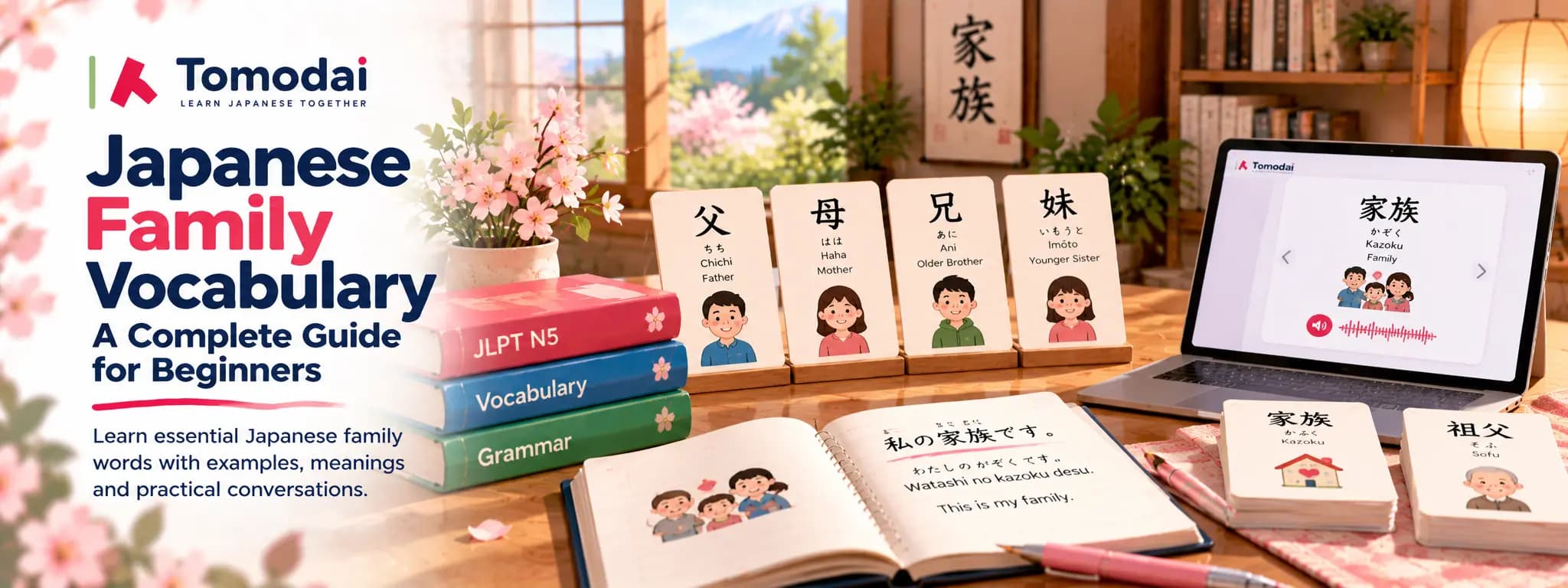
In Japanese, the words you use for family members change dynamically depending on who you are speaking to and whose family you are talking about. You use humble, modest terms when describing your own family to outsiders (e.g., 父 for your father), and respectful honorific terms when referring to someone else’s family or addressing your parents directly (e.g., お父さん).
1. How Do You Say “Family” in Japanese?
The core root noun and polite out-group variations
The standard Japanese noun for "family" is 家族 (kazoku). It describes your own family unit or families in general. When speaking politely about someone else's household, add the honorific prefix ご- (go-).
Refers to family in general or one’s own immediate family unit.
Prefixed with the honorific ご (go-) when politely speaking about someone else's family.
2. Essential Japanese Family Vocabulary
Core terms organized by relational tier
Immediate Family & Siblings
Tier 1 Core| # | Kanji | Hiragana | Romaji | English Meaning |
|---|---|---|---|---|
| 01 | 家族 | かぞく | kazoku | Family |
| 02 | 父 | ちち | chichi | My father (humble) |
| 03 | 母 | はは | haha | My mother (humble) |
| 04 | 両親 | りょうしん | ryōshin | Parents |
| 05 | 父親 | ちちおや | chichioya | Father (biological / neutral) |
| 06 | 母親 | ははおや | hahaoya | Mother (biological / neutral) |
| 07 | 子供 | こども | kodomo | Child / Children |
| 08 | 息子 | むすこ | musuko | Son |
| 09 | 娘 | むすめ | musume | Daughter |
| 10 | 兄 | あに | ani | My older brother |
| 11 | 姉 | あね | ane | My older sister |
| 12 | 弟 | おとうと | otōto | My younger brother |
| 13 | 妹 | いもうと | imōto | My younger sister |
| 14 | 兄弟 | きょうだい | kyōdai | Siblings (or brothers) |
| 15 | 姉妹 | しまい | shimai | Sisters |
Grandparents & Spouses
| 祖父 | そふ | sofu | My grandfather |
| 祖母 | そぼ | sobo | My grandmother |
| 祖父母 | そふぼ | sofubo | Grandparents |
| 夫 | おっと | otto | My husband |
| 妻 | つま | tsuma | My wife |
| 夫婦 | ふうふ | fūfu | Married couple |
Extended Family & Relatives
| 親戚 | しんせき | shinseki | Relatives |
| おじ | おじ | oji | My uncle |
| おば | おば | oba | My aunt |
| いとこ | いとこ | itoko | Cousin |
| 甥 | おい | oi | Nephew |
| 姪 | めい | mei | Niece |
| 孫 | まご | mago | Grandchild |
3. My Family vs. Someone Else's Family (内 vs 外)
Humble vocabulary vs. Honorific respectful vocabulary
In Japanese society, there is an essential cultural line between the in-group (内, uchi: yourself, your household, your company) and the out-group (外, soto: acquaintances, teachers, coworkers, clients). Always humble your own family when speaking to outsiders, and elevate theirs.
| Relationship | Talking About My Family (Humble / 内) | Someone Else's Family / Direct Call (Honorific / 外) |
|---|---|---|
| Father | 父 (chichi) | お父さん (otōsan) |
| Mother | 母 (haha) | お母さん (okāsan) |
| Older Brother | 兄 (ani) | お兄さん (onīsan) |
| Older Sister | 姉 (ane) | お姉さん (onēsan) |
| Younger Brother | 弟 (otōto) | 弟さん (otōtosan) |
| Younger Sister | 妹 (imōto) | 妹さん (imōtosan) |
| Grandfather | 祖父 (sofu) | おじいさん (ojīsan) |
| Grandmother | 祖母 (sobo) | おばあさん (obāsan) |
| Husband | 夫 / 主人 | ご主人 (goshujin) |
| Wife | 妻 / 家内 | 奥さん (okusan) |
When you speak directly to your father in the kitchen, you say: 「お父さん、ありがとう」 (Otōsan, arigatō). But when you tell your teacher or coworker about him, you immediately humble the reference: 「私の父です」 (Watashi no chichi desu).
4. 10 Everyday Sentences About Family
Practical patterns for introductions and basic descriptions
This is my father.
This is my mother.
I have one older brother.
I have one younger sister.
There are four people in my family.
I live with my parents.
I have two children.
My father works at a company.
My mother is a teacher.
I have one sibling.
5. How to Ask About Someone's Family
Polite inquiries for everyday conversation
6. A Beginner Family Conversation
Real-world chat exchange between Japanese friends
7. Visual Japanese Family Tree
Humble in-group hierarchy diagram (内 / In-Group Perspective)
8. Grammar Patterns for Family Conversations
JLPT N5 foundational structures
Pattern 1: 私の + Noun — "My ~"
Particle のThe particle の connects two nouns to show possession or familial relationship. Do not confuse it with "is."
Pattern 2: [Person] が います — "I have / There is ~"
Animate ExistenceUse います (imasu) strictly for living beings (people and pets). Never use あります (arimasu) for family members.
Pattern 3: [Number] + 人です — Counting People
Counter 人 (nin)Family members are counted using the suffix 人(にん). Be careful: one person and two people have unique native Japanese readings!
9. Common Beginner Mistakes to Avoid
Avoid awkward social or grammatical slips
Using お父さん for your father with bosses or teachers
Using お父さん elevates your father above the outside person. Always use humble 父(ちち) in polite society.
Ignoring long vowels in relatives
おじさん (uncle/middle-aged man) vs. おじいさん (grandfather). The extra beat completely shifts age and meaning!
Translating "brother" into one Japanese word
Japanese does not have a single neutral standalone word for "brother" without specifying birth order: 兄(あに) for older, 弟(おとうと) for younger.
Using あります instead of います
Saying 子供があります treats children like inanimate objects. Always use 子供がいます.
10. Pronunciation Tips for Family Words
Rhythm, long vowels, and mora timing
11. How to Introduce Your Family: Ready Template
Fill-in-the-blank script for speaking practice
私はアレックスです。家族は四人です。父と母と妹がいます。父は会社員です。母は先生です。妹は学生です。
Watashi wa Arekkusu desu. Kazoku wa yonin desu. Chichi to haha to imōto ga imasu. Chichi wa kaishain desu. Haha wa sensei desu. Imōto wa gakusei desu.
12. Practice Exercises & Quizzes
Test your recall. Click any question to reveal the verified answer.
01 Exercise 1: Matching (父, 母, 兄, 妹, 祖父) ↓
Answer: 1-b (Father), 2-e (Mother), 3-d (Older brother), 4-a (Younger sister), 5-c (Grandfather)
02 Exercise 2: Complete the sentence — 私の__は五人です。 ↓
Answer: a. 家族 (kazoku). It describes the entire family unit.
03 Exercise 3: Translate — "I have one older brother." ↓
Answer: b. 兄が一人います。 (Ani ga hitori imasu.)
04 Exercise 4: Which word is used for "my mother" when speaking to outside acquaintances? ↓
Answer: b. 母 (haha). Humble form for in-group member.
05 Exercises 5 to 10: Translations & Short Questions ↓
5. "I have two children": 子供が二人います。 (Kodomo ga futari imasu.)
6. "My family lives in Osaka": 私の家族は大阪に住んでいます。
7. "There are four people in my family": 私の家族は四人です。
8. Japanese word for "younger sister": 妹(いもうと)
9. Difference between 兄 and 弟: 兄 (older brother) vs. 弟 (younger brother).
10. Natural question for family count: a. 家族は何人ですか。
13. 7-Day Japanese Family Vocabulary Study Plan
A structured 15-minute daily progression
Family & Parents
Learn 家族, 父, 母, and 両親. Write four descriptive sentences.
Age Order Distinction
Learn 兄, 姉, 弟, 妹, and 兄弟. Practice older vs. younger siblings aloud.
Children & Elders
Learn 子供, 息子, 娘, 祖父, 祖母, and 孫. Draw a 3-generation tree.
Uncles, Aunts & Cousins
Learn 親戚, おじ, おば, いとこ, 甥, and 姪 without looking at Romaji.
Humble vs. Respectful
Pair 父/お父さん, 母/お母さん, 兄/お兄さん. Practice asking about others.
Roleplay & Audio
Read the sample dialogues aloud. Record yourself doing Alex’s self-introduction.
The 5-Minute Speaking Exam
Without notes: recite 15 family words, introduce your own family, and ask 3 polite questions about someone else's household.
Key Takeaways for Japanese Learners
- ✓ 家族 (kazoku) is family; ご家族 (gokazoku) is someone else’s family.
- ✓ Use 父 (chichi) and 母 (haha) for your parents when speaking to outsiders.
- ✓ Use お父さん and お母さん for someone else's parents or addressing your own directly.
- ✓ Always use います (imasu) for living family members, never あります.
- ✓ Remember special counters: 一人 (hitori), 二人 (futari), and 四人 (yonin).
- ✓ Watch vowel lengths: おじさん (uncle) vs. おじいさん (grandfather).
Master Japanese Numbers, Counters & Grammar
Counting people, age, and family members requires mastering Japanese numerical systems and foundational sentence structures. Check out our in-depth guides:

Sophia Martinez
Sophia Martinez creates vocabulary lessons and conversation guides designed for everyday communication. Her articles introduce useful words and expressions in context, making it easier for learners to remember and confidently use Japanese in real-world situations. Areas of Expertise Japanese Vocabulary Everyday Conversation Pronunciation Daily Expressions Speaking Practice
Pass the JLPT & Speak Confidently
Join thousands of learners mastering JLPT N5–N1 grammar with structured native breakdowns, intelligent spaced-repetition flashcards, and instant voice conversations with AI Sensei.