How to evaluate a Japanese textbook: What to look for
Introduction: The 2026 Landscape of Japanese Acquisition
Learning Japanese has changed significantly over the last few years. If you rely solely on a traditional textbook, you might find yourself memorizing lists of vocabulary without knowing how to actually use them in a natural conversation. In 2026, the most effective 2026 Japanese study approach is no longer about passive consumption; it is about active, tech-integrated acquisition.
Today, the best Japanese learning resources bridge the gap between static grammar explanations and real-world fluency. You need tools that provide instant feedback on your output, help you practice speaking, and adapt to your specific pace. Whether you are aiming for the JLPT or simply want to hold a conversation with friends, a textbook should serve as a base, not a boundary. This guide provides a strategic roadmap to help you evaluate which materials will actually support your progress, ensuring you spend your time on resources that prioritize practical usage and meaningful communication.
Core Methodology: Strategic Framework for Resource Selection
When you walk into a bookstore or browse an online shop for Japanese materials, it is easy to feel overwhelmed by the sheer volume of options. To avoid wasting time on resources that don’t align with your goals, I suggest using a simple filter-based language acquisition framework. Instead of asking which textbook is "best," ask which one serves your specific stage of development.
For a beginner, the priority is clarity and logical progression. You are building the foundation of your Japanese learning strategy, so look for materials that explain the "why" behind particles like wa and ga rather than just providing lists of vocabulary. A good beginner resource should introduce script and grammar at a pace that allows you to internalize the patterns rather than just memorizing static phrases.
If you are at an intermediate level and preparing for the JLPT, your needs shift. At this stage, you need resources that bridge the gap between textbook grammar and natural, authentic content. Ask yourself: Does this resource provide enough context to show how this grammar point is used in a conversation? Does it offer enough variety to challenge my reading comprehension? If you find yourself struggling to identify the subject in subject-less sentences, look for a resource that explicitly addresses how Japanese omits the subject when it is clear from the context.
For advanced learners, the focus should be on refinement. Seek out materials that expose you to nuance, such as the difference between formal keigo and casual speech. At this level, look for resources that facilitate active production—tools that force you to create your own sentences rather than just recognizing correct ones.
Regardless of your level, always apply these three filters before committing to a new resource:
- Utility: Does this material help me achieve my immediate goal, such as passing a specific JLPT level or improving my speaking confidence?
- Context: Does the resource explain the cultural or social environment where this language is used?
- Active Application: Does the resource provide opportunities for me to use the language, or is it strictly passive?
By filtering your choices through these lenses, you ensure that every book or app you pick becomes a genuine support system for your progress, rather than just another item on your shelf.
Categorized Resource Directory (Apps, Textbooks, Immersion Tools)
When you sit down to curate your study materials, it is easy to feel overwhelmed by the sheer volume of options. To keep your learning focused, I recommend categorizing tools by their specific function rather than their popularity. Think of your study tools as a toolkit: you need a hammer for one task and a screwdriver for another. Here is how to evaluate the different categories of resources available in 2026.
Digital Platforms and Spaced Repetition Systems
Japanese apps often promise quick results, but the most effective ones are those that respect how your memory works. Look for tools that utilize spaced repetition, a method that schedules your reviews based on how well you remember a specific piece of information. This prevents you from wasting time on words you already know while ensuring you do not forget the ones you just learned.
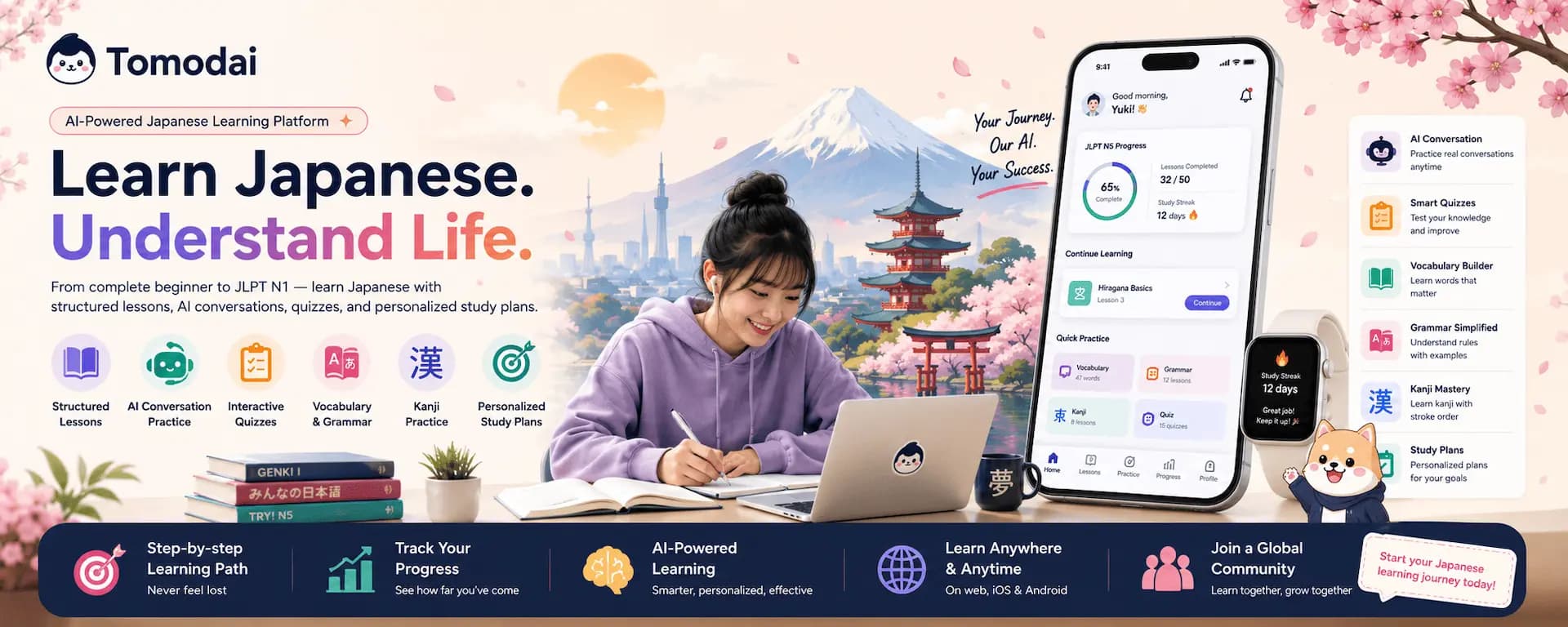
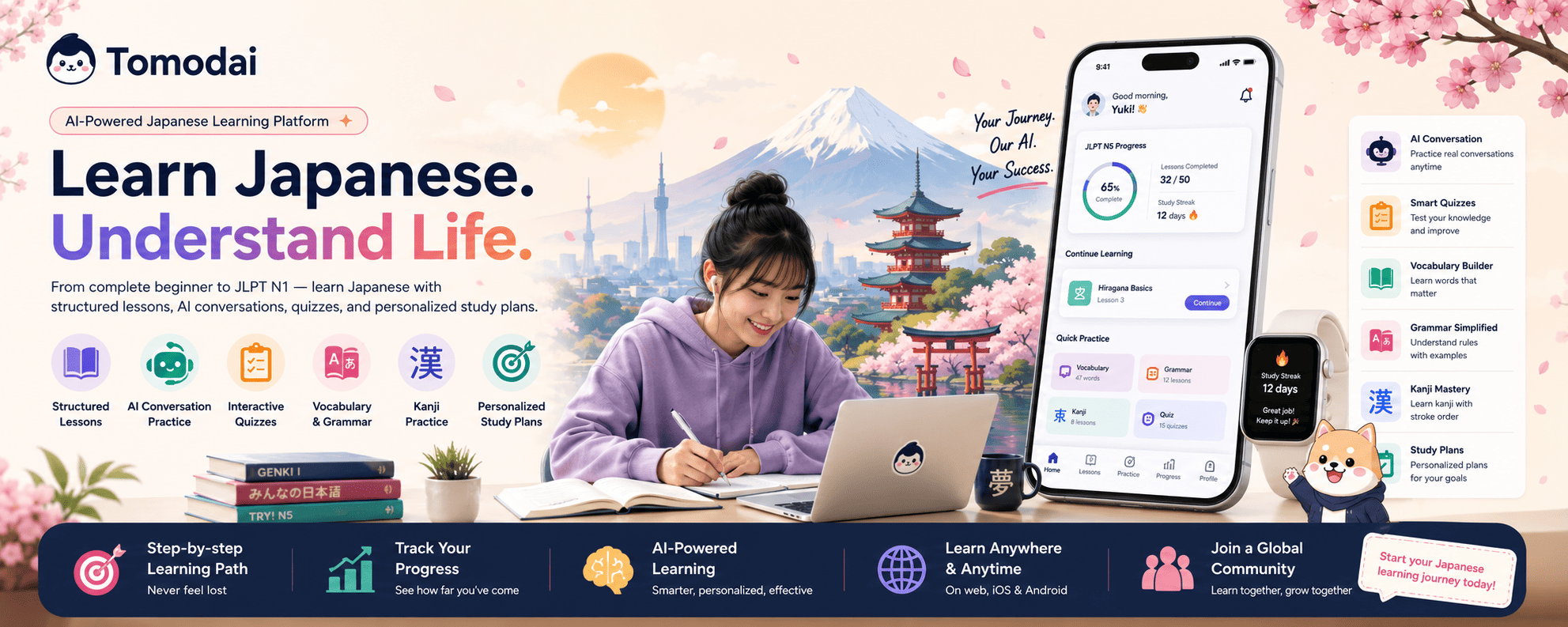
For example, when using an app for vocabulary, ask yourself if it forces you to recall the kanji or reading before showing you the answer. Tools like Tomodai AI Sensei are particularly useful here, as they allow you to move beyond simple flashcards. Instead of just memorizing a word in isolation, you can engage in conversation to see how that word functions naturally within a sentence. This active practice is significantly more effective than passive repetition because it requires you to synthesize grammar and vocabulary under pressure, just like you would in a real-world interaction.
Foundational Textbooks and Grammar References
While digital tools are excellent for practice, high-quality Japanese textbooks remain the best way to understand the underlying logic of the language. A good textbook does not just give you a list of rules; it explains why a sentence is structured the way it is. When reviewing a potential book, check how it handles tricky topics like particle usage. Does it clearly distinguish between the nuances of wa and ga, or does it simply state they are interchangeable? A strong textbook will acknowledge that wa highlights the topic, whereas ga emphasizes the subject—a distinction that is vital for natural communication.
When selecting your primary text, ensure it includes clear explanations of conjugations and honorific levels (keigo). You want a resource that provides realistic, culturally appropriate examples rather than artificial sentences you would never hear in Japan. If you are preparing for the JLPT, look for materials that align with the specific requirements of your target level, from N5 to N1, to ensure your study time is efficient and goal-oriented.
Finally, remember that immersion tools—such as native podcasts, news articles, or media—serve as the bridge between your textbook knowledge and real-world usage. Use these not to learn grammar from scratch, but to see how the patterns you studied in your books appear in the wild.
Digital Platforms and Spaced Repetition Systems
Textbooks provide the structure, but your memory needs a nudge to keep that information fresh. This is where SRS (spaced repetition systems) becomes an essential companion to your study. Instead of reviewing everything daily, these digital tools schedule reviews based on your individual retention, showing you a word just as you are about to forget it.
Many Japanese vocabulary apps now integrate this logic directly into their interfaces. When choosing one, look for platforms that allow you to track your progress alongside your textbook lessons. This creates a feedback loop where you move vocabulary from short-term recognition to long-term mastery, ensuring you aren't just memorizing for a test, but actually building a usable mental library of kanji and expressions.
Foundational Textbooks and Grammar References
While digital tools are excellent for practice, high-quality Japanese textbooks remain the backbone of a solid study plan. When evaluating these, look for resources that explain the "why" behind Japanese grammar books rather than just providing lists of rules. A great textbook provides clear context—explaining, for instance, why a speaker might choose wa over ga in a specific scenario—rather than presenting them as interchangeable.
Look for materials that prioritize natural sentence patterns over rigid, artificial examples. The best resources bridge the gap between textbook formal speech and the nuanced reality of daily conversation.
Best Practices for Integrating Resources into Daily Study
The most common hurdle learners face isn't a lack of materials, but the fragmentation of their study time. When you jump between five different apps, three textbooks, and a handful of YouTube channels, your brain struggles to connect the dots. A cohesive Japanese study routine requires a balanced "stack"—a set of core tools that work together rather than competing for your attention.
Effective language learning integration starts by separating your time into input and output phases. Think of your textbook as your "anchor." It provides the logical structure for your grammar and vocabulary acquisition. Use it during your primary study block to build a foundation. Once you have a handle on a new concept, immediately pivot to an output-focused tool like Tomodai AI Sensei. For example, if your textbook covers the difference between te-form and plain-form verbs, don't just complete the exercises. Spend ten minutes describing your morning routine to the AI to practice those specific conjugations in a conversational, low-pressure environment.
To keep your study stack lean, try this simple framework:
- The Anchor (30-40%): Your primary textbook or structured curriculum. This is where you learn the "rules" and systematic logic.
- The Retention Engine (20%): A spaced repetition system to ensure today's vocabulary doesn't evaporate by next week.
- The Practice Lab (40-50%): Active, output-based tasks. Whether it is writing short journal entries or using AI conversation partners to test your grammar, this is where you turn passive knowledge into actual ability.
By defining the role of each resource, you stop "collecting" tools and start using them. If a resource doesn't fit into one of these three roles, it is likely cluttering your progress. Focus on depth with your anchor and consistency with your output tools to create a sustainable, long-term rhythm.
Evaluating Progress: Metrics for Language Proficiency
It is easy to measure progress by how many pages of a textbook you have turned, but actual language learning progress is more subtle. To stay motivated, focus on these three practical metrics instead of just checking off chapters.
- Hours of Comprehensible Input: Instead of counting pages, track your time spent with Japanese you can actually understand. Whether it is listening to a podcast or reading a graded reader, the goal is to spend more time engaging with content that is just slightly above your current level.
- Output Consistency: How often are you creating Japanese? Aim for a regular rhythm of writing or speaking. Using Tomodai AI Sensei to record a daily reflection or drafting a short journal entry is far more effective for your long-term retention than sporadic, high-intensity study sessions.
- Retention Rates: Use your spaced repetition system to monitor how well you recall vocabulary and kanji. If you notice a high "forgetting rate," it is a signal to slow down your new input and focus on reviewing what you have already learned.
By monitoring these Japanese proficiency metrics, you shift your perspective from "finishing a book" to building genuine, usable skill. Language learning progress is rarely linear, so look for these indicators of growth over weeks rather than days. If you find your retention is slipping, adjust your daily study volume to prioritize quality over the speed of completion.
Conclusion: Building Your Custom Learning Path
Choosing the right textbook is only the opening chapter of your language study. In 2026, the most successful learners are those who treat their resources as a starting point rather than a rigid script. A textbook provides the necessary structure, but your personal progress depends on how you bridge the gap between those printed pages and your daily life.
To build a truly effective custom Japanese learning path, focus on these three habits:
- Consistency over intensity: Twenty minutes of focused, daily interaction with your target language is significantly more effective than one marathon session on the weekend. Use your textbook to anchor your study, but supplement it regularly with tools like AI Sensei to move from passive reading to active conversation.
- Active integration: When you learn a new grammar point or set of vocabulary, don't just complete the exercises in the book. Try to construct three sentences about your actual life using those terms. Making the language personal helps your brain categorize the information more effectively than rote memorization.
- Iterative adjustment: Treat your study routine like an experiment. If a specific resource feels like it is stalling your progress, don't be afraid to pivot. Your needs will change as you move from N5 toward N1, and your toolkit should evolve alongside your growing proficiency.
Ultimately, there is no single "perfect" book that fits every learner. The best resource is the one that keeps you engaged, helps you identify the logic behind the particles and kanji you encounter, and encourages you to keep showing up. By prioritizing your own curiosity and maintaining a steady, reflective pace, you ensure that your Japanese study remains a sustainable part of your life. Take what you have learned, curate your resources to match your specific goals, and keep practicing—one conversation at a time.
Pass the JLPT & Speak Confidently
Learn with structured N5–N1 grammar lessons, intelligent SRS flashcards, and instant real-time conversational practice with AI Sensei.