How to Learn Japanese: Complete Beginner's Guide (2026)
 Alex Chen
Learning Japanese is one of the most rewarding skills you can develop.
Whether your goal is to watch anime without subtitles, travel confidently in Japan, pass the JLPT exam, study abroad, or work with Japanese companies, every learner begins with the same question:
"Where should I start?"
The internet is full of apps, YouTube channels, textbooks, and study methods. While these resources are valuable, many beginners jump between them without following a clear learning path.
The result is often frustration, slow progress, and feeling overwhelmed.
The good news is that learning Japanese becomes much easier when you follow a structured roadmap.
In this complete beginner's guide, you'll learn:
- How the Japanese language works
- Which writing system to learn first
- The best order to study grammar, vocabulary, and Kanji
- How long it typically takes to reach each level
- Common mistakes beginners should avoid
- A practical daily study plan
- The best resources to accelerate your progress
By the end of this guide, you'll have a clear roadmap for learning Japanese with confidence.
Why Learn Japanese?
Japanese is spoken by more than 120 million people and is one of the world's most influential languages in technology, business, entertainment, and culture.
Learning Japanese opens doors to many opportunities.
Travel with Confidence
Knowing basic Japanese helps you:
- Order food
- Ask for directions
- Read train signs
- Talk with locals
- Enjoy a more authentic travel experience
Advance Your Career
Japanese language skills are valuable in industries such as:
- Information Technology
- Automotive Engineering
- Manufacturing
- Translation
- Customer Support
- Tourism
- Gaming
- Finance
Many international companies actively hire professionals with Japanese language proficiency.
Enjoy Japanese Entertainment
Understanding Japanese allows you to experience:
- Anime
- Manga
- Light novels
- Movies
- Music
- Games
without relying entirely on translations.
Study or Live in Japan
Many universities and employers in Japan require Japanese language skills, especially JLPT N3 or higher for daily life and professional communication.
Is Japanese Difficult to Learn?
Many beginners believe Japanese is one of the hardest languages in the world.
The reality is more encouraging.
Japanese is different from English, but it is not impossible to learn.
Some aspects are actually easier than many European languages.
What Makes Japanese Easier?
✅ No grammatical gender
Unlike French or German, Japanese nouns don't have masculine or feminine forms.
✅ No plural forms
One word can often refer to both singular and plural.
Example:
Japanese
本
Hiragana
ほん
Romaji
Hon
Meaning
Book / Books
The meaning depends on the context.
✅ Regular pronunciation
Most Japanese words are pronounced exactly as they are written.
Unlike English, there are very few pronunciation exceptions.
What Makes Japanese Challenging?
Some areas require more practice.
Three Writing Systems
Japanese uses:
- Hiragana
- Katakana
- Kanji
Learning multiple writing systems takes time, but they each serve a specific purpose.
Kanji
Kanji are Chinese characters used in written Japanese.
There are thousands of Kanji, but beginners only need to focus on the most common ones.
Different Sentence Structure
English:
I eat sushi.
Japanese:
Japanese
私は寿司を食べます。
Furigana
私(わたし)は寿司(すし)を食(た)べます。
Romaji
Watashi wa sushi o tabemasu.
Meaning
I eat sushi.
Notice that the verb comes at the end of the sentence.
Learning Tip
Don't try to master everything at once. Focus on one skill at a time, and build your knowledge step by step.
How Long Does It Take to Learn Japanese?
The answer depends on:
- Your goals
- Daily study time
- Learning method
- Consistency
Here is a general roadmap.
Goal | Estimated Time |
|---|---|
Learn Hiragana | 1 week |
Learn Katakana | 1 week |
Basic Conversation | 2–3 months |
JLPT N5 | 4–6 months |
JLPT N4 | 8–12 months |
JLPT N3 | 1.5–2 years |
JLPT N2 | 2.5–4 years |
JLPT N1 | 4–6 years |
Studying just 30–60 minutes every day is usually more effective than studying several hours only on weekends.
Understanding the Japanese Writing System
One of the first things every learner notices is that Japanese uses three writing systems instead of one.
At first, this may seem intimidating.
In reality, each writing system has a specific purpose, and they work together to form complete sentences.
Understanding this system early will make your learning journey much smoother.
Hiragana (ひらがな)
Hiragana is the foundation of written Japanese.
It is the first writing system every beginner should learn.
Hiragana is used for:
- Native Japanese words
- Grammar endings
- Particles
- Words without Kanji
Example:
Japanese
こんにちは
Hiragana
こんにちは
Romaji
Konnichiwa
Meaning
Hello
If you only learn one writing system first, make it Hiragana.
Katakana (カタカナ)
Katakana is mainly used for foreign loanwords, company names, and emphasis.
Example:
Japanese
コーヒー
Hiragana
こーひー
Romaji
Koohii
Meaning
Coffee
You'll frequently encounter Katakana in restaurants, product packaging, technology, and travel.
Kanji (漢字)
Kanji represents meanings rather than sounds.
Example:
Japanese
日本
Furigana
日本(にほん)
Romaji
Nihon
Meaning
Japan
Kanji may seem difficult at first, but learning them gradually in context is far more effective than memorizing isolated characters.
The Best Order to Learn Japanese
One of the biggest mistakes beginners make is trying to learn everything at once.
Many learners jump straight into Kanji, memorize random vocabulary, or watch advanced anime hoping they'll learn naturally. Unfortunately, this usually leads to frustration.
Instead, follow a structured roadmap. Each step builds on the previous one, making learning easier and more enjoyable.
Step 1: Learn Hiragana First
Estimated Time: 5–7 Days
Hiragana is the foundation of Japanese.
Almost every beginner resource uses Hiragana, and you'll need it to read grammar, dictionaries, and vocabulary.
Your Goal
- Learn all 46 basic Hiragana characters
- Read simple words without Romaji
- Write each character correctly
Example
Japanese | Hiragana | Romaji | Meaning |
|---|---|---|---|
あさ | あさ | Asa | Morning |
ねこ | ねこ | Neko | Cat |
いぬ | いぬ | Inu | Dog |
やま | やま | Yama | Mountain |
みず | みず | Mizu | Water |
Learning Tip
Stop relying on Romaji as soon as possible. Reading Hiragana directly helps you develop better pronunciation and reading skills.
Step 2: Learn Katakana
Estimated Time: 5–7 Days
Katakana is used for:
- Foreign words
- Brand names
- Country names
- Scientific terms
- Technology
Examples
Japanese | Hiragana | Romaji | Meaning |
|---|---|---|---|
コンピューター | こんぴゅーたー | Konpyuutaa | Computer |
テレビ | てれび | Terebi | Television |
バス | ばす | Basu | Bus |
ホテル | ほてる | Hoteru | Hotel |
コーヒー | こーひー | Koohii | Coffee |
Step 3: Learn Basic Vocabulary
Vocabulary is what allows you to communicate.
Instead of memorizing random words, focus on the words you'll use every day.
Essential Beginner Vocabulary
Japanese | Hiragana | Romaji | Meaning |
|---|---|---|---|
私 | わたし | Watashi | I, Me |
あなた | あなた | Anata | You |
はい | はい | Hai | Yes |
いいえ | いいえ | Iie | No |
今日 | きょう | Kyou | Today |
明日 | あした | Ashita | Tomorrow |
学生 | がくせい | Gakusei | Student |
日本 | にほん | Nihon | Japan |
水 | みず | Mizu | Water |
食べる | たべる | Taberu | To eat |
飲む | のむ | Nomu | To drink |
行く | いく | Iku | To go |
来る | くる | Kuru | To come |
見る | みる | Miru | To see |
聞く | きく | Kiku | To listen |
Learn Basic Japanese Grammar
Many beginners worry about grammar.
The good news is that Japanese grammar follows logical patterns. Once you understand the basics, it becomes much easier to build sentences.
Grammar Point: です (Desu)
Meaning
"is", "am", or "are" (polite sentence ending)
JLPT Level
N5
Structure
Noun + です
Usage
Used to make polite statements or introductions.
Example 1
Japanese
私は学生です。
Furigana
私(わたし)は学生(がくせい)です。
Romaji
Watashi wa gakusei desu.
Meaning
I am a student.
Example 2
Japanese
これは本です。
Furigana
本(ほん)
Romaji
Kore wa hon desu.
Meaning
This is a book.
Example 3
Japanese
彼は先生です。
Furigana
彼(かれ)は先生(せんせい)です。
Romaji
Kare wa sensei desu.
Meaning
He is a teacher.
Common Mistakes
❌ Using です after verbs.
Incorrect:
食べますです
Correct:
食べます
Learning Tip
Master です before learning verb conjugations.
It appears in thousands of beginner conversations.
Learn Japanese Sentence Structure
Japanese follows a different word order than English.
English uses:
Subject → Verb → Object
Japanese uses:
Subject → Object → Verb
English
I drink water.
Japanese
Japanese
私は水を飲みます。
Furigana
私(わたし)は水(みず)を飲(の)みます。
Romaji
Watashi wa mizu o nomimasu.
Meaning
I drink water.
The verb always comes at the end.
This becomes natural with practice.
Start Learning Kanji Gradually
Many beginners delay Kanji because they think it's too difficult.
Instead, start early—but slowly.
Learning just one or two Kanji each day builds a strong foundation.
Beginner Kanji Example
Item | Value |
|---|---|
Kanji | 日 |
Meaning | Sun, Day |
On Reading | ニチ (Nichi), ジツ (Jitsu) |
Kun Reading | ひ (Hi), び (Bi), か (Ka) |
Stroke Count | 4 |
JLPT Level | N5 |
Common Words
日本(にほん)— Japan
今日(きょう)— Today
日曜日(にちようび)— Sunday
Example Sentence
Japanese
今日は暑いです。
Furigana
今日(きょう)は暑(あつ)いです。
Romaji
Kyou wa atsui desu.
Meaning
Today is hot.
Memory Tip
Imagine the Kanji 日 as the shape of the sun shining through a window.
Practice Listening Every Day
Listening helps you become familiar with natural pronunciation and rhythm.
Even if you don't understand every word, your brain gradually learns sentence patterns.
Good listening practice includes:
- Beginner podcasts
- Slow Japanese audio
- Children's stories
- JLPT listening exercises
- AI conversations
Aim for 10–20 minutes daily.
Speak from Day One
One common myth is that you should wait until you're fluent before speaking.
In reality, speaking early helps you:
- Build confidence
- Improve pronunciation
- Remember vocabulary
- Think in Japanese
Start with simple self-introductions.
Example
Japanese
はじめまして。
Hiragana
はじめまして。
Romaji
Hajimemashite.
Meaning
Nice to meet you.
Build a Daily Study Routine
Consistency matters more than intensity.
Studying 30–60 minutes every day produces better long-term results than studying several hours only once a week.
Example 45-Minute Study Plan
Activity | Time |
|---|---|
Review Hiragana/Katakana | 5 min |
Vocabulary | 10 min |
Grammar | 10 min |
Listening Practice | 10 min |
Speaking Practice | 5 min |
Review Mistakes | 5 min |
Even a short daily session creates steady progress over time.
Best Resources for Beginners
A balanced study routine includes different types of resources.
Use:
- Structured lessons
- Vocabulary flashcards
- Grammar guides
- Kanji practice
- Listening exercises
- Speaking practice with AI or language partners
- Regular quizzes and review sessions
Avoid relying on only one app or resource. Combining reading, listening, speaking, and writing leads to stronger long-term retention.
10 Common Mistakes Beginners Make
Almost every Japanese learner makes mistakes in the beginning. The good news is that they're easy to avoid once you know what to watch for.
1. Depending on Romaji for Too Long
Romaji helps you get started, but relying on it slows your reading progress.
Instead:
- Learn Hiragana first.
- Read Japanese without Romaji whenever possible.
2. Trying to Learn Too Much at Once
Many beginners attempt to memorize hundreds of words or dozens of grammar points in a single week.
Instead:
- Learn a few new concepts each day.
- Review them regularly.
3. Ignoring Listening Practice
Reading alone isn't enough. Listening trains your ears to recognize natural pronunciation and rhythm.
Instead:
- Listen to beginner-friendly Japanese every day, even for 10 minutes.
4. Avoiding Speaking
Some learners wait until they feel "ready" before speaking.
The truth is that speaking is part of learning—not the reward after learning.
5. Memorizing Individual Kanji
Kanji are much easier to remember when learned in words and sentences.
Example:
Learn:
食べる(たべる)
Taberu
To eat
instead of memorizing only:
食
6. Studying Without Review
Forgetting is natural.
Regular review helps move information into long-term memory.
7. Comparing Yourself to Others
Everyone learns at a different pace.
Focus on your own consistency rather than someone else's progress.
8. Learning Random Vocabulary
Random words are difficult to remember.
Instead, learn vocabulary by topic:
- Food
- Family
- Travel
- School
- Work
- Shopping
9. Not Using Japanese Every Day
Even five minutes of practice is better than skipping an entire week.
Consistency beats intensity.
10. Giving Up Too Soon
Japanese is a long-term journey.
Progress may feel slow at first, but every lesson builds a stronger foundation.
Proven Memory Techniques
Learning Japanese becomes much easier when you use effective study methods.
1. Spaced Repetition (SRS)
Review words just before you're about to forget them.
This strengthens long-term memory while reducing unnecessary repetition.
2. Active Recall
Instead of reading the answer repeatedly, try to remember it first.
For example:
Question:
"How do you say 'water' in Japanese?"
Answer:
水(みず)
Mizu
3. Learn in Context
Instead of memorizing:
食べる
Learn:
私は寿司を食べます。
Furigana
私(わたし)は寿司(すし)を食(た)べます。
Romaji
Watashi wa sushi o tabemasu.
Meaning
I eat sushi.
Context improves retention.
4. Shadowing
Listen to native audio and repeat immediately.
This improves:
- Pronunciation
- Listening
- Speaking
- Rhythm
5. Daily Review
Spend a few minutes reviewing yesterday's lesson before starting today's.
90-Day Beginner Roadmap
Month 1
Focus:
- Hiragana
- Katakana
- Greetings
- Numbers
- Basic vocabulary
- です grammar
- Simple reading
Goal
Read and write basic Japanese.
Month 2
Focus:
- JLPT N5 grammar
- Basic verbs
- Daily conversations
- Listening practice
- First Kanji
Goal
Create simple sentences.
Month 3
Focus:
- More Kanji
- Reading practice
- Speaking practice
- Short conversations
- Daily writing
Goal
Prepare for JLPT N5-level study.
Sample Weekly Study Schedule
Day | Focus |
|---|---|
Monday | Hiragana & Vocabulary |
Tuesday | Grammar & Listening |
Wednesday | Vocabulary & Speaking |
Thursday | Kanji & Reading |
Friday | Grammar Review |
Saturday | Quiz & Conversation Practice |
Sunday | Weekly Review & Revision |
Key Takeaways
- Learn Hiragana before anything else.
- Master Katakana next.
- Build practical vocabulary.
- Study grammar step by step.
- Learn Kanji gradually.
- Practice listening every day.
- Speak from the beginning.
- Review consistently using spaced repetition.
- Follow a structured study plan.
- Stay consistent and enjoy the journey.
Frequently Asked Questions
Is Japanese difficult for English speakers?
Japanese is different from English, but it follows logical grammar patterns. With consistent practice and a structured study plan, beginners can make steady progress.
How long does it take to learn Japanese?
Learning time depends on your goals and study routine. Many learners can reach JLPT N5 in about 4–6 months with regular daily practice.
Should I learn Hiragana or Kanji first?
Always start with Hiragana, then Katakana, and finally begin learning Kanji gradually.
Can I learn Japanese without Kanji?
You can learn basic conversation without Kanji, but reading newspapers, books, websites, and signs requires Kanji. Learning Kanji is essential for long-term proficiency.
Should I learn Romaji?
Romaji is helpful only during your first few days. Transition to reading Hiragana as soon as possible.
How much should I study each day?
Thirty to sixty minutes of focused practice each day is enough for consistent improvement.
Can adults learn Japanese?
Absolutely. Adults often have stronger study habits and can make excellent progress with regular practice.
Continue Your Japanese Journey
Learning Japanese isn't about studying harder.
It's about studying smarter.
By following a structured roadmap, practicing consistently, and using the right learning resources, you'll build confidence one lesson at a time.
Remember:
Every Japanese speaker once learned their first Hiragana character.
Every fluent learner once struggled with their first Kanji.
The most important step is simply to keep going.
Pass the JLPT & Speak Confidently
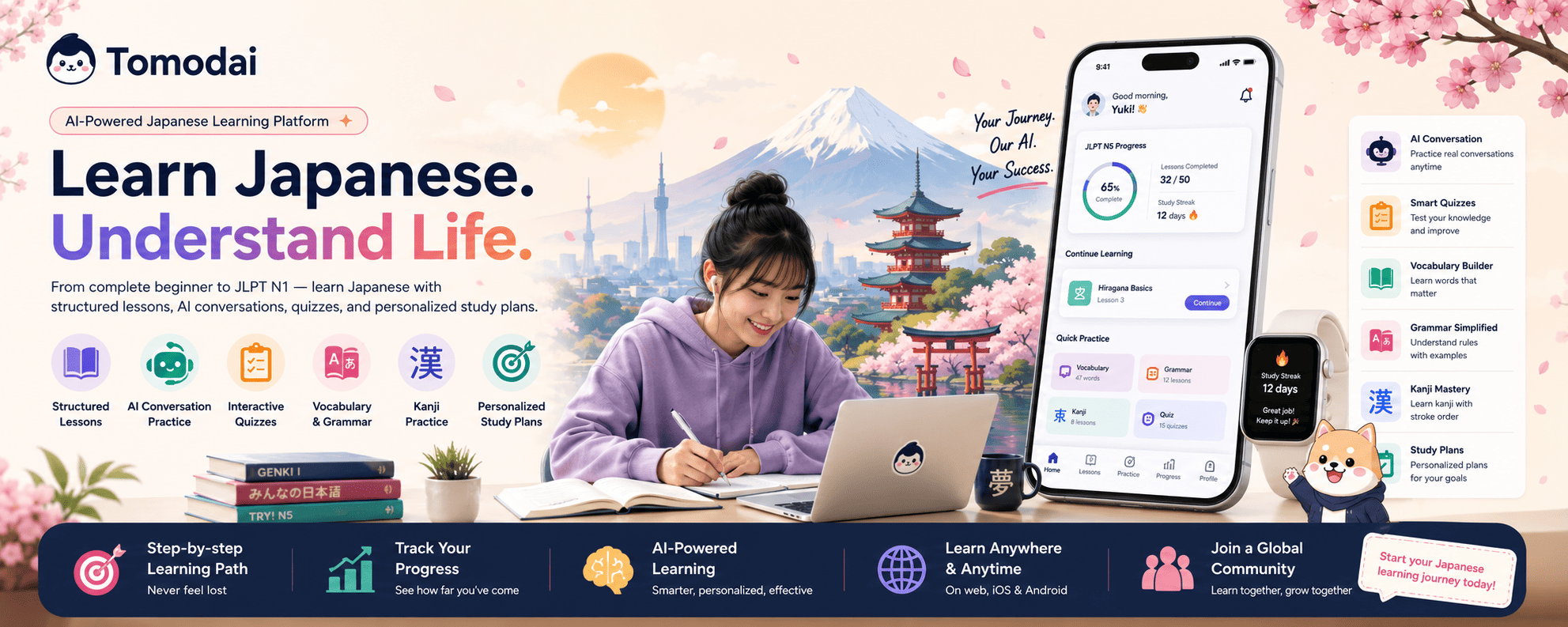
Learn with structured N5–N1 grammar lessons, intelligent SRS flashcards, and instant real-time conversational practice with AI Sensei.